
A research white paper proposes adapting Lean Six Sigma principles to improve how doctoral researchers identify and explain real-world business problems.
The framework emphasises measurable performance gaps, authoritative evidence and stronger alignment between practical problems and academic research design.
For African universities and organisations, the approach could support more credible, policy-relevant and evidence-driven research.
Researchers Propose Stronger Problem Definition Framework
A research white paper by James C. Rice and Scott A. McCalla of the University of Phoenix has proposed a structured framework for developing stronger research problem statements using principles adapted from Lean Six Sigma.
Titled Building a Lean Six Sigma–Based Background of the Problem and Problem Statement, the paper addresses a recurring challenge in practitioner research: distinguishing an identifiable organisational concern from a properly evidenced research problem.
- The authors argue that researchers must demonstrate the existence of a performance gap using reliable evidence rather than relying on assumptions, personal dissatisfaction or predetermined solutions.
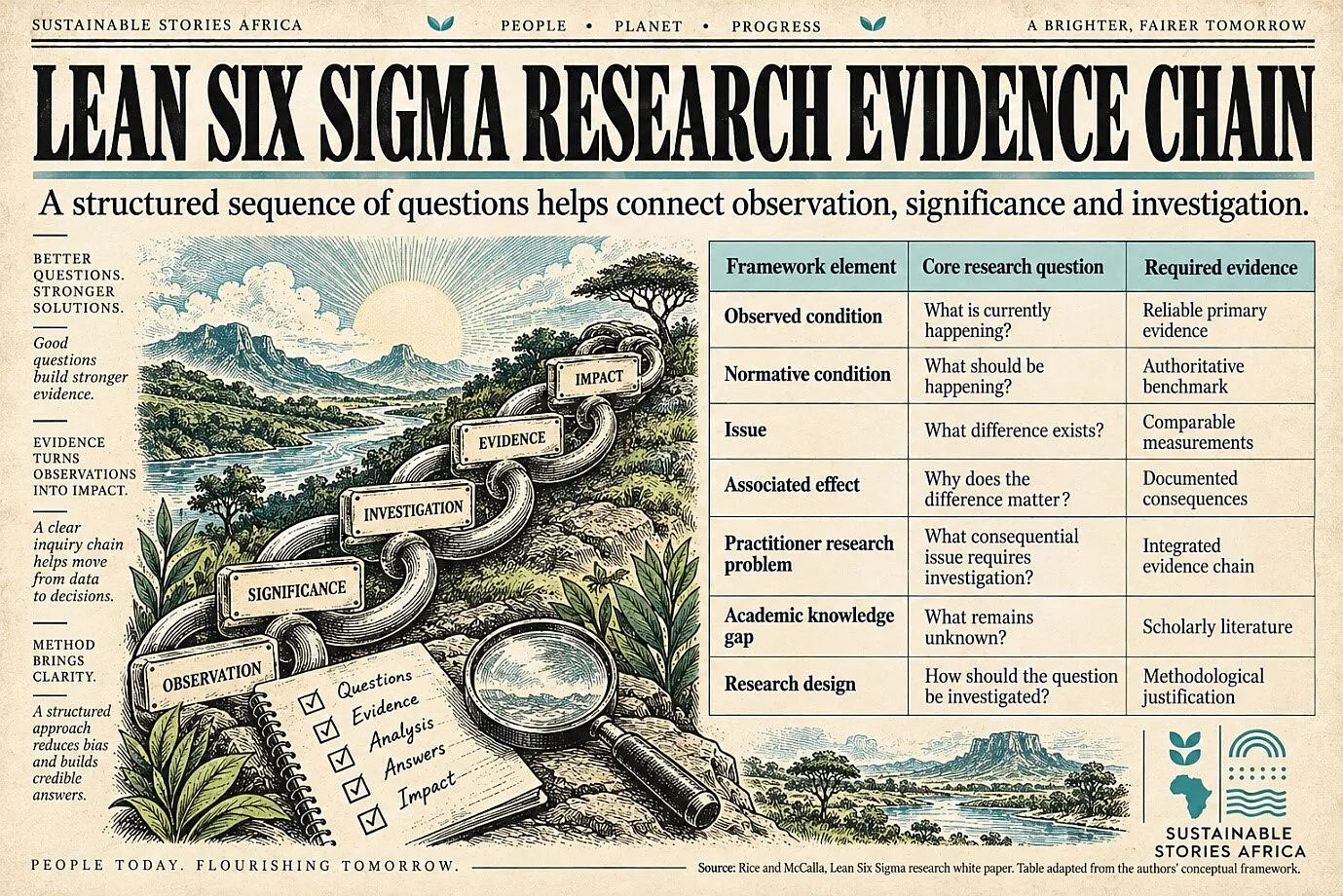
- Their proposed framework connects five elements: an observed condition, an authoritative normative condition, a documented issue, an associated effect and a practitioner research problem.
The model draws particularly on the Define and Measure stages of Lean Six Sigma's DMAIC methodology.
- DMAIC refers to Define, Measure, Analyse, Improve and Control, a systematic approach commonly used in quality and process improvement.
The authors adapt this logic to strengthen the foundations of doctoral research, while distinguishing research design from operational problem-solving.
The proposal is especially relevant to professional doctorate programmes and business research that examine organisational performance, public administration or management challenges.
Evidence Chains Strengthen Academic Research Credibility
The paper identifies an important distinction between observing a situation and establishing a researchable problem.
- An organisation may experience declining performance, but the existence of an unfavourable result does not automatically demonstrate why it occurred or whether a particular management practice caused it.
- Researchers must first establish the observed condition using credible evidence.
- They must then identify a suitable comparison point, described as the normative condition.
- Such benchmarks may come from recognised standards, organisational requirements, historical performance or other authoritative sources.
A difference between the observed and expected condition establishes an issue.
- However, according to the proposed framework, the issue becomes a consequential practitioner research problem only when credible evidence links it to a meaningful effect.
- This helps prevent researchers from prematurely claiming causes or prescribing interventions before completing appropriate analysis.
The paper also recommends that evidence of observed conditions should generally come from authoritative primary sources released within the preceding five years.
African Universities Could Improve Applied Research
The proposed framework offers potentially useful lessons for African universities, business schools and research institutions.
- Many organisations face complex challenges involving operational efficiency, service delivery, environmental compliance, financial management and infrastructure performance.
- Research that addresses these challenges can contribute to institutional improvement when supported by reliable data and appropriate methods.
- For example, a study examining interruptions in public electricity supply should distinguish actual service performance from an established reliability benchmark.
- Researchers would then need to document the consequences of the identified gap before framing a specific problem for investigation.
The same approach could apply to corporate sustainability reporting.
- A researcher could examine whether organisational disclosures meet defined requirements, identify documented weaknesses and investigate their consequences for governance or decision-making.
- Such applications may improve the relevance of research to policymakers and business leaders.
However, the framework itself remains a conceptual proposal.
Its effectiveness across different academic disciplines and institutional settings would require further evaluation.
Research Institutions Must Strengthen Methodological Discipline
Academic supervisors and research departments should emphasise evidence quality, comparability and methodological alignment.
- Researchers must differentiate between a practical organisational problem and an unresolved academic knowledge gap.
- The research purpose, questions, methodology and analytical design should then follow logically from the problem being investigated.
The authors also caution against unsupported causal claims.
- A relationship between two variables does not automatically establish that one caused the other.
African research institutions could incorporate these principles into doctoral training, applied research programmes and professional development courses.
Improved research governance may also help organisations commission studies that generate usable evidence rather than merely validating existing management assumptions.
Path Forward – Strengthen Evidence Before Proposing Solutions
African universities and organisations should promote research practices that connect observable conditions, credible benchmarks and documented consequences.
The Lean Six Sigma-inspired framework offers a practical model for strengthening research problem statements.
Its wider value will depend on rigorous methodological application, high-quality evidence and institutional commitment to research that informs effective decisions.