Cape Town is preparing a controlled trial of virtual power plants, with applications open for companies able to coordinate household energy assets.
The initial phase anticipates approximately 150 homes, primarily using residential batteries to shift electricity consumption away from peak periods.
The experiment will test more than software: it will examine how private platforms, municipal networks and incentive arrangements can work together.
Household batteries enter the municipal test
GreenCape and its partners have opened applications for a Virtual Power Plant Regulatory Sandbox Pilot within Cape Town’s electricity distribution network, seeking to test how privately operated platforms can support municipal utilities while navigating technical and regulatory constraints.
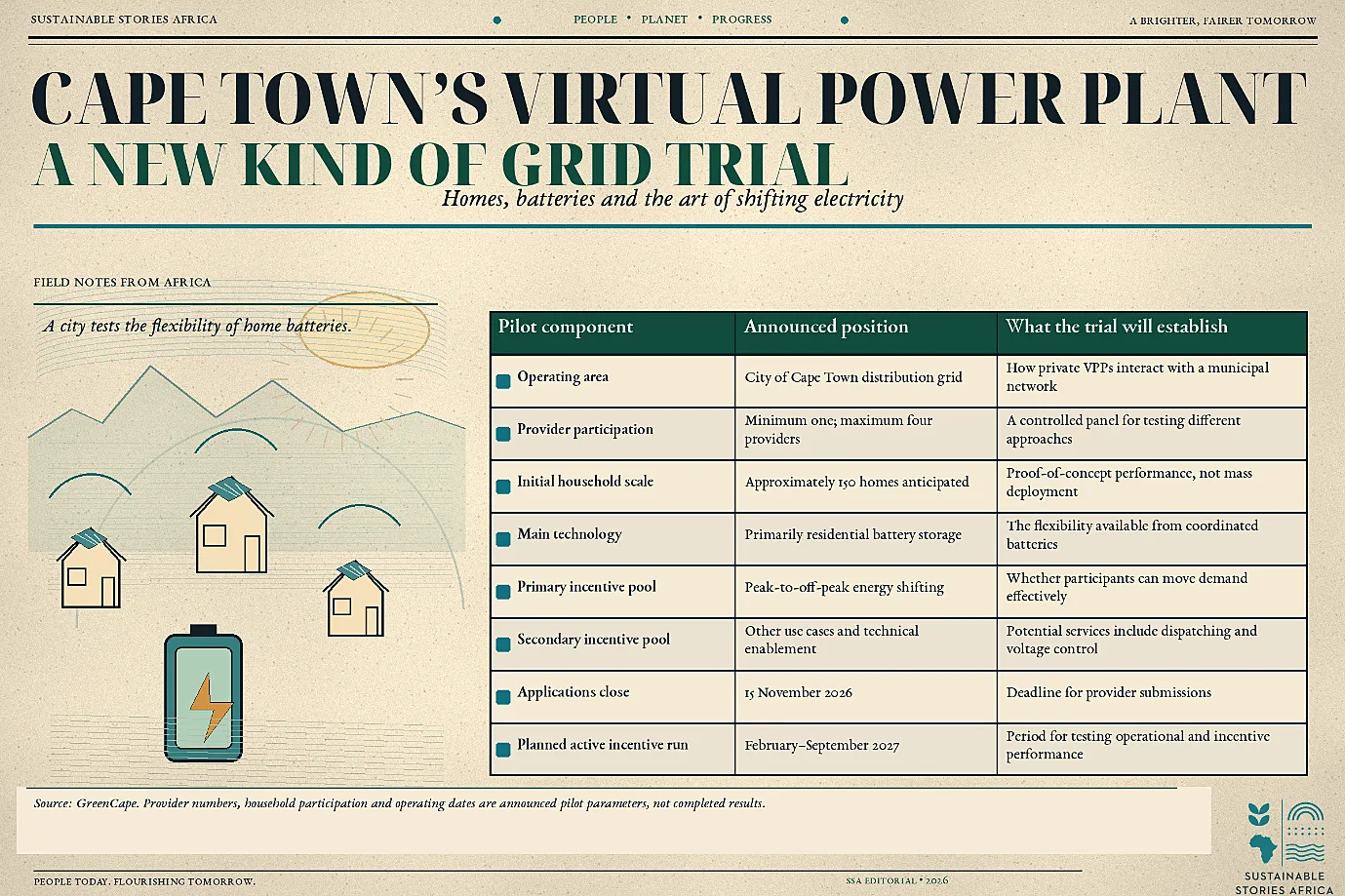
- Applications close on 15 November 2026.
The initiative brings together GreenCape, Integrate to Zero and Global Grids Catalyst, with the City of Cape Town collaborating on the pilot.
Between one and four VPP providers will be selected, and the initial phase anticipates onboarding approximately 150 homes, primarily using residential battery storage.
Its central test is straightforward:
- Can coordinated household assets shift electricity consumption from peak to off-peak periods in ways that create shared value for customers, providers and the municipal network?
The planned trial will examine that proposition rather than assume it has already been demonstrated at scale.
A power plant without one site
A virtual power plant connects distributed energy assets through software so they can operate as a coordinated system.
- Depending on its design, it can bring together rooftop solar, batteries and flexible appliances, managing when electricity is consumed, stored or supplied.
The practical distinction is between owning an asset and coordinating its operation.
- A household battery may serve one customer’s needs; an aggregation platform seeks additional value by managing many assets together, within agreed operating limits.
GreenCape says the sandbox will explore how private VPPs can operate within South African municipal distribution networks while accounting for municipal governance, regulatory requirements and technical constraints.
- Its primary focus is shifting peak consumption into off-peak periods.
The controlled setting matters because a technically capable platform does not automatically have an agreed commercial or regulatory route into municipal electricity operations.
Extracting value from existing assets
South Africa already has examples of coordinated demand management.
- Reporting by the Mail & Guardian in July described Plentify’s deployment of approximately 9,000 intelligent geyser controllers across 13 Balwin Properties estates.
- According to the company, that programme reduced peak electricity consumption by 46% and maximum demand by 36%.
These are company-reported results from a separate programme, not forecasts for Cape Town’s sandbox.
Such examples illustrate why flexibility is attracting attention.
Coordinating when devices consume electricity can change a network’s demand profile without requiring every participating asset to generate power.
- For households, the prospect is better use of installed equipment and potentially lower electricity costs.
- For utilities, it is more manageable demand and greater operating flexibility.
Whether these benefits arise in this pilot and how they are distributed will depend on measured performance and the incentive arrangements tested.
VPPs nevertheless have limits.
- Eskom has said coordinated distributed resources could reduce peak demand and support system stability.
- It should complement rather than replace investment in new generation and transmission infrastructure.
Testing rules alongside technology
GreenCape’s timetable provides for appointing the participant panel on 30 November, followed by setup and technical testing in December 2026 and January 2027.
- The active incentive run is scheduled for February to September 2027.
Successful applicants will be eligible for two funding pools.
- The primary pool supports peak-to-off-peak energy shifting; the secondary pool covers other use cases, including instantaneous dispatching, voltage control and ancillary services, alongside technical enablement such as city-approved advanced meters.
The priority is credible evidence: how much flexibility can be delivered, under what network conditions, and at what incentive cost?
- A small, well-measured trial can answer these questions more usefully than broad claims about replacing conventional power infrastructure.
Path Forward – Turning Batteries Into Flexibility
The immediate step is selecting qualified providers and completing technical testing before the planned incentive run begins in February 2027.
The sandbox will assess both operating performance and compatibility with municipal requirements.
For African utilities following the experiment, its value will lie in transferable evidence: whether coordinated distributed assets can offer dependable flexibility, how participants are rewarded, and which safeguards make the model workable beyond a controlled pilot.