Researchers have proposed three signals that could help identify journals needing closer scrutiny: rapid output growth, concentrated authorship and problematic-paper flags.
Nature reports that the screening exercise identified 3,753 journals meeting at least one threshold.
For African institutions, the challenge is to protect research quality without confusing legitimate regional publishing with misconduct.
Screening signals are not guilty verdicts
Three journal-level warning signs could help universities and research databases prioritise integrity checks, according to a preprint reported by Nature on October 28.
- The study identified 3,753 journals meeting at least one screening threshold, but neither the authors nor experts cited in the report treat a flag as proof of misconduct.
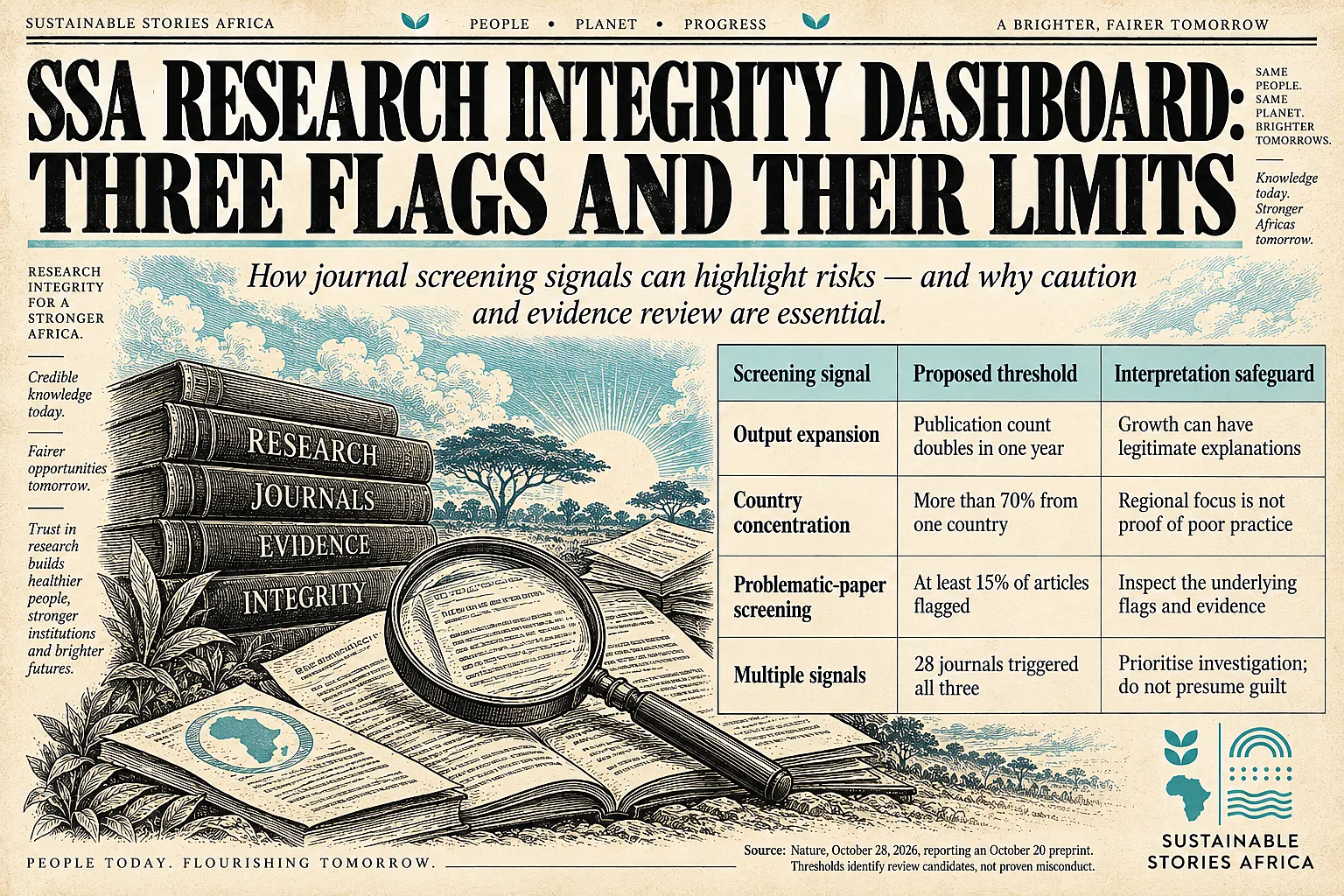
The proposed signals are a doubling of publication output in a single year, more than 70% of articles originating from one country, or at least 15% of articles being flagged by the Problematic Paper Screener.
- Their purpose is to prompt investigation, not automatically disqualify a journal or its authors.
The distinction matters for African researchers, editors and university managers.
- An institution seeking stronger evidence of research quality should avoid replacing one crude shortcut with another.
- A journal’s growth or regional focus needs context before it becomes the basis for a funding or promotion decision.
Database inclusion faces closer scrutiny
The researchers used titles extracted from OpenAlex and compared them with journals indexed in Scopus.
- Nature reports that 5% of the flagged journals in that comparison had been delisted.
- That figure is not a finding that the remaining journals are necessarily illegitimate; screening and formal database review answer different questions.
Nearly 300 journals were flagged by two signals and 28 by all three.
According to the report, the roughly 3,500 that were not delisted contributed more than half a million papers in the years they triggered at least one signal.
- These are screening results, not counts of fraudulent papers.
- Scopus, operated by Elsevier, already reviews changes in publication volume and scope, unusual authorship patterns, anomalous citation behaviour and vulnerability to questionable content.
- An Elsevier spokesperson said its process includes individual assessment and consideration of a journal’s response.
“No single signal, and no fixed threshold, determines the outcome,” the spokesperson told Nature.
- Researchers cited in the article similarly warn that a new journal may legitimately expand quickly, while a small journal may naturally publish many authors from its home country.
- The findings were posted as a preprint on October 20 and should be described accordingly.
Protect quality without penalising local relevance
Africa’s research institutions can use the proposed thresholds as triage tools while defending the value of locally relevant scholarship.
- A journal serving a national professional community may have concentrated authorship for understandable reasons.
- The appropriate follow-up is to examine editorial practice and the underlying papers, not assume that geographical concentration establishes poor quality.
Likewise, rapid expansion should ask questions about editorial capacity, peer review and changes in scope.
- It should not automatically judge every additional article as suspect.
- This more careful approach follows the limitations identified by the specialists in Nature’s reporting.
The potential gain is a fairer evaluation system.
- Researchers would receive clearer guidance on venue selection, editors should explain unusual patterns, and institutions could focus investigative resources where multiple concerns converge.
Such a system should also distinguish journal-level concerns from individual responsibility.
- An author’s paper still requires assessment on its own evidence; inclusion in a flagged title does not, by itself, establish that author’s misconduct.
Investigate patterns and document decisions
Universities and funders should build a review process that records why a journal was flagged, what additional evidence was examined and how the final judgement was reached.
- Researchers should be able to understand the criteria and correct factual errors in an assessment.
Libraries and research offices can help by bringing together information about editorial boards, review policies, ownership changes and the papers that trigger concerns.
- The task is to improve the evidence available for a decision, not construct an unchallengeable blacklist from three numbers.
Editors, in turn, can explain changes in output and demonstrate how quality control scales with submissions.
- Database listings provide relevant information, but they should sit alongside, not replace, informed scrutiny.
The study’s most useful contribution is an invitation to ask better questions before extending or withdrawing trust.
The same discipline should apply when concerns are communicated publicly: describe the evidence and its limits before attaching a label to an institution or researcher.
Path Forward – Scrutinise Publishing Patterns Without Silencing Scholarship
African institutions should treat the three thresholds as prompts for proportionate investigation, not automatic findings of misconduct.
The priorities are transparent review, contextual judgement and support for researchers choosing publication venues.
Protecting research integrity also means allowing legitimate regional scholarship in simpler metrics, while ensuring suspicious patterns receive a documented fair response.
Culled from: These three red flags could unmask dodgy journals | Nature