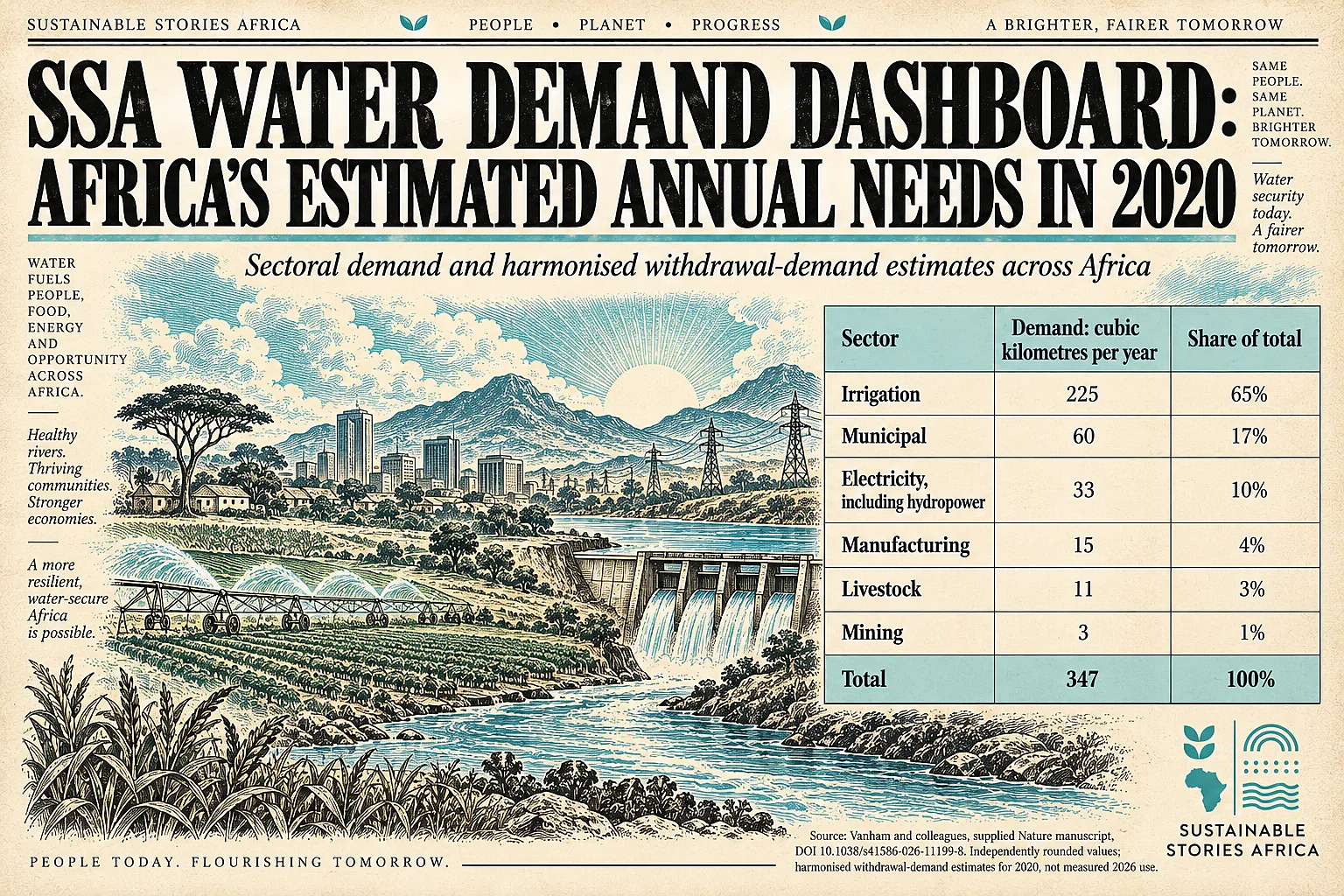
An Africa-wide study estimates annual water demand at 347 cubic kilometres in 2020, up 26% from 2010.
Irrigation accounts for almost two-thirds of the total, but local pressures differ sharply across sectors and river basins.
The research separates physical scarcity from access constraints, showing why more available water does not automatically mean a reliable household supply.
The water challenge is not one problem
Africa’s estimated annual water demand increased 26% between 2010 and 2020, reaching 347 cubic kilometres, according to an Africa-wide assessment
- Irrigation accounts for 65% of demand, but the study finds that water insecurity also reflects access and infrastructure constraints, including in places where aggregate renewable resources exceed estimated needs.
Led by Davy Vanham with an international research team, the analysis “Spatial and sectoral water demand assessment for the African continent” covers municipal services, irrigation, livestock, manufacturing, electricity and mining.
- Its results are harmonised estimates based on multiple datasets and modelling assumptions, not direct measurements of all water actually used across the continent.
Irrigation leads, but local pressures differ
The study estimates 225 cubic kilometres of annual irrigation demand in 2020, followed by about 60 for municipalities, 33 for electricity including hydropower, 15 for manufacturing, 11 for livestock, and 3 for mining. These rounded sector figures sum to the rounded continental total.
- Demand is expressed in water-withdrawal terms: the amount extracted from a source to meet needs.
- Withdrawal differs from consumption, which is the portion not returned to the source.
The municipal assessment includes people without piped connections, an important distinction, because, where observed, utility supply alone would exclude unmet needs.
- The paper estimates that 642 million Africans had piped access in 2020 while 717 million did not.
Lack of piped access is not the same as having no drinking-water source or no safely managed service; these are different measures.
Continental shares can also obscure local exposure.
- Mining accounts for only 1% overall; however, it is the principal demand category in 18 subnational regions.
- Egypt has the largest estimated national demand, followed by Nigeria, Sudan and Morocco.
Planning therefore requires basin and subnational evidence, not only continent-wide averages.
Protect access and ecosystems together
The study compares demand with renewable water availability while allowing for environmental flows: water needed to sustain ecosystem integrity.
- The scarcity results change substantially depending on how strongly those flows are protected.
- Basins exceeding available water account for 14% of total demand under the lower-protection method and 57% under the higher-protection approach.
These are shares of estimated demand located in the affected basins, not percentages of Africans living without water.
- The annual basin balances do not resolve every seasonal shortage or local access problem.
- The paper cautions that underlying data uncertainty limits interpretation of local estimates.
For African governments and investors, the implication is to distinguish the constraint before choosing the intervention.
- Where infrastructure and service delivery limit access, additional information about water resources alone will not connect households.
- Where demand presses against ecological limits, expanding abstraction without examining trade-offs may transfer the problem.
The potential gain is better-targeted investment: projects can be assessed against service needs, competing uses and ecosystem requirements rather than a broad assumption that every water problem has the same solution.
Use the baseline without overstating its precision
Water authorities should use the open-access assessment as a starting point for local validation, not as a replacement for measurements.
- Utilities, basin organisations and sector regulators can compare its estimates with available operational evidence and investigate material differences.
- The study draws on information from more than 450 utilities, 2,534 power plants and 682 mines.
Financiers can ask proposed projects to explain which constraint they address: inadequate access, inefficient service, competing demand or physical scarcity.
- Agricultural, energy and mining investments should also disclose their relevant basin context rather than rely on small continental sector shares to imply low local impact.
The immediate priority is a shared evidence base that keeps units, years and definitions consistent.
Path Forward – Plan Water Access Alongside Basin Limits
Africa’s water investments should distinguish unmet service needs from physical scarcity and account for competing sectors and environmental flows.
The study provides a detailed 2020 baseline, not a real-time inventory.
The next step is local validation and coordinated planning, so infrastructure improves access without obscuring ecological limits or shifting pressures between households, farms, industry and energy systems.