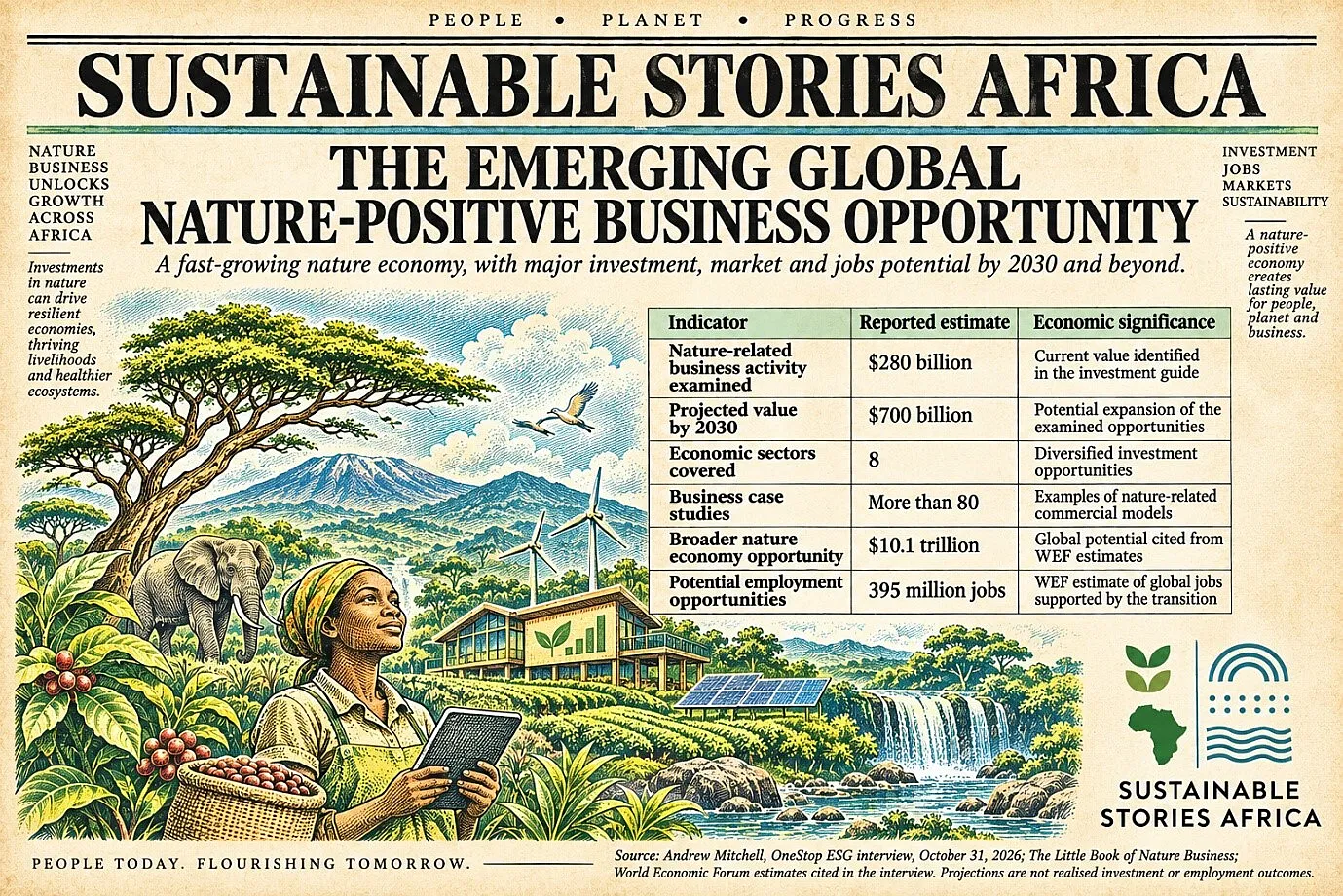
Nature-positive businesses examined in The Little Book of Nature Business could grow from an estimated $280 billion to $700 billion by 2030, according to environmental finance advocate Andrew Mitchell.
The projection highlights expanding commercial opportunities in agriculture, construction, materials and other industries that depend on healthy ecosystems.
For African economies, the emerging market offers opportunities to attract sustainable investment, strengthen livelihoods and integrate biodiversity protection into economic development.
Nature Protection Emerges as a Major Investment Opportunity
Businesses that protect, sustainably use or restore natural ecosystems could get substantial new investment opportunities as the global economy increasingly recognises biodiversity’s financial importance.
Andrew Mitchell, founder and senior adviser to Global Canopy and co-founder of the Taskforce on Nature-related Financial Disclosures (TNFD), says nature-related businesses examined in a recent investment guide could expand in value from approximately $280 billion to $700 billion by 2030.
- In an interview published by OneStop ESG on October 31, 2026, Mitchell argued that businesses and investors must move beyond treating nature exclusively as an environmental risk.
His remarks draw on The Little Book of Nature Business, developed with Professor John Tobin-de la Puente, which examines commercial opportunities across eight economic sectors.
- The publication identifies more than 80 case studies demonstrating how businesses can generate economic value while supporting measurable environmental improvements.
For African economies, where agriculture, forestry, fisheries and other natural-resource sectors drive substantial economic activity, the emerging investment approach offers opportunities to combine commercial development with environmental protection.
Expanding Nature Finance Beyond Traditional Conservation
Nature-related investment has often been associated with forest protection, wildlife conservation and ecosystem restoration.
- Mitchell argues that this narrow interpretation overlooks significant opportunities in manufacturing, construction, food systems, pharmaceuticals and emerging technologies.
- Examples highlighted in the interview include bioplastics, vertical farming, regenerative agriculture and construction materials developed using biological processes.
The guide identifies nature-related business activity currently valued at about $280 billion across eight sectors and projected to increase to $700 billion by 2030.
- Mitchell also referenced broader World Economic Forum estimates suggesting that a future nature-positive economy could create $10.1 trillion in economic opportunities and support 395 million jobs globally.
These figures represent different analytical scopes and should not be treated as interchangeable measures of the same market.
The business case extends beyond potential revenue.
- Companies increasingly face operational exposure to water shortages, soil degradation, biodiversity loss and disruption to ecosystem services.
Such dependencies can influence production costs, supply-chain resilience and long-term profitability.
The TNFD provides a framework for identifying nature-related dependencies, impacts, risks and opportunities, encouraging businesses to incorporate environmental considerations into financial and strategic decisions.
Africa Could Turn Natural Capital Into Sustainable Economic Growth
Africa's diverse ecosystems and significant agricultural resources create potential opportunities to develop nature-positive business models.
- Regenerative agriculture, for example, could improve soil productivity, strengthen drought resilience, and reduce harmful land-management practices.
Sustainable forestry enterprises may benefit from growing demand for responsibly sourced materials, while innovative waste-recovery and bio-based manufacturing businesses could support circular economic development.
- Similarly, investments in watershed protection, sustainable fisheries and ecosystem restoration could help communities maintain the natural resources underpinning their livelihoods.
However, opportunities will not automatically translate into investment.
Many African nature-based enterprises face limited access to affordable finance, weak market infrastructure and difficulties demonstrating commercially viable returns.
- Mitchell highlighted blended finance, project preparation and aggregating smaller investment opportunities as possible mechanisms to overcome these constraints.
- He also emphasised that claims of positive environmental performance must be supported by evidence rather than marketing assertions.
Investors should examine measurable ecological improvements, full product life cycles and potential unintended impacts before classifying a business as nature-positive.
Aligning Investment Decisions With Measurable Environmental Outcomes
African policymakers, financial institutions and businesses can support nature-positive investment by integrating biodiversity considerations into economic planning and corporate governance.
- Governments can establish clearer policies and incentives for sustainable land use, responsible production and ecosystem restoration.
- Financial institutions should strengthen their capacity to assess nature-related dependencies, evaluate environmental outcomes and structure financing for enterprises with credible commercial prospects.
- Businesses can apply TNFD-informed assessments to procurement, supply-chain management, product development and capital allocation.
Crucially, environmental reporting should continue to influence commercial decisions, including whether activities cause significant ecological damage.
- Independent verification and transparent disclosure will also be necessary to limit greenwashing and strengthen investor confidence.
Not every conservation priority will produce a competitive commercial return. Public finance and philanthropic support therefore remain important for protecting ecosystems whose benefits are widely shared but not readily monetised.
Path Forward – Financing Nature Recovery Through Credible Investment
The projected expansion of nature-positive businesses provides African economies the opportunity to link biodiversity protection with innovation, employment and sustainable investment.
Realising these benefits will require stronger project preparation, appropriate financing structures, transparent environmental measurement and policies that reward genuine ecosystem improvements.
Nature-positive growth must deliver measurable benefits for communities and businesses without compromising ecological integrity.
Culled from: Andrew Mitchell on the Business Case for a Nature-Positive Economy | OneStop ESG