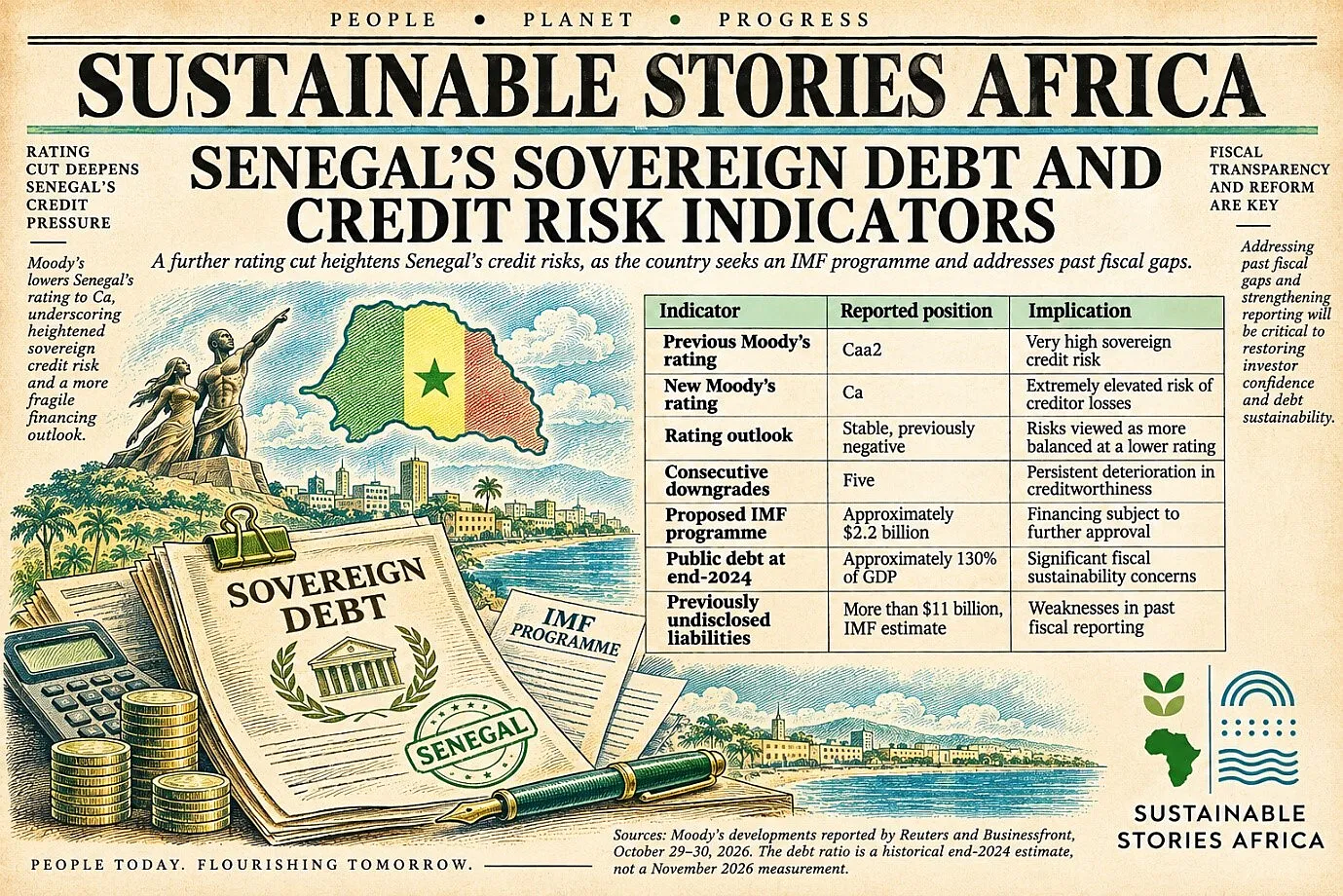
Moody's has downgraded Senegal's foreign-currency sovereign credit rating from Caa2 to Ca, warning that private creditors could suffer greater losses under the country's proposed debt restructuring.
The downgrade follows the discovery of previously undisclosed public liabilities and comes despite progress towards a proposed $2.2 billion IMF programme.
The worsening credit outlook raises concerns about financing costs, fiscal stability and the government's capacity to sustain essential development spending.
Senegal’s Debt Crisis Deepens Despite IMF Progress
Senegal's sovereign debt crisis has intensified after Moody's Ratings downgraded the country's foreign-currency senior unsecured and long-term issuer ratings from Caa2 to Ca on October 29, 2026.
- The decision marked the country's fifth consecutive downgrade and reflected growing expectations that private external creditors could face greater losses than previously anticipated under a planned debt restructuring.
Although Moody's revised Senegal's outlook from negative to stable, the lower rating signals severe credit stress and heightened concerns about repayment obligations.
- The downgrade is a staff-level agreement between Senegal and the International Monetary Fund in September for a proposed $2.2 billion financing programme.
However, the arrangement still requires corrective measures, financing assurances and approval from the IMF's Executive Board.
- It should therefore not be described as an already disbursed bailout.
The development places renewed attention on Senegal's fiscal management and the wider consequences of sovereign debt distress for sustainable economic development.
Hidden Liabilities Expose Deep Fiscal Vulnerabilities
Senegal's financial difficulties intensified after President Bassirou Diomaye Faye government disclosed previously unreported liabilities inherited from the preceding administration.
- A subsequent audit found that earlier fiscal deficits and debt figures had been significantly understated.
According to the financial reporting cited by Businessfront, IMF assessments estimated undisclosed liabilities exceeding $11 billion, with public debt reaching approximately 130% of gross domestic product at the end of 2024.
- The revelations disrupted Senegal's relationship with international lenders and prompted the suspension of an earlier IMF programme while the scale of the fiscal discrepancies was assessed.
In September 2026, Senegal reached a staff-level agreement for a proposed 36-month Extended Credit Facility worth approximately $2.2 billion, intended to restore macroeconomic stability and improve debt sustainability.
The government also announced plans to seek restructuring under an enhanced G20 Common Framework process.
Moody's latest downgrade reflects concern that private creditors may find deeper losses through changes to repayment terms, maturity schedules or principal obligations.
Restoring Fiscal Credibility Without Sacrificing Development
Senegal's debt restructuring presents difficult choices for policymakers, creditors and development partners.
- Restoring debt sustainability could eventually reduce financing pressure, improve confidence and give the government greater flexibility to support essential public services.
However, restructuring alone will not address the weaknesses exposed by inaccurate fiscal reporting.
- Strengthening public financial management, transparent debt accounting and credible medium-term budgeting are necessary to rebuild trust.
The social consequences are particularly important.
- When governments have severe debt distress, rising financing needs can compete with spending on healthcare, education, infrastructure and climate adaptation.
For Senegal, protecting productive public investment while improving fiscal discipline will be critical to maintaining long-term development prospects.
Membership in the West African Economic and Monetary Union offers some protection.
- Moody's noted that the regional monetary arrangement helps contain exchange-rate and balance-of-payments risks while supporting access to regional financing markets.
Nevertheless, regional monetary stability cannot substitute for restoring sustainable public finances.
Debt Reform Must Prioritise Transparency and Social Protection
Senegal's government must pursue credible negotiations with official and private creditors while establishing stronger institutional mechanisms for recording and monitoring public liabilities.
- The IMF and other development partners should support reforms that improve expenditure transparency, fiscal oversight and public accountability.
Debt restructuring should also consider how adjustment measures affect vulnerable households and the country's capacity to finance long-term economic development.
- Protecting essential social programmes, improving domestic revenue mobilisation and strengthening public investment selection can help limit the adverse consequences of fiscal consolidation.
For African governments more broadly, Senegal's experience reinforces the importance of publishing comprehensive debt information and ensuring that fiscal institutions operate with independent scrutiny.
Path Forward – Restoring Debt Sustainability While Protecting Development
Senegal's recovery will depend on completing credible restructuring negotiations, securing necessary programme approvals and demonstrating measurable improvements in fiscal transparency.
The priority is to restore confidence without letting debt adjustment undermine essential services, economic opportunity or climate resilience.
Successful reform could provide an important lesson for African countries confronting sovereign borrowing pressures and public financial management challenges.
Culled from: Despite IMF bailout deal, Moody's pushes Senegal's rating deeper into junk - Businessfront and Reuters — Senegal sovereign rating downgrade.