
OpenAI has launched ChatGPT for Teens, automatically placing users aged 13 to 17 - or those estimated to be under 18 - into an experience built around study support, critical thinking and stronger default safeguards.
For African education systems, the product widens the promise of personalised learning; however, its value will depend on affordable access, teacher guidance, local relevance and evidence that safety protections work in practice.
Teen AI Moves Beyond Simple Answers
OpenAI introduced ChatGPT for Teens on 18 August 2026 as a learning-centred experience that tries to change the basic bargain between students and generative AI.
Instead of treating speed as the main benefit, the design is intended to help young people explain, practise, question and understand.
That matters because the central education debate is no longer whether teenagers will use AI, but whether the tool will deepen learning or quietly replace it.
The teen experience is activated when a user states they are aged 13 to 17 or when OpenAI's systems estimate they are under 18.
It arrives with stronger built-in protections, healthy-use prompts and added controls for parents.
The launch therefore combines an education product with a safety architecture, putting age-appropriate behaviour into the default experience rather than leaving every family to assemble its own safeguards.
Learning Tools Arrive With Built-In Limits
The learning offer is organised around active participation. Study Mode uses guiding questions and step-by-step support; responsible homework reminders can detect when a student appears to be seeking a shortcut and redirect the session towards collaborative problem-solving.
Quizzes and learning visualisations add ways to test understanding, while Study Hours allow teens or linked parents to include Study Mode as the default at selected times.
The design is significant because it addresses a familiar weakness of generative AI in education:
- A fluent answer can resemble learning even when the student has not built the underlying skill.
- OpenAI says Study Mode draws on scaffolding, metacognitive prompts and knowledge checks.
- The practical test will be whether these interventions consistently slow students down at the right moment, without making legitimate research and exploration frustrating.
Safety Design Extends Beyond Content Filters
The safeguards cover higher-risk areas including self-harm, violence, eating disorders, dangerous activities and explicit sexual or graphic content.
- Linked parental accounts can use Quiet Hours, manage selected settings and receive limited notifications in high-risk situations. OpenAI is also adding eating-disorder-related alerts, while emphasising that only limited information should be shared when offline support may be needed.
Healthy-use features include break reminders, cues that ChatGPT is an AI system and warnings before teens upload sensitive images.
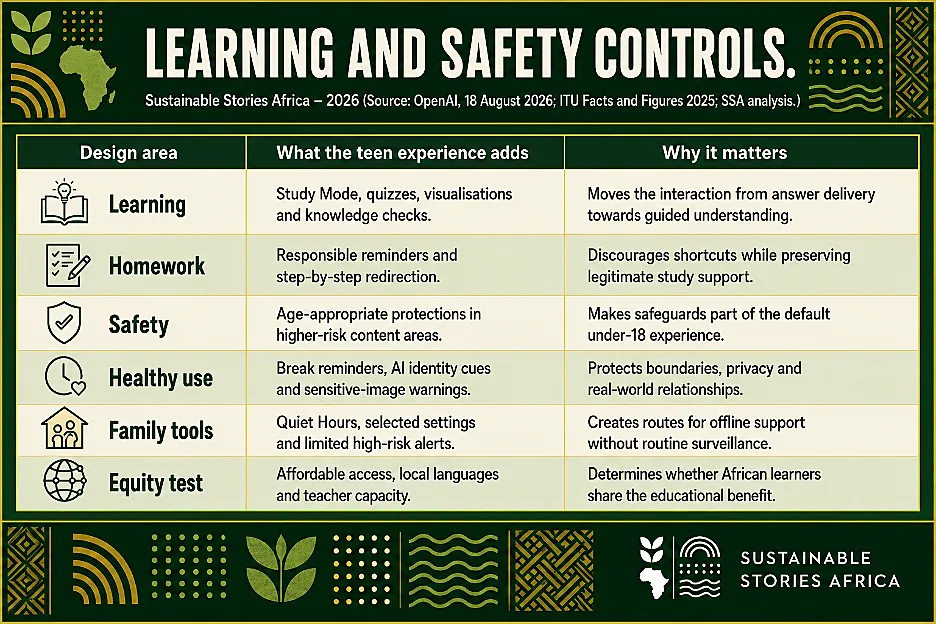
The under-18 rules also restrict romantic language, emotional dependence and claims of feelings or consciousness.
These boundaries matter because a safe education tool must manage not only harmful content, but also the relationship a young person may imagine they have with it.
Africa's Opportunity Depends on Fair Access
The opportunity is clear in contexts where students cannot always get after-school help.
- A guided tutor available on demand could support revision, language practice and difficult concepts.
However, the access gap is equally clear.
- ITU data for 2025 show that only 36% of Africa's population used the internet, while urban residents across Africa were 2.6 times as likely to be online as rural residents.
That divide means a better AI learning product can still widen inequality if it reaches connected, English-fluent and device-owning students first.
African adoption will need low-data options, local-language performance, disability access, curriculum alignment and school policies that protect students' data while keeping teachers central to learning.
Schools Need Rules, Skills and Oversight
Education ministries and school leaders should define when AI assistance is permitted, how students acknowledge its use and which assessments must remain independent.
Teachers need training to recognise productive use, over-reliance and confidently wrong outputs. Parents need plain-language controls, not only settings menus.
The product also needs external scrutiny.
- OpenAI says it is adding under-18 evaluations to its system cards and will publish more of what it learns.
- Useful accountability would report safety performance, false positives, learning outcomes and regional differences, including how the system behaves in African languages and low-connectivity settings.
Path Forward – Building Trust Through Evidence and Access
ChatGPT for Teens shifts the debate from unrestricted access towards designed responsibility.
Its strongest idea is that AI should help a student think, rather than merely deliver the finished answer.
The path forward is to pair product safeguards with teacher capacity, affordable connectivity and transparent evaluation.
If those pieces move together, AI can widen educational support without weakening agency, privacy or the human relationships on which learning depends.