Grundfos warns that EU data centre electricity demand could nearly triple by 2030.
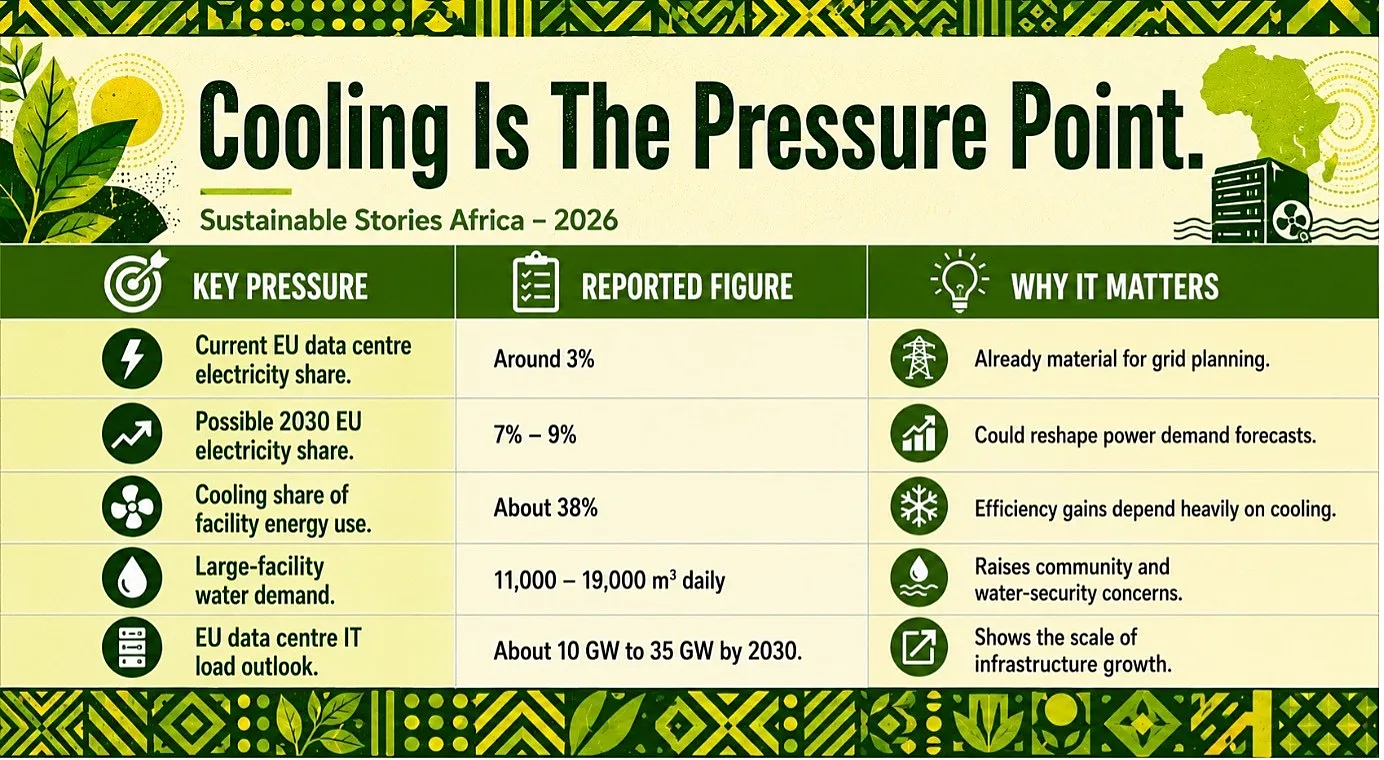
The company says data centres may rise from about 3% to 7–9% of EU electricity use.
The warning matters beyond Europe: AI growth is becoming a test of power, water and infrastructure for every digital economy.
AI’s Hidden Infrastructure Cost Emerges
Europe's artificial intelligence ambition is colliding with a physical constraint that spreadsheets cannot optimise away: data centres require electricity, cooling and water at a scale that grids and communities are struggling to absorb.
A new Grundfos report quantifies the pressure. EU data centre electricity demand could nearly triple by 2030, rising from roughly 3% of total EU electricity consumption today to between 7% and 9% by decade's end.
The Danish water-technology company's argument is not against building data centres; it is about how they are designed, cooled and integrated into broader energy and water systems.
For Africa and the Global South, the warning lands at a critical moment.
Digital transformation is accelerating across the continent, yet power reliability, water stress and urban infrastructure remain structural constraints.
Europe's experience confirms the principle: the AI economy will reward countries that plan data infrastructure as energy infrastructure, rather than as a separate budget line.
Cooling Is The Pressure Point
Data centres are not just electricity consumers; they are a water infrastructure.
Grundfos research places cooling at the centre of the debate, estimating that cooling systems account for approximately 38% of total facility energy use in an average data centre.
Daily cooling water demand in large facilities can reach between 11,000 and 19,000 cubic metres, rivalling the daily consumption of tens of thousands of households.
This creates a policy-grade trade-off. Cooling methods that reduce electricity use often require more water. Those who conserve water typically increase power demand.
In regions facing drought, heat stress or grid congestion, the balance is a public policy decision, not an engineering preference.
For African cities competing to attract cloud regions and AI infrastructure, the stakes are concrete.
Without integrated planning, data centres could crowd out households, agriculture and industry's use of limited power and water.
With smart design, they become anchors for cleaner grids and resilient urban systems.
Efficiency Can Protect Digital Growth
Europe's data centre debate carries a constructive conclusion: digital growth and sustainability are not competing priorities.
They require better cooling technology, stronger efficiency standards, smarter water management and planning frameworks that treat data centres as critical infrastructure.
The business case is coherent. Efficient cooling lowers operating costs, reduces grid pressure, improves uptime and strengthens ESG credibility for technology companies.
- For investors, efficiency reduces transition risk.
- For governments, it aligns digital sovereignty with climate commitments.
- For communities, it converts resource-intensive facilities into local economic anchors.
Africa's digital economy will require data centres closer to users, businesses and public institutions.
However, competitive advantage will not rest on land availability or tax incentives alone.
The markets that win will offer reliable renewable power, predictable regulation, water-sensitive planning and transparent community engagement.
When planned well, data centres can accelerate renewable procurement and create skilled jobs across engineering, construction and energy services.
When planned poorly, they deepen the infrastructure stress they were meant to resolve.
Build Smarter Before Demand Surges
The next step is policy discipline. Governments should require water and energy assessments before approving large facilities, while operators should disclose power and cooling performance more transparently.
Utilities, city planners and technology companies also need to coordinate earlier.
Grid connections, renewable power contracts, wastewater reuse, district heating opportunities and cooling design should be considered before construction begins, not after demand has already arrived.
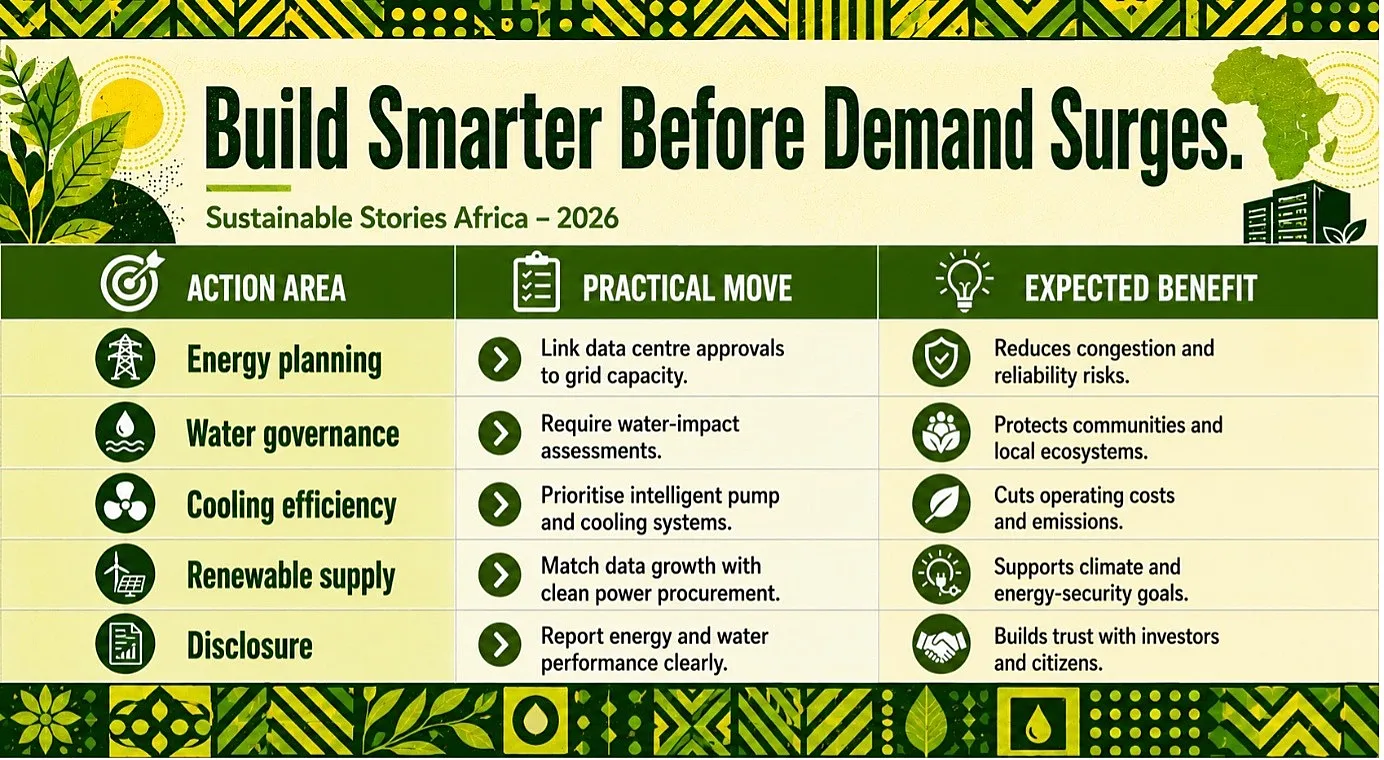
For African policymakers, the warning is not anti-technology. It is pro-planning. AI infrastructure can support finance, health, education, logistics and public services, but only if energy and water systems are strong enough to carry the load.
Plan Digital Growth Around Resilience
The path forward is to treat data centres as part of the national infrastructure strategy, rather than isolated technology assets.
Energy, water, climate and industrial policy must move together.
For African markets, the opportunity is clear: build digital capacity around renewable power, efficient cooling and transparent resource planning.
That is how AI growth can support ESG goals rather than overwhelming them.
Culled From: Grundfos Report Warns EU Data Centre Energy Demand Could Triple to 9% of Electricity Use by 2030