WWF’s Living Planet Report 2026 records a 73% decline in the average size of monitored wildlife populations between 1970 and 2022.
The assessment also identifies recoveries, showing that targeted action can rebuild populations even as the overall index remains deeply negative.
For Africa, with an 80% decline, the challenge is to link conservation changes in food production, energy and finance, rather than expect protected areas alone to reverse nature loss.
Wildlife Loss Demands A Wider Response
WWF has reported a 73% decline in the average size of monitored vertebrate wildlife populations over 52 years, while highlighting evidence that nature can recover when conservation is sustained.
Released on October 7, the Living Planet Report 2026 places the transformation of food, energy and finance systems alongside species protection.
The findings matter for African governments, businesses and communities because recovery raises economic questions, choices and environmental management.
Protecting a habitat while leaving the pressures surrounding it unchanged may preserve a temporary refuge without resolving the causes of decline.
Reading The Index Without Misleading Conclusions
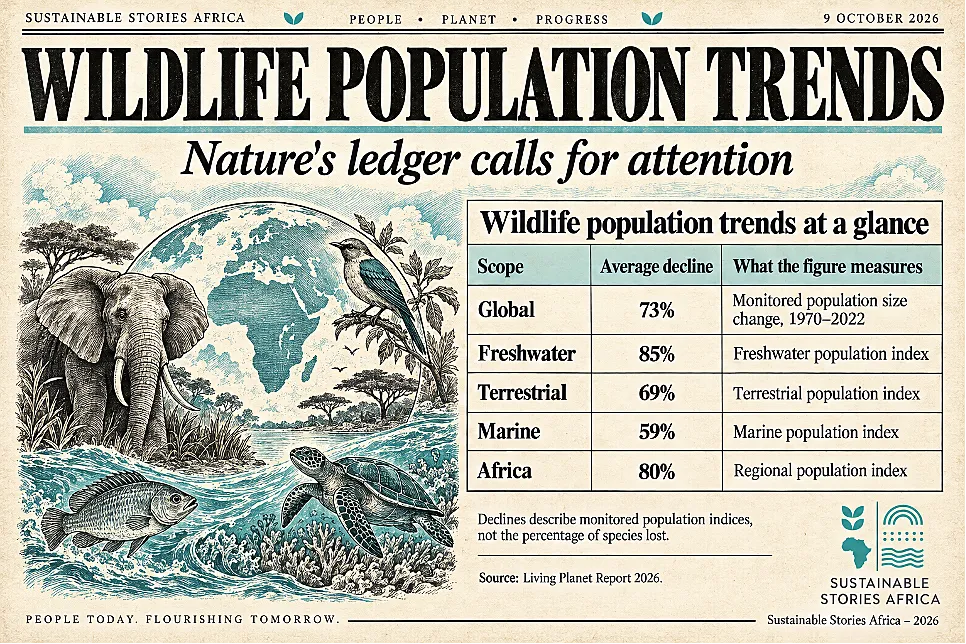
The Living Planet Index, produced by ZSL, draws on 35,803 population trends across 5,790 vertebrate species between 1970 and 2022.
- Freshwater populations show the largest average decline, at 85%, followed by terrestrial populations at 69% and marine populations at 59%.
- Africa’s regional index records an 80% decline.
These figures describe changes in monitored population sizes.
- They do not mean that 73% of all animals have disappeared, or that 73% of species have become extinct.
- The distinction is essential when communicating the report to audiences who may otherwise interpret the headline as an animal census.
WWF also notes that half the tracked populations are stable or increasing.
- A negative overall index can coexist with recoveries because the magnitude of declines matters.
- Success in one location does not automatically cancel a substantial loss elsewhere.
Recovery Links Conservation With Economic Choices
The report points to recoveries among turtles, tuna, tigers and southern African elephants.
- These examples support a constructive message: deterioration is not inevitable, but improvement requires conditions that allow populations to recover and remain secure.
For African decision-makers, the implication is to examine the activities surrounding conservation investments.
- A biodiversity project should ask whether agricultural sourcing, infrastructure development or financing decisions continue to undermine the habitat it is trying to protect.
- Otherwise, an organisation could finance restoration in one place while supporting degradation in another.
That assessment should include communities whose livelihoods depend on the landscape.
- Conservation designed without their participation may overlook legitimate access needs and the knowledge required to manage an area over time.
- A durable intervention needs a clear account of responsibilities, benefits and routes for resolving disputes.
The report’s recovery examples offer grounds for action, rather than permission to assume that all ecosystems will rebound quickly.
The appropriate measure is evidence of sustained improvement at the scale where an intervention operates.
Investment Must Address Drivers And Outcomes
The practical response is to connect conservation spending with decisions that shape land and resource use.
- Governments can examine whether incentives encourage activities that weaken ecosystems, while businesses can assess biodiversity risks in procurement and project development.
Financial institutions should ask clients to identify material dependencies on nature and explain how proposed activities affect them.
- A useful disclosure would show where risks arise, what management changes are being made and how results will be measured.
- A list of environmental donations is insufficient evidence of improved performance.
Public communication also needs discipline.
- Wildlife recovery should be reported with a location, period and indicator, without presenting a successful project as proof that wider nature loss has ended.
- Equally, a severe global decline should not erase local gains.
Reporting both allows readers to understand the scale of the problem and the practical value of intervention.
Path Forward – Turn Nature Recovery Into Economic Practice
African institutions should connect biodiversity protection with procurement, land use and investment decisions, while ensuring communities participate in implementation.
The next step is to move from broad commitments to measurable recovery plans.
Accurate interpretation of the index, transparent local monitoring and sustained finance can help conservation gains endure beyond individual projects.