New research finds that preserving plant diversity could help grasslands sustain carbon uptake and forage production as the climate warms.
Modelling indicates substantial losses under a severe diversity reduction scenario, with some tropical and subtropical regions especially exposed.
For African livestock communities, the findings strengthen the case for managing pasture health alongside climate resilience, while keeping projected benefits distinct from verified carbon removals.
Diverse Pastures Offer Protection Against Warming
A new peer-reviewed study has found that grasslands with a wider range of plant functions are better positioned to sustain productivity and carbon storage under climate change.
Researchers from the Potsdam Institute for Climate Impact Research and Kiel University published their findings in PNAS, announced on October 8.
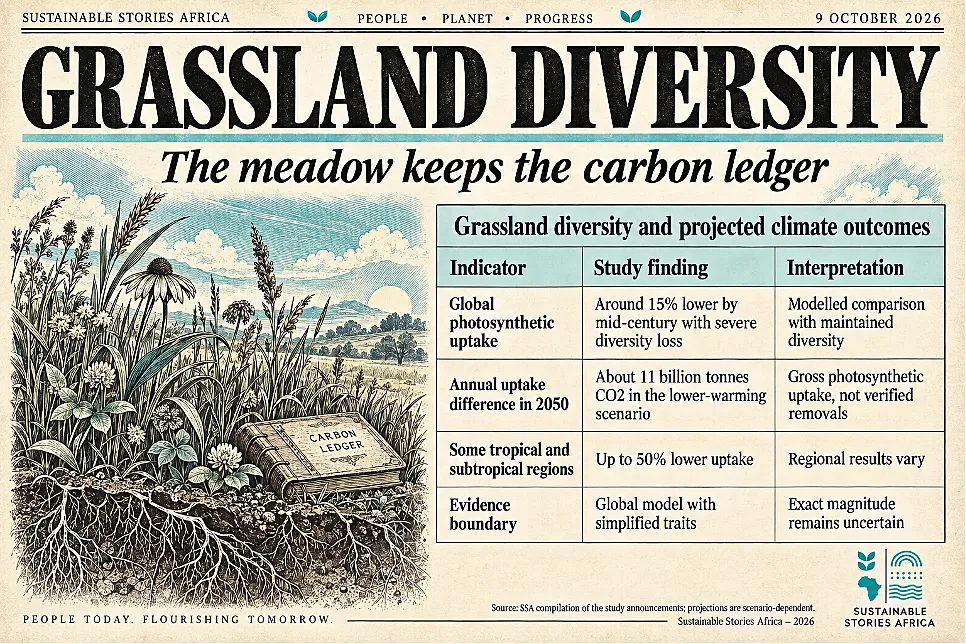
Their modelling suggests that severe plant diversity loss could leave global grasslands taking up about 15% less carbon dioxide from photosynthesis by mid-century than a scenario in which diversity is maintained.
The finding links biodiversity protection with a practical economic concern:
- Keeping grazing landscapes productive as climatic conditions change.
The Model Reveals Uneven Regional Exposure
The team compared maintained diversity with an extreme reduction in plant diversity under warming scenarios below 2°C and around 4°C.
- In the lower-warming scenario, the difference in annual photosynthetic uptake reached approximately 11 billion tonnes of CO2 in 2050.
- Some tropical and subtropical areas showed reductions of up to 50%.
The results are projections from a global vegetation model.
- They do not establish that every pasture will lose the same share of productivity.
- Nor is photosynthetic uptake equivalent to permanent carbon removal: the headline figures should not be treated as quantities of saleable carbon credits.
Kiel University cautions that the model simplifies plant traits and interactions, making the exact magnitude uncertain.
- That qualification is central to interpreting the findings, rather than a reason to dismiss their direction.
Pasture Health Supports Livelihoods Beyond Carbon
For African grazing systems, the study invites a broader way of assessing land management.
- Judge a pasture by what it can continue to provide under stress, rather than by short-term output alone.
- The questions include whether useful plant functions remain present, whether grazing pressure is compatible with recovery, and whether local users can maintain access to land and water.
The livelihood implications follow from the model rather than from a new survey of African households.
- Nevertheless, the connection is straightforward: a landscape that sustains forage gives livestock keepers more options when conditions deteriorate
- Losing that capacity can create pressure to buy feed, reduce herds or move animals elsewhere.
A credible response would therefore connect ecological monitoring with the decisions people actually make about grazing.
- Local knowledge should help interpret vegetation change, especially where a global model cannot capture differences between neighbouring landscapes.
This makes resilience a shared management objective:
- Maintain useful vegetation, support viable livelihoods and verify environmental results assessed together over time.
Management Must Preserve Functions And Fairness
The researchers recommend maintaining existing diversity and preventing overgrazing.
- Translating that advice into policy requires attention to incentives and rights.
- Restrictions that protect vegetation on paper but remove access without alternatives could shift costs onto the people the intervention is meant to support.
An appropriate programme would establish a baseline, agree practical grazing arrangements with users and track whether plant diversity and forage condition improve together.
- It should also record who bears the costs and receives the benefits.
For businesses making climate claims, the evidence supports investing in resilience and biodiversity protection.
- Any claim of quantified carbon storage still needs its own measurement framework.
The study offers a reason to protect diverse pastures; it does not replace site-level verification.
Path Forward – Protect Diversity While Strengthening Grazing Livelihoods
Governments and agricultural institutions should connect pasture conservation with support for livestock keepers, using locally appropriate management and monitoring.
The priority is to preserve ecological functions before they are lost, while testing how global model findings translate into real landscapes.
Ensure transparent carbon accounting and fair access to land accompany investment.