
Wellcome calls for clearer responsibilities across global institutions tackling antimicrobial resistance.
Its governance report argues that evidence, political leadership and national implementation need stronger connections.
For African countries, the central issue is whether international structures can support locally relevant priorities and sustained action against drug-resistant infections.
Drug resistance demands a more coherent response
Wellcome’s report From Evidence to Progress calls for a coordinated global governance system that puts scientific evidence at the centre of action on antimicrobial resistance.
- Its recommendations focus on defining institutional responsibilities, engaging researchers and governments, and maintaining political accountability after major international meetings.
The report builds on the 2024 United Nations high-level meeting on AMR.
- It argues that commitments will have limited effect if the organisations responsible for evidence, advocacy and implementation operate without clear connections.
AMR develops when pathogens no longer respond to medicines used against them.
- Its effects extend beyond an individual infection: treatment becomes more difficult, health services face additional demands, and patients can lose access to reliable options.
WHO identifies both inappropriate antimicrobial use and inadequate access to suitable health products as drivers of the crisis.
Evidence and political leadership need distinct responsibilities
The proposed Independent Panel on Evidence for Action against AMR would synthesise research and guide priorities.
- Wellcome recommends a clear distinction between this technical role and political advocacy, protecting scientific integrity while ensuring that findings reach decision-makers
The Global Leaders Group would maintain high-level political engagement.
- The Multi-Stakeholder Partnership Platform would connect researchers, civil society, governments, businesses and resource partners.
- The Quadripartite organisations and their joint secretariat would support alignment and technical work, with ministerial meetings providing opportunities to review progress.
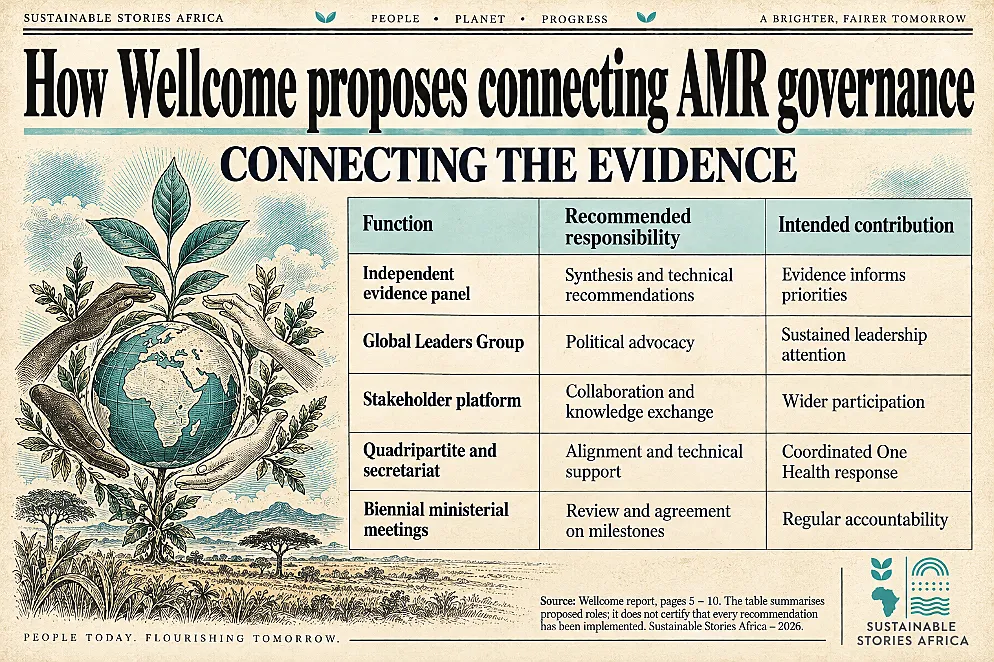
The report proposed an initial evidence panel by the end of 2025 and a fully formed governance system by the 2026 ministerial meeting.
- These are recommendations in the source, not proof of achievement.
- An April 2026 Global Leaders Group update referred to the panel’s continuing establishment process and preparations for the ministerial meeting in Abuja.
National priorities should shape the global agenda
Wellcome argues that countries carrying the greatest burden should influence the evidence panel’s membership and priorities.
This is an important governance question:
Evidence can be technically strong yet poorly matched to the choices a particular health system faces.
For African decision-makers, an international structure would lie partly in its ability to support practical national choices.
- A ministry may need to weigh investment in laboratory capacity, infection prevention and access to appropriate medicines.
- Global recommendations become useful when they help clarify those choices and acknowledge resource constraints.
These examples are policy implications, rather than an assessment of any individual country’s performance.
- National priorities require local data and engagement with clinicians, patients and relevant One Health sectors.
- A common framework should support that process without assuming that every country faces the same problem in the same form.
The report’s emphasis on independence also has practical value.
- Political advocacy is necessary to secure attention and resources, but the evidence informing decisions should remain open to scrutiny even when findings are inconvenient.
Accountability must reach beyond international meeting rooms
Wellcome recommends regular communication between governance bodies and opportunities to assess progress.
- It also calls for embedding AMR in broader health discussions, reflecting its connections with preparedness and health-system resilience.
For national institutions, the next step is to link external commitments with identifiable responsibilities at home.
- Action plans need accountable owners, realistic resources and indicators that show whether implementation is advancing.
- The existence of a plan alone cannot demonstrate better care.
Researchers and civil society can join by making evidence accessible and raising questions about gaps between promises and delivery.
Funders should confirm whether their support strengthens national capabilities and coordination, rather than creating additional reporting demands with little practical benefit.
The immediate challenge is to make governance useful to the institutions and people responding to resistant infections.
Clearer remits can reduce duplication, but their success depends on whether evidence reaches decisions and leads to sustained action.
Path Forward – Connect global evidence with national delivery
AMR institutions need clear remits, scientific independence and regular progress reviews.
Countries with high burdens should help shape priorities and receive support that reflects local realities.
African governments and partners should link international commitments to funded national action, transparent responsibilities and measurable implementation across human, animal and environmental health.