New research from the University of Cape Town finds that currency risk is becoming Africa's central power finance problem.
It matters because dollar-based financing and power purchase agreements shift exchange-rate risk onto utilities and consumers.
Local-currency financing could lower capital costs and tariffs in Kenya, Ghana and Nigeria.
A Costly Dependence on Dollars
Africa's renewables sector is attracting major investment as foreign companies set up operations across the continent.
However, the money comes with a hidden price.
New research from the University of Cape Town shows that foreign dependence in power finance carries a cost because many projects rely on dollar financing and power purchase agreements (PPAs), according to Renewable Rising reporting.
The effect is to shift currency risk to utilities and, ultimately, consumers.
For a continent trying to connect millions of people to reliable electricity, that shift in risk matters.
- A project can be technically sound and fully built, yet still become expensive for the public if the currency in which it was financed strengthens against the one in which people earn and pay their bills.
What Depreciation Has Done
The exposure is large.
- Between 2014 and 2024, currency depreciation was sharp across several African markets.
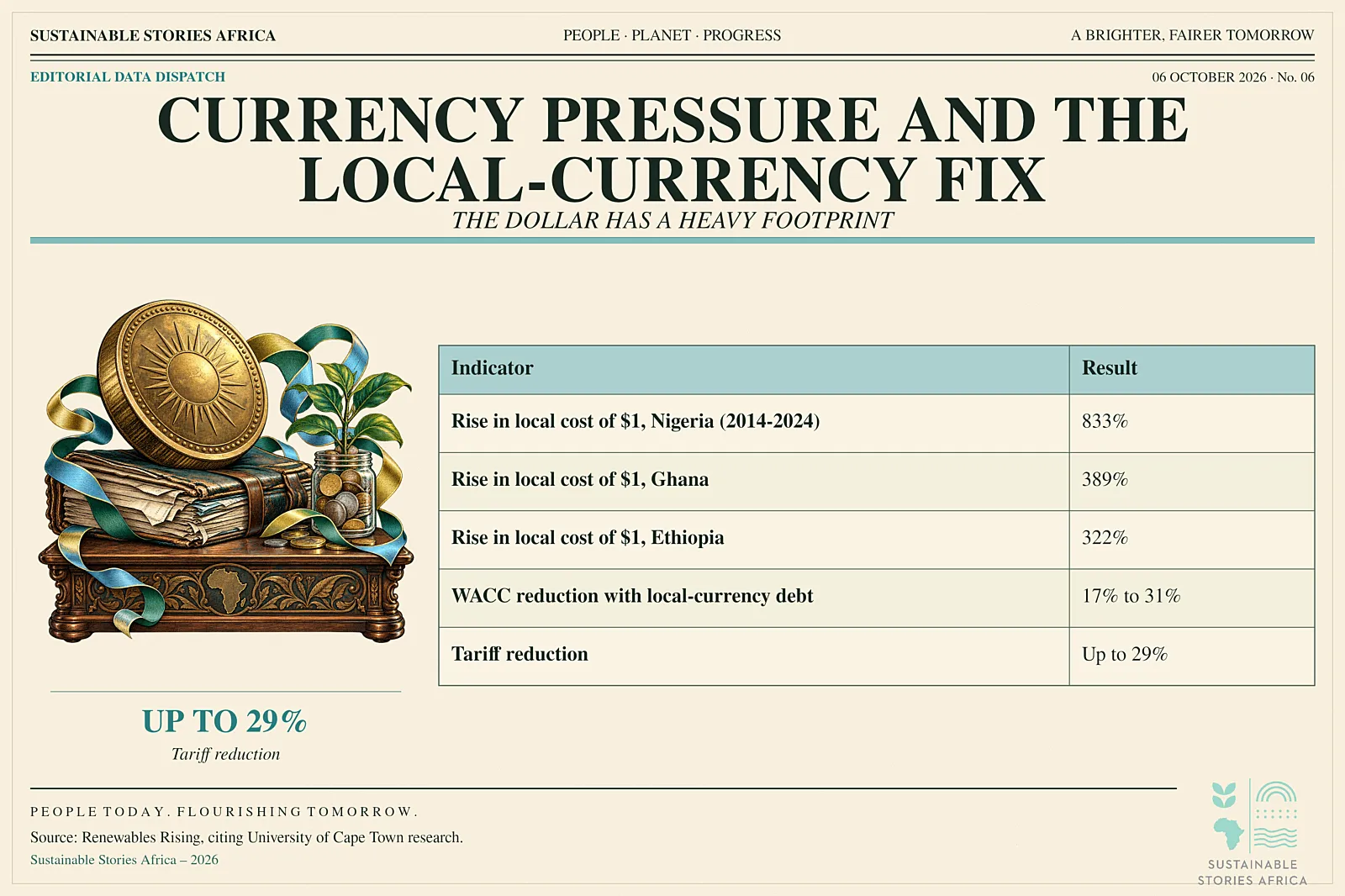
- The local-currency cost of $1 rose 833% in Nigeria, 389% in Ghana and 322% in Ethiopia.
- Such movements can significantly change project economics.
Consider how this works in practice.
- A developer borrows in dollars and sells power under a PPA.
- If the naira, cedi or birr weakens, the utility must find more local currency to meet the same dollar obligation.
- That pressure then flows into tariffs, public finances or both.
The researchers therefore argue that the problem has moved on from raising capital to managing currency risk.
Capital is arriving; however, the structure of that capital determines who carries the danger when exchange rates move.
Nigeria, Ghana and Ethiopia are not isolated cases.
They show how quickly a financing model that looks affordable on paper can lose value once exchange rates move, and why investors and policymakers are now paying closer attention to the currency in which power is financed.
Cheaper Capital and Fairer Tariffs
There is a practical remedy.
- Local-currency financing reduces the mismatch between the revenues projects earn and the debt they repay.
- Modelling in Kenya, Ghana and Nigeria found that replacing hard-currency debt, particularly with partial hedging, reduced the weighted average cost of capital (WACC) by 17% to 31% and tariffs by up to 29%.
Lower tariffs would make power more affordable for households and businesses, while cheaper capital could make more projects bankable.
- Utilities would face less exposure to sudden exchange-rate shocks, giving governments greater room to plan energy budgets.
Developers also gain:
- Predictable local revenues matched to local debt make projects easier to finance and defend before regulators and communities.
If nothing changes, the same risk will keep accumulating with each new dollar-denominated project, and consumers will keep paying for movements they cannot control.
Build Local-Currency Markets
Governments, central banks and development finance institutions should expand local-currency lending and hedging facilities.
Developers and lenders can test blended structures that combine local debt with partial hedges.
Regulators should examine how PPAs allocate currency risk, so that tariff negotiations reflect the full cost of exchange-rate exposure rather than hiding it from consumers. Success should be measured by lower tariffs and more projects reaching financial close.
Path Forward – Local Currency Financing Offers Lower Tariffs
Researchers advocate replacing hard-currency debt with local-currency financing, ideally paired with partial hedging, to ease the burden on utilities and consumers.
Modelling in Kenya, Ghana and Nigeria suggests this could cut capital costs by up to 31% and tariffs by up to 29%, strengthening affordability and the bankability of African renewable projects.
Culled from: Power finance problem shifts from capital to currency risk