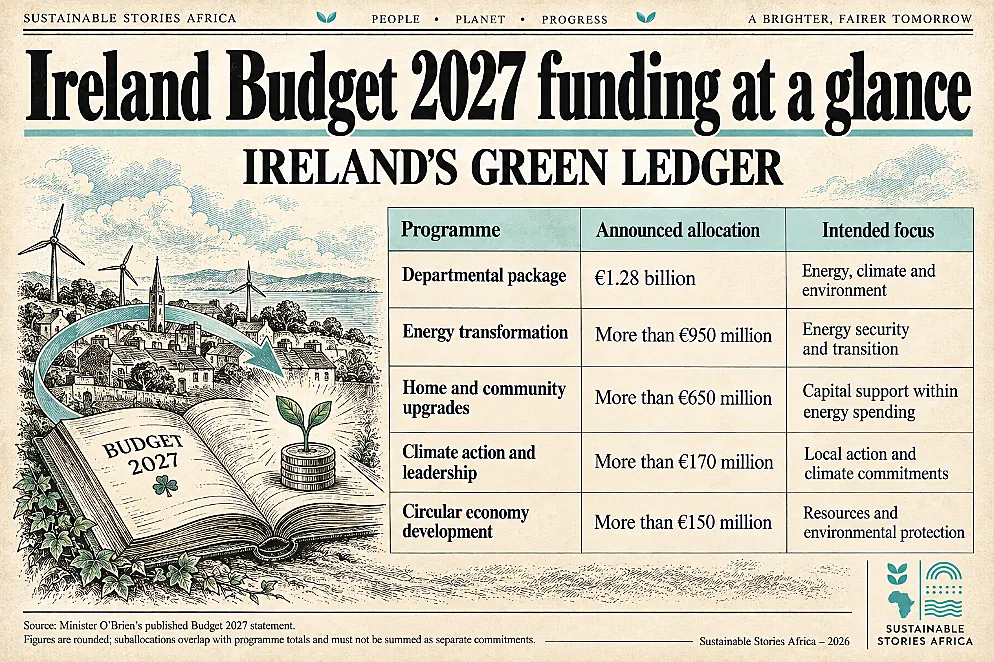
Ireland has announced €1.28 billion for energy, climate and environmental programmes in Budget 2027.
The package combines support for cleaner energy with measures to reduce household and business costs.
For African policymakers, it offers a financing example worth examining, with success depending on delivery, access and measurable savings rather than headline allocations alone.
Climate spending puts energy affordability at centre
Ireland has allocated €1.28 billion in Budget 2027 to energy, climate action and environmental programmes, including more than €950 million for energy transformation.
- The announcement, reported on October 7, places household upgrades and reduced exposure to imported fossil fuels at the centre of the package.
The overall figure should not be described as renewable-energy funding alone.
- It covers a broader mix of energy investment, climate programmes and environmental protection.
- That distinction matters when comparing public budgets: different spending categories support different outcomes and must be assessed on their own terms.
Minister Darragh O’Brien’s published statement links the package to affordability as well as sustainability.
Its policy logic is that support for current bills can sit alongside investments that reduce future energy demand.
Budget lines connect homes with climate delivery
A record capital allocation of more than €650 million will support Sustainable Energy Authority of Ireland home and community upgrades.
- The statement identifies €647 million from carbon-tax receipts within this allocation.
- That contribution is part of the upgrade funding, not an additional amount.
Support includes insulation, solar power, batteries and heating changes.
- The government also announced an increase in the household microgeneration income-tax disregard from €400 to €600 for electricity sold to the grid.
OneStop ESG also reports proposed capital support for biomethane and further district-heating investment.
- These measures point to a wider transition programme, but announced funding should be distinguished from completed projects or verified emissions reductions.
Lower demand can improve household resilience
The package’s potential benefit is changing what households need to buy.
- A grant that improves a home’s energy performance could continue delivering value after a temporary bill subsidy ends.
- For a business, a suitable clean-energy investment could also reduce exposure to fuel-price changes.
These outcomes depend on circumstances.
- Property condition, installation quality, financing terms and actual usage determine whether an upgrade delivers the expected benefit.
- Estimated savings are therefore a planning tool, not a guarantee for every recipient.
The equity question is equally important.
- A programme may seem generous on paper while remaining difficult to access for people who cannot meet upfront costs, navigate applications or obtain permission to alter rented property.
- Its social value depends on who receives support and who remains excluded.
For African governments, the useful comparison is the relationship between public spending and household need.
- The Irish policy mix cannot simply be copied into markets with different incomes, housing conditions or electricity systems.
- It does, however, invite a practical question: which investments can make clean-energy choices more affordable for the people least able to finance them independently?
Delivery needs transparent measures of public value
Governments should assess climate budgets through implementation as well as allocation.
- Useful measures include completed installations, access among lower-income households, the quality of work and verified changes in energy use.
- Public reporting should explain delays and distinguish committed funds from actual expenditure.
Financiers supporting comparable African programmes could work with public agencies to reduce upfront barriers and ensure repayment obligations remain realistic.
- Funding arrangements should clearly define who carries performance risk and how households obtain help when installations fail.
Procurement also deserves attention.
- Expanding a programme quickly can create pressure on installers and quality assurance.
- Training, inspection and accessible complaints processes are part of delivery, rather than administrative details to address after problems emerge.
The immediate policy task is to connect the money with accountable outcomes.
- A climate budget becomes meaningful when households experience reliable improvements and public institutions can demonstrate where the funds went.
Ireland’s announcement provides a substantial commitment; implementation will determine its lasting value.
Turn climate allocations into measurable benefits
Ireland’s programme judgement should include completed upgrades, equitable access and credible evidence of savings.
Announced spending is the starting point for that assessment.
African policymakers can draw on the affordability principle while designing locally appropriate finance and delivery systems that make climate investment useful to households and businesses.
Culled from: Ireland Budget 2027 Allocates €1.28 Billion to Renewable Energy and Climate Action | OneStop ESG