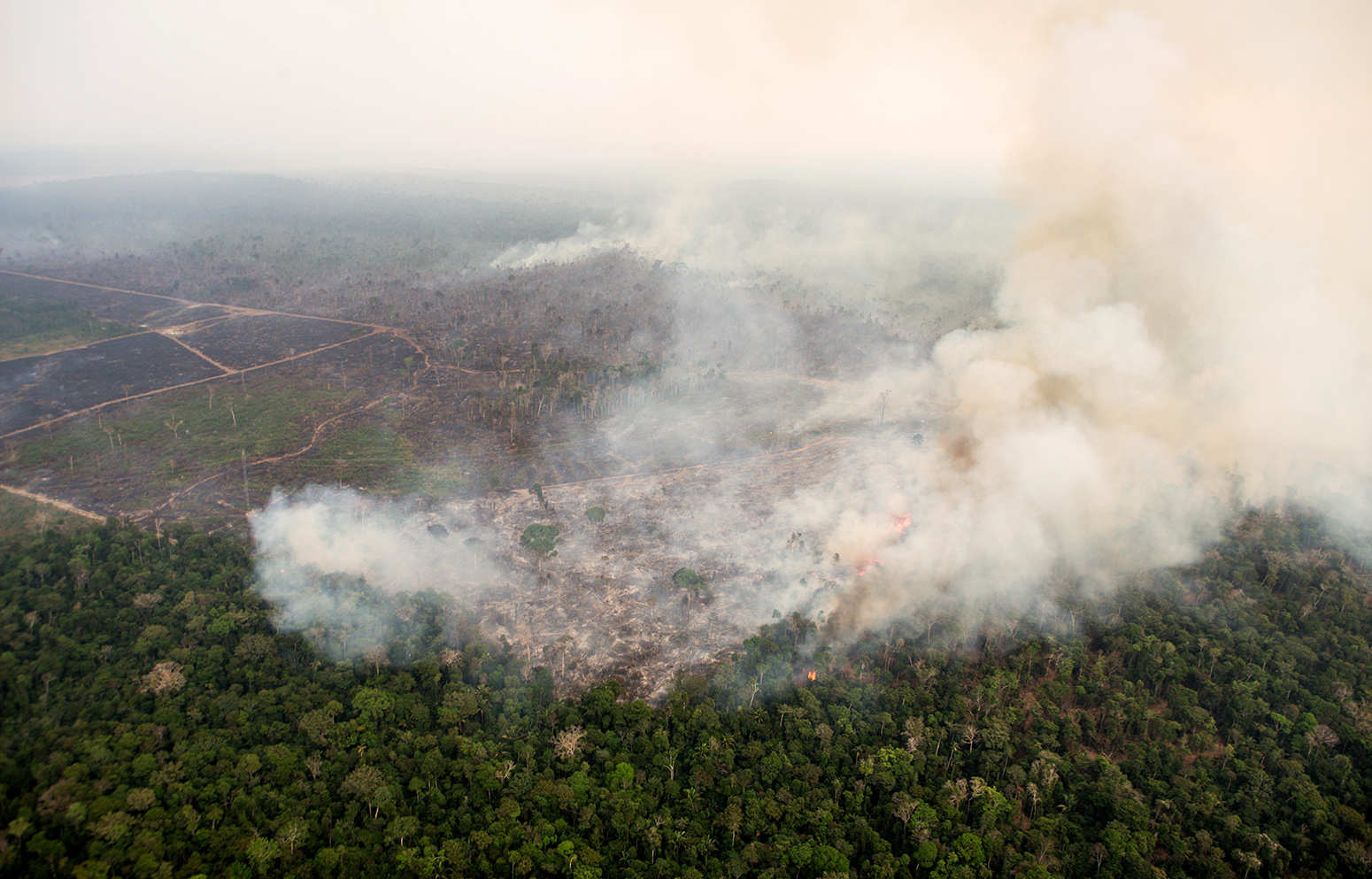
Amazon fires are destroying the forest’s carbon uptake through ozone pollution, alongside the carbon released by burning trees.
A new study identifies an overlooked climate cost that persists in surviving vegetation.
For African forest policy and climate finance, the findings raise a practical question: how should protection programmes account for pollution as well as visible tree loss?
Surviving trees carry an invisible climate cost
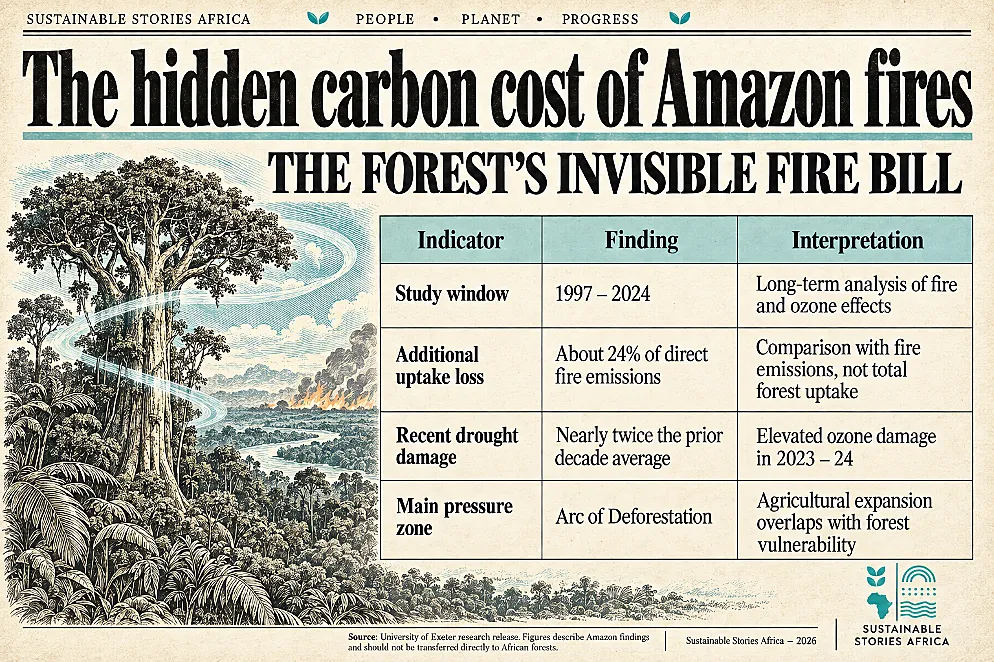
Wildfire pollution is weakening the Amazon’s ability to absorb carbon, adding a loss equivalent to about 24% of the carbon emitted directly by fires, according to research announced on October 7. Scientists from Exeter, ETH Zurich and James Cook University examined how fire-generated ozone affects the forest’s carbon balance.
The finding matters because a tree can survive a fire season while becoming less effective at removing carbon dioxide.
Counting burned vegetation alone therefore misses part of the damage.
The study, published in Communications Earth & Environment, highlights a climate consequence that is harder to see than a cleared forest or smoke plume.
Smoke changes the value of forest survival
Ground-level ozone forms through reactions involving pollutants and sunlight.
- The TropOz research programme explains that ozone enters leaves, damages cells and lowers plant productivity.
- Its work combines controlled experiments, atmospheric monitoring and modelling to understand tropical vegetation, where evidence has historically been thinner than in temperate regions.
The Amazon analysis covered 1997–2024.
- Ozone damage during the 2023 – 24 drought was almost twice the previous decade’s average, according to the researchers’ release.
- Damage was concentrated along the agricultural frontier known as the Arc of Deforestation.
Forest protection can deliver wider environmental gains
The policy implication is that preventing forest degradation may protect more than the carbon contained in trunks and branches.
- It may also preserve the future work of living vegetation.
- This broadens the case for prevention: protecting a forest means defending both an existing store of carbon and its continuing capacity to absorb more.
For a restoration investor, the distinction is practical.
- A programme assessed only by planting totals or hectares protected could overlook the environmental conditions that determine whether trees grow well.
- Survival remains essential, but survival and healthy functioning are different measures.
- Pollution exposure deserves attention alongside fire management and land-use pressures.
This is an analytical lesson for Africa, rather than an estimate of African carbon losses.
- The Amazon result does not establish how much uptake is lost in the Congo Basin or any particular woodland.
- Local species, weather, fire regimes and pollution sources must be studied before comparable numbers can be reported.
- Treating the Brazilian estimate as a continental default would weaken the credibility of forest claims.
Carbon accounting needs evidence beyond burned hectares
Governments and project developers should ask whether their monitoring systems capture conditions that affect forest growth after a fire.
- Where capacity allows, forest assessments could connect air-quality observations with ecological measurements and fire records.
- Such work would help distinguish observed damage from modelled effects and make uncertainty visible to decision-makers.
Climate financiers should also examine what their contracts reward.
- If funding prioritises emergency response while giving little support to prevention or long-term monitoring, programmes may struggle to show how protection changes forest performance
- A more useful assessment would consider avoided destruction, ecosystem condition and the quality of evidence supporting carbon claims.
For companies trading forest-based credits, the immediate action is to ask careful questions.
- What is measured?
- What is estimated?
- Which risks are included?
The new finding is a reason to distinguish the evidence behind claims, rather than to apply a blanket adjustment to every forest project.
- Stronger scrutiny can support credible conservation investment while reducing exaggerated promises.
Monitoring should also be designed for continuity.
- Repeated observations are more useful than a single snapshot for assessing whether forest conditions change.
- Partners should agree how results will be shared and how unexpected findings will affect project decisions.
Path Forward – Protect forests through better pollution evidence
Forest protection programmes should connect fire prevention, ecosystem monitoring and air-quality research.
African institutions can use the Amazon finding to identify local evidence gaps without importing its numerical estimates.
The next step is to fund measurements that make forest carbon claims more transparent and help governments protect the continuing productivity of surviving trees.
Culled from: Amazon wildfires are generating ozone that weakens surviving trees' carbon uptake