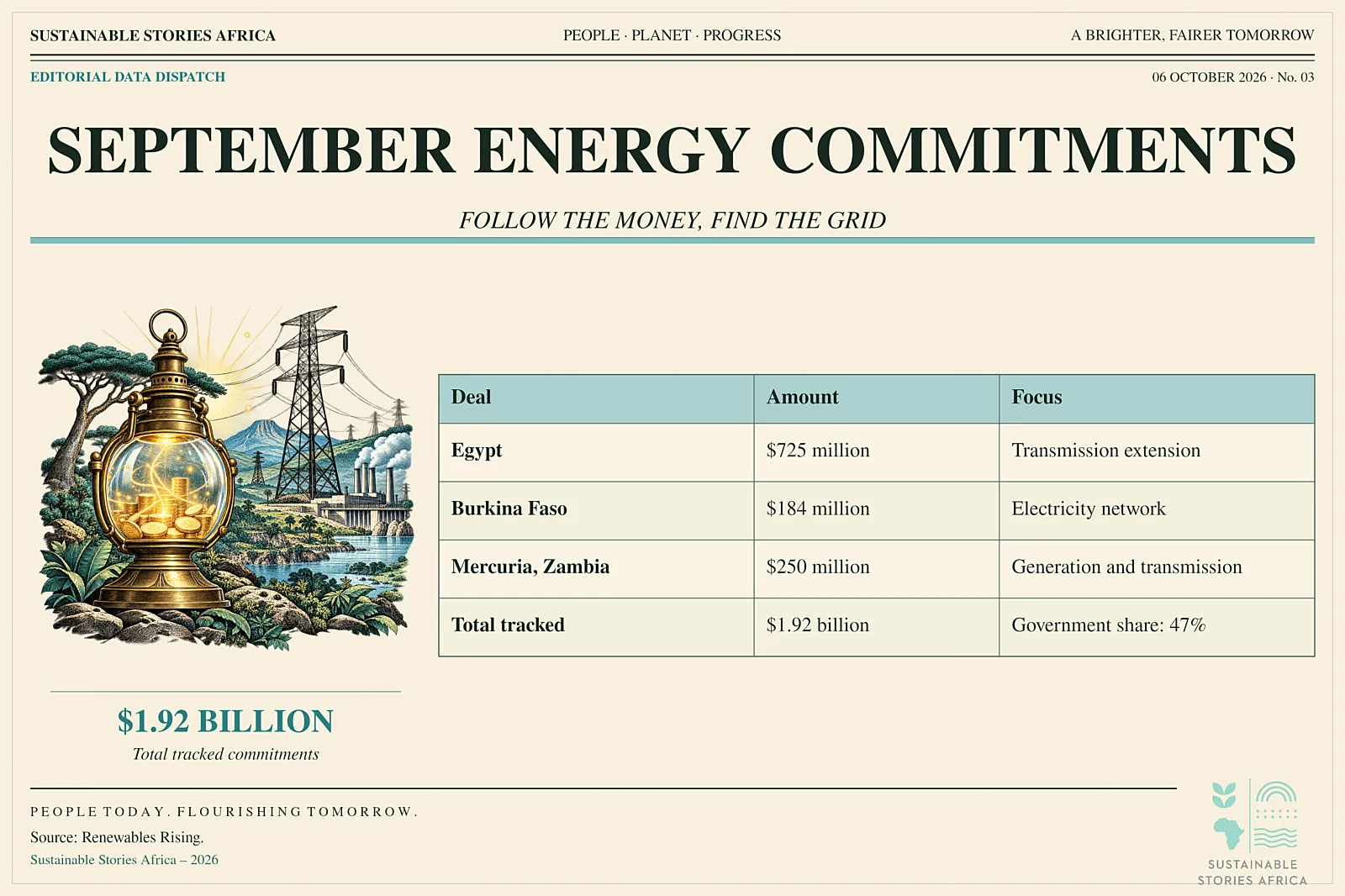
Two African governments committed $909 million to energy in September, almost half of the $1.92 billion tracked that month.
The spending matters because weak transmission is now one of the biggest gaps in Africa's power systems.
Grid investment is meant to connect new renewable capacity and improve reliability for households and businesses.
Governments Take the Lead
African governments, not private developers, set the pace on energy finance in September.
- Egypt and Burkina Faso together committed $909 million, equal to 47% of the $1.92 billion in energy deals tracked by Renewables Rising for the month.
Egypt allocated $725 million to extend its transmission network, while Burkina Faso approved $184 million to expand its electricity network.
- Development finance institutions largely funded the remaining deals, mostly through debt.
Together, the two governments accounted for $909 million of the month's total, leaving roughly $1.01 billion, or 53%, to be shared across other transactions.
This concentration shows how much of Africa's energy finance still depends on a handful of large commitments in any given month.
Why Grids Dominate the Money
Grids accounted for the bulk of the funding.
- Transmission has become one of the biggest gaps in Africa's power systems, and investment is moving towards connecting new renewable capacity and improving reliability.
- A solar or wind plant that cannot reach demand centres earns little, and a weak network can leave generated power stranded or cause outages that hurt factories, clinics and homes.
For readers outside the sector, the point is simple:
- Electricity must travel from where it is produced to where it is used.
- Generation headlines attract attention, but transmission determines whether that power arrives at a price and quality that customers can rely on.
The split between public and development money is also telling.
- Governments are putting their own balance sheets behind the wires, while development lenders supply debt for much of the rest, a pattern that keeps projects within public planning frameworks.
Private capital is still arriving, though.
- Mercuria entered Africa's regional power market with a $250 million deal in Zambia, one of the largest private commitments to the country's power sector.
The financing will support generation and transmission projects.
Reliable Power, Wider Access
If the money is spent well, the gains extend beyond engineering.
- Stronger transmission lets countries add renewable generation without wasting it, improves reliability for industry and can open the way for cross-border trade in electricity.
Egypt's allocation shows how a large grid-focused commitment can anchor a broader energy programme, while Burkina Faso's approval shows that smaller economies are also prioritising networks.
The cost of delays is equally clear.
- Without grid upgrades, new generation capacity risks being stranded, and households and businesses continue to absorb the cost of unreliable supply.
For lenders and investors, a visible pipeline of public grid spending also reduces uncertainty.
- When governments commit their own funds first, private developers can plan projects with greater confidence that evacuation lines will follow.
Match Generation With Wires
Policymakers should plan generation and transmission together, so that new plants are never built ahead of the lines that connect them.
Development finance institutions can keep supplying debt, while private investors such as Mercuria can bring capital to the generation projects that depend on strong networks.
Utilities will need to show that the funds translate into delivered kilometres of line and measurable improvements in reliability.
Governments should publish delivery timelines so that citizens and financiers can track progress.
Path Forward – Build Grids Before Clean Generation Stalls
Governments are advocating stronger transmission as the foundation of Africa's power systems, with Egypt and Burkina Faso committing $909 million to network expansion.
Development lenders are supplying debt for most remaining deals, while private players such as Mercuria fund generation and transmission, linking renewable capacity to reliable supply.
Culled from: Governments put $909 million into energy in September