Karl Deisseroth, Peter Hegemann and Georg Nagel have received the 2026 Nobel Prize in Physiology or Medicine for work underpinning optogenetics.
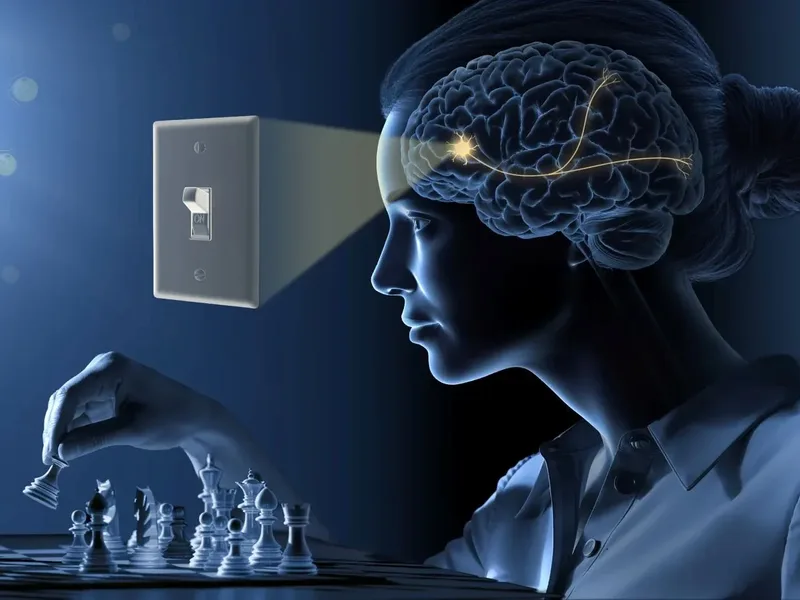
The technique uses light to control selected nerve cells, opening new ways to investigate brain function.
Its journey from algae research to neuroscience offers African science funders a lesson in supporting discovery while keeping clinical promises proportionate to evidence.
A pond organism helped illuminate brain function
Research into how a single-celled alga responds to light has helped produce a Nobel-winning method for investigating the brain.
- Karl Deisseroth, Peter Hegemann and Georg Nagel were recognised on October 5 for work on light-gated ion channels and optogenetics, with Stanford confirming Deisseroth’s shared award.
The story gained fresh attention in a Down To Earth explainer published on October 6.
- At its centre is a scientific connection: proteins that help an organism respond to its surroundings can also become tools for testing how nerve cells influence behaviour.
For sustainability-minded research institutions, the significance extends beyond the award.
- A discovery does not need an obvious commercial application at the outset to become valuable.
However, funding must still support the time and infrastructure required to translate knowledge into useful tools.
Light provides a precise experimental switch
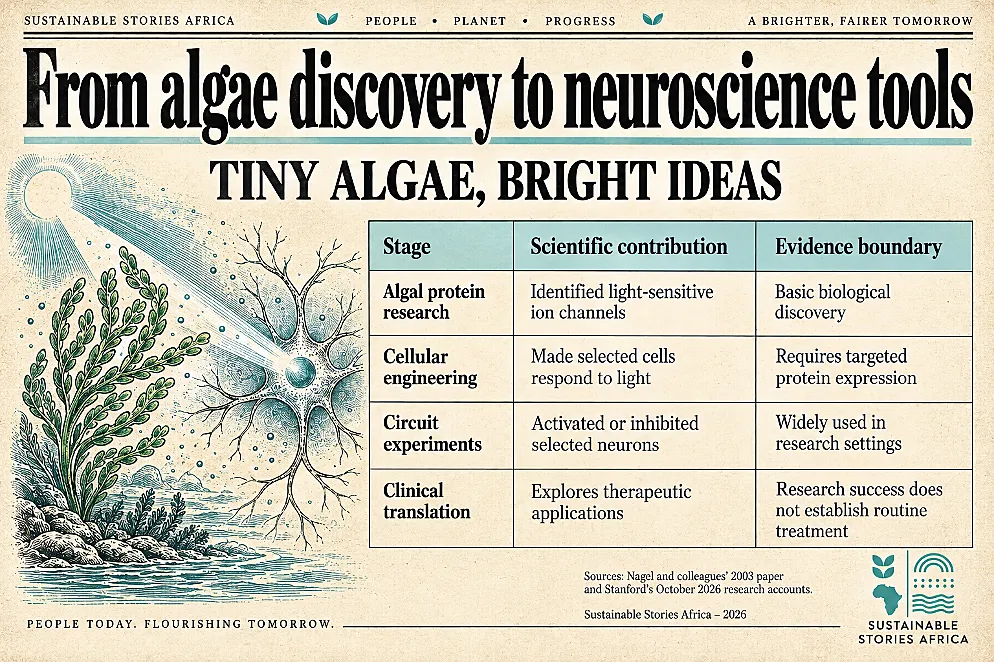
Hegemann and Nagel investigated channelrhodopsins in Chlamydomonas.
- A 2003 research paper demonstrated that channelrhodopsin-2 acts as a light-gated channel that allows positively charged ions to cross a cell membrane.
- Introducing the protein into other cells made it possible to test light-controlled electrical responses.
Deisseroth and collaborators developed ways to express light-sensitive proteins in selected mammalian neurons and deliver light using fine optical fibres.
- Different proteins can activate or inhibit activity, allowing researchers to examine specific circuits with close control over timing.
This gives scientists a way to test causal relationships.
- Observing cells during a behaviour shows an association; changing their activity and examining the effect can help determine what they contribute.
- The distinction makes optogenetics useful for investigating how circuits work.
Better tools can support better health knowledge
For people living with neurological illness, the long-term value lies in a better understanding of disease and potential routes to treatment.
- That prospect should be communicated with care.
- A method capable of changing behaviour in a laboratory animal is not automatically safe, effective or practical for treating a person.
Stanford reports that thousands of laboratories use optogenetics supported by training and the distribution of engineered gene materials.
- These activities matter because a discovery’s influence depends partly on whether other researchers can reproduce and adapt it.
The wider development lesson is about access to scientific capability.
- Funding equipment without supporting staff, maintenance or collaboration can leave a laboratory unable to use what it has purchased.
- Equally, excluding foundational biology from research priorities can narrow the pool of discoveries from which future applications emerge.
For African institutions, these are policy implications, not evidence that a particular local programme is ready to introduce optogenetics.
- Research choices should reflect available expertise, ethical oversight and the questions a laboratory can answer responsibly.
Fund discovery while testing promises against evidence
Science ministries, universities and philanthropic funders should consider how their portfolios balance immediate public needs with research whose applications remain uncertain.
- Transparent selection criteria can make that balance defensible.
- Long-term support should still require credible methods, appropriate oversight and clear reporting of progress.
International partnerships could provide training, shared facilities and opportunities for African researchers to shape scientific questions.
- Their quality should be judged by the capabilities built locally and the fairness of collaboration, rather than by announcements alone.
- Agreements should clarify access to data, publication roles and the responsibilities of each institution.
Public communication has a role too.
- Reporting a Nobel award can explain what researchers have demonstrated, what remains experimental and why the distinction matters.
- Patients deserve a clear account of uncertainty.
- Funders deserve an honest explanation of the path between an experimental tool and a practical health benefit.
The immediate action, therefore, is to support capable research systems and communicate their results accurately.
Celebrating discovery becomes more useful when it leads to durable opportunities for the next generation of scientists.
Path Forward – Build research capacity beyond immediate applications
African research funders should protect room for discovery science while investing in training, facilities and accountable partnerships.
Clinical claims must remain tied to demonstrated evidence.
The algae-to-neuroscience journey shows why patient investment matters: the next useful health tool may begin with a question whose eventual application is impossible to predict.
Culled from: https://www.downtoearth.org.in/health/how-pond-algae-led-to-a-nobel-prize-and-a-new-way-to-study-the-brain