
South Africa’s Competition Commission has set out how it will assess potentially anti-competitive conduct in repair, service and maintenance aftermarkets.
The October 2026 guidelines address access to parts, tools, software and repair information outside applicable warranty protection.
For households and independent repair businesses, the issue is whether product maintenance is affordable and lawful rather than premature product replacement.
Repair access becomes a clearer competition issue
South Africa’s Competition Commission has issued October 2026 guidelines explaining its approach to competition concerns in repair, service and maintenance aftermarkets.
- The guideline examines practices that can disadvantage independent providers and limit consumers’ choices when they must pay for repairs outside applicable warranty protections.
A product may be physically repairable, but difficult to maintain if essential components or diagnostic inputs are available only through restricted channels.
- It can affect the options open to both consumers and small businesses.
The Commission’s approach also connects repair competition with product longevity.
- When repair remains economically and technically feasible, barriers can contribute to premature replacement and undermine the benefits of keeping goods in use.
Parts and software can restrict market participation
The document addresses electronics, appliances, equipment and other relevant goods.
- Motor vehicles are excluded because separate automotive aftermarket guidelines apply.
- It focuses on repair work outside statutory, implied or express warranty protections; a product still within a warranty period can nevertheless require work that the warranty does not cover.
Access concerns extend beyond physical parts.
- The Commission identifies tools, manuals, diagnostic systems, activation mechanisms and software as potential repair inputs.
- It will examine practices such as exclusionary supply arrangements, technological restrictions and terms that prevent independent firms from competing effectively.
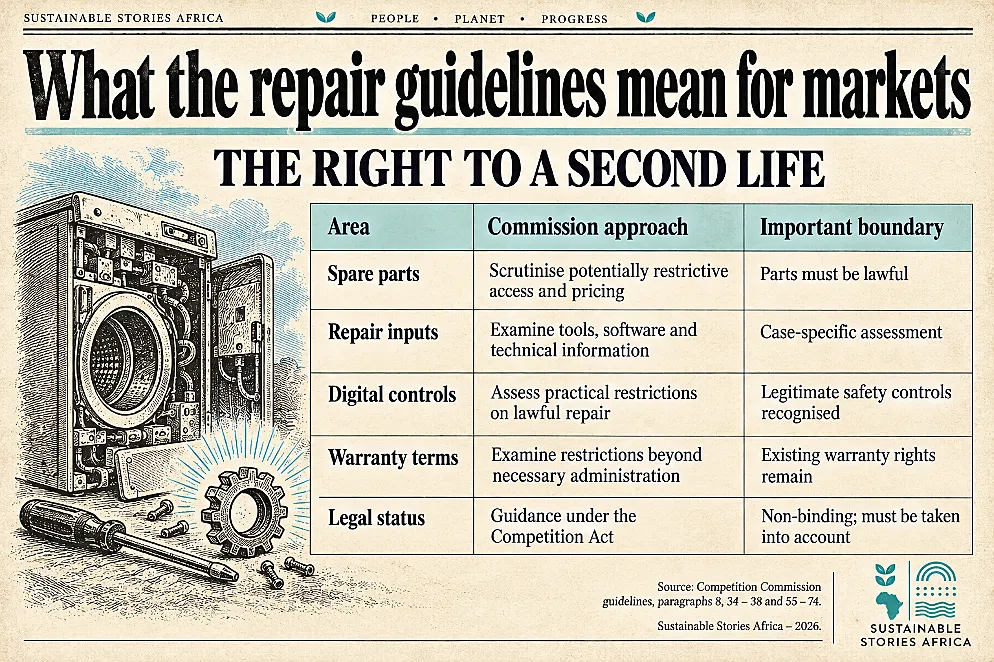
The legal status is important.
- Issued under section 79 of the Competition Act, the guidelines are non-binding, although people interpreting or applying the Act must take them into account.
- They do not establish a separate regulatory framework or create substantive obligations beyond the Act.
The Commission must still establish the relevant legal requirements on the facts of each case.
Longer product lives can support household value
More competitive repair markets could give consumers additional options and allow independent businesses to serve customers who would otherwise face limited choices.
- The potential sustainability benefit concern links to keeping usable products in circulation for longer.
- Neither lower prices nor reduced waste follows automatically from publication, however.
Repair must remain safe and worthwhile.
- The guidelines exclude counterfeit and unlawfully sourced parts and recognise relevant product regulations.
- They also acknowledge that some activation controls and accreditation requirements protect security, personal information or components whose failure could endanger users.
The issue is proportionality.
Access legitimate protection against its purpose and effect, including whether a less restrictive approach is reasonably available.
- This prevents the discussion from reducing repair policy to a choice between unrestricted access and complete manufacturer control.
For other African markets, this is an analytical example of how competition policy can support circular-economy objectives
- It does not establish repair rights outside South Africa or remove the need to examine each jurisdiction’s laws and market conditions.
Firms should review restrictions against demonstrable needs
Manufacturers and importers should examine how their repair policies affect independent providers and consumers.
- The review should cover parts distribution, access to technical inputs, accreditation requirements and the practical effect of digital controls.
- Where restrictions are defended on safety or efficiency grounds, supporting evidence matters.
Independent repair firms should document the barriers they encounter.
- Records of denied access, incompatible tools, unclear requirements or pricing arrangements can help distinguish a general complaint from an identifiable competition concern.
- Consumers also benefit from clear information about repair options and the limits of warranty coverage.
For policymakers, the next challenge is implementing within the existing legal framework.
- Public understanding of the guidelines should not be confused with a promise that every dispute will result in intervention.
- Market characteristics, applicable law and the evidence remain central.
The practical objective is a repair market where necessary protections can coexist with fair opportunities to compete.
Achieving that would support household value, independent enterprise and more responsible resource use.
Path Forward – Make lawful repair practical and competitive
Manufacturers should test restrictions against their stated purpose, while independent providers should document barriers to lawful repair.
The Commission will assess complaints under existing competition law.
Across Africa, the broader lesson is to connect circular-economy ambitions with workable market access, transparent conditions and proportionate safeguards for consumers and product safety.