WMO forecasts a very strong El Niño towards the end of 2026, with an exceptionally high likelihood of persistence through February 2027.
The outlook increases the urgency of preparing for heat, drought and flooding, while recognising that regional impacts differ.
For African governments and businesses, the immediate task is to translate seasonal forecasts into locally informed decisions that protect livelihoods and essential services.
A Strong Forecast Demands Early Preparation
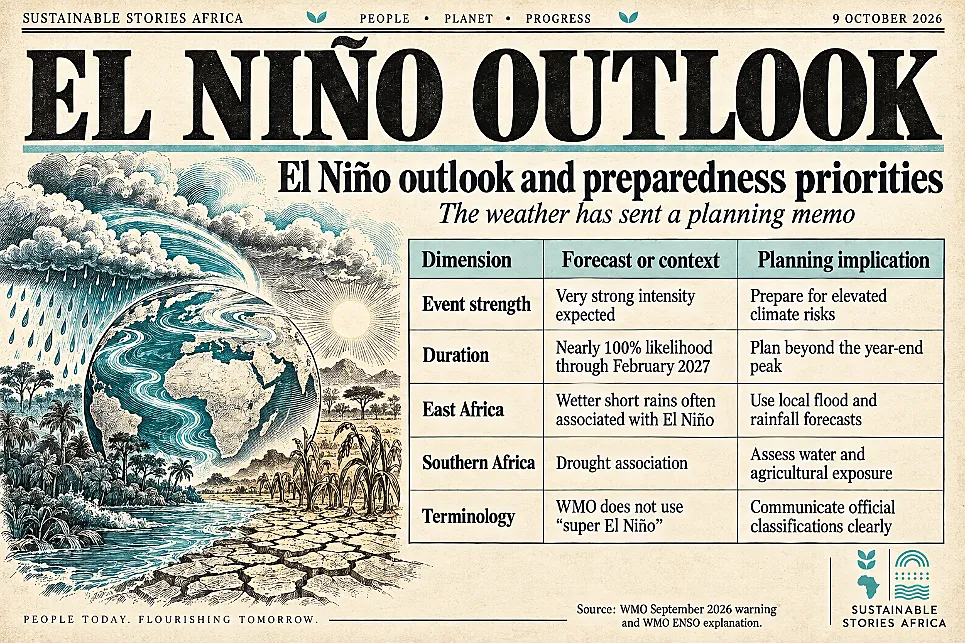
The World Meteorological Organisation (WMO) has warned that El Niño is expected to intensify towards the end of 2026, with climate impacts continuing into 2027.
- Its September update gives a nearly 100% likelihood that the event will persist through February, providing a strong basis for preparedness ahead of the year-end peak.
For African decision-makers, the significance is the lead time.
- Seasonal information can help authorities and businesses prepare before disruption occurs.
- However, only if the forecast reaches those responsible for agriculture, water, health, infrastructure and emergency response.
Regional Impacts Require Careful Forecast Interpretation
El Niño is the warm phase of the El Niño–Southern Oscillation, involving ocean and atmospheric conditions in the equatorial Pacific.
- WMO classifies events by strength and does not use the term “super El Niño”, although it appears widely in public discussion.
The agency explains that impacts depend on intensity, duration, timing and interaction with other climate patterns.
- El Niño is often associated with wetter short rains in East Africa and drought conditions in southern Africa, but these associations do not guarantee the same outcome in every location.
The distinction between a global outlook and a local forecast is therefore essential.
- A high probability of El Niño persistence is not a high probability of a particular flood in a particular district.
- Authorities still need regional and national meteorological guidance to decide what action is appropriate.
WMO’s warning supports readiness; it does not justify treating every possible impact as certain.
Preparedness Can Reduce Avoidable Livelihood Losses
For farming communities, useful information needs to arrive in a form that helps with decisions, not as a distant climate headline.
- The questions include when conditions may change, what uncertainty remains and which options are feasible with available resources.
A local preparedness programme might examine water availability, drainage, storage and access to markets.
- Those are planning considerations, not claims that all African regions face the same combination of risks.
- The objective is to identify vulnerabilities before an extreme event tests them.
Businesses should apply the same discipline to continuity planning.
- A company that depends on climate-sensitive suppliers needs to understand where exposure sits and how a disruption could affect employees and customers.
- Contingency arrangements should be realistic about transport, communication and the time required to restore services.
The potential benefit is not simply avoiding a dramatic disaster.
- Early preparation can also reduce smaller interruptions that can result in lost income, damaged stock or missed access to essential services.
The value of a warning lies in the decisions it enables.
Forecasts Need Budgets And Clear Responsibilities
Governments should link meteorological advice with explicit responsibilities and funded actions.
- A warning system is incomplete if it identifies risk but leaves institutions uncertain about who must respond.
- Preparedness plans should specify the trigger for action, available resources and people responsible for communication.
- They should also explain how messages will reach communities with limited connectivity or literacy, and how local feedback can reveal gaps in the plan.
For financiers and development partners, supporting readiness means looking beyond equipment procurement.
- Forecast interpretation, community engagement and maintenance of response systems are part of the service.
- Judge investment by whether information is usable and action can occur in time.
Public communication must preserve uncertainty without becoming vague.
- Readers should understand what is forecast with high confidence, what varies by region and where to obtain local updates.
- That approach can strengthen trust when conditions evolve, and forecasts are revised.
Path Forward – Convert Seasonal Warnings Into Local Protection
African institutions should use national and regional forecasts to identify priority risks, agree action triggers and fund preparation before disruption occurs.
Communities and businesses need timely updates and practical response options.
The priority is to turn a strong global outlook into locally appropriate protection, while keeping forecast probabilities distinct from guaranteed outcomes.