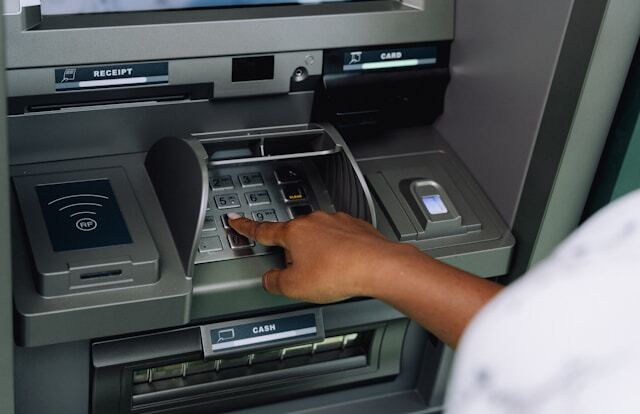
Nigeria’s shrinking ATM network is raising questions about who finances dependable access to cash as customers increasingly use nearby agents.
Techpoint’s reporting identifies reliability and operating costs as central obstacles to rebuilding confidence in bank machines.
The issue reaches beyond payment technology: withdrawal charges, travel and failed transactions affect whether people can use their money when they need it.
Cash Access Remains A Household Concern
Nigeria’s declining ATM footprint is exposing a difficult financial inclusion question:
- Who should pay for reliable access to cash when bank machines are distant, empty or unavailable?
An October 6 report by Techpoint Africa examines the tension between restoring ATM service and the convenience of neighbourhood agents.
The report suggests that a return to machines will depend on dependable service as much as deployment.
For customers, the relevant test is practical: can they obtain the amount they need without spending more on transport, fees or repeated attempts?
Fewer Machines Change The Access Equation
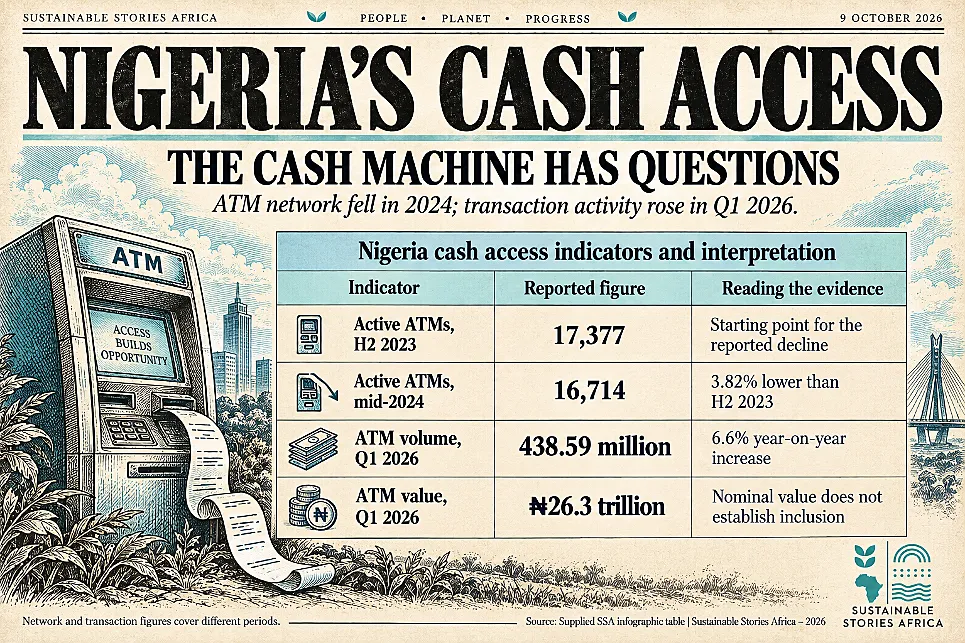
Techpoint reports that active ATMs fell from 17,377 in the second half of 2023 to 16,714 by mid-2024, a decline of 3.82%.
- It also cites Q1 2026 data showing ATM transaction volume rising 6.6% year on year to 438.59 million, while value reached N26.3 trillion.
Those measures describe different things.
- A smaller network can process more transactions, and higher transaction value does not establish wider access.
- It may reflect larger withdrawals, price changes or other factors that require separate investigation.
The report also warns against treating total point-of-sale transactions as a measure of agent withdrawals alone.
- Terminals serve multiple payment purposes, so a change in aggregate PoS activity cannot establish that customers have stopped using agents for cash.
That distinction matters for policy.
- Decisions about access should be informed by where cash is available and what customers pay, rather than by a single transaction headline.
Reliability Determines Whether Convenience Becomes Inclusion
From an inclusion perspective, an ATM and an agent should be assessed as parts of a service network.
- Customers need a dependable choice, and the better option may change with location, time and the amount required.
A low advertised withdrawal fee is of limited value if the customer must pay for a journey and then return without cash.
- Equally, a nearby agent can reduce travel but charge a fee that becomes burdensome across repeated withdrawals.
- Comparing the channels therefore requires the full customer cost, including time and failed attempts.
The central question is whether households can access money without avoidable penalties for where they live or how they earn.
- Banks and regulators should examine the experience of people making small, frequent withdrawals, rather than assume that a channel working for larger transactions works equally well for everyone.
These are implications of the access problem, rather than findings from a new national household survey.
- They point to the information needed to understand whether infrastructure investment delivers a social benefit.
Infrastructure Investment Needs Transparent Service Measures
A credible response would track cash availability, machine uptime, failed transactions and complaint resolution alongside the number of installed ATMs.
- Deployment totals alone cannot show whether a terminal is useful.
Banks should explain how they choose locations and how underserved communities can raise access concerns.
- Agents also need transparent pricing and dependable routes for resolving errors.
- Public oversight should examine both channels without assuming that one must displace the other.
Financing decisions require similar clarity.
- If maintaining cash infrastructure is expensive, the question is how costs are distributed between institutions and users, and whether that distribution supports inclusion.
- A business case should account for the service provided rather than rely only on transaction fees.
The next stage of the debate should therefore focus on functioning access points and customer outcomes.
Digital payment growth does not remove the need to understand the circumstances in which people still need physical cash.
Path Forward – Restore Reliable Access Without Excluding Customers
Banks and payment providers should measure the total cost and reliability of cash access, including travel and unsuccessful withdrawals.
Regulators should use those results to evaluate service improvements.
The priority is a dependable combination of machines and agents, with clear fees and effective redress when customers cannot access their funds.
Culled from: Nigeria's ATMs are disappearing. Who will pay to bring them back?