
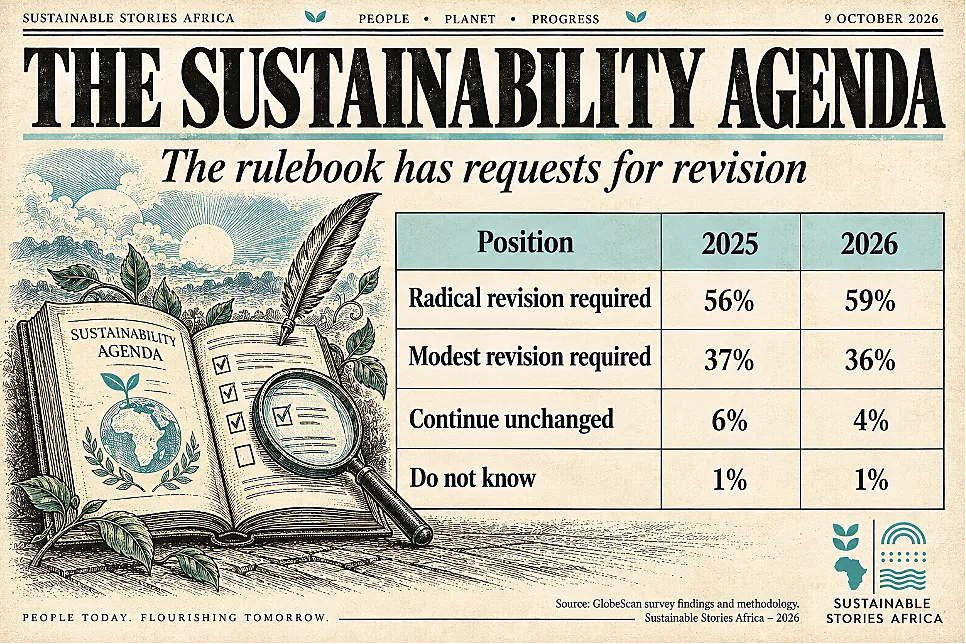
A GlobeScan, ERM and Volans survey finds that 59% of sustainability experts want the current agenda radically revised.
Only 4% believe it works well unchanged, while another 36% favour more modest revision.
The findings challenge businesses and policymakers to examine whether sustainability programmes change decisions and outcomes, rather than simply generate commitments and reports.
Expert Frustration Challenges The Current Approach
Almost six in ten sustainability experts now favour a radical revision of the sustainability agenda, according to findings published by GlobeScan on October 7.
The research, conducted with ERM and Volans, indicates growing dissatisfaction with the pace and direction of change.
- The result is a signal to organisations that publish ambitious sustainability commitments: confidence in the agenda cannot be taken for granted.
For African businesses, the relevant question is whether programmes influence investment, operating choices and stakeholder outcomes, or remain separate from the decisions that determine performance.
Survey Results Show Support For Revision
The survey covered 610 experts in 57 countries between June and August 2026.
- Support for radical revision rose from 56% in 2025 to 59% in 2026.
- Modest revision attracted 36%, while support for continuing unchanged fell from 6% to 4%.
Together, the two revision categories account for 95% of respondents.
The research measures expert opinion, rather than a representative poll of the public or a direct assessment of company performance.
- Its findings should therefore inform debate without being presented as proof that all existing sustainability programmes have failed.
There is also an important distinction between frustration with implementation and rejection of sustainability objectives.
- Wanting a different approach does not establish agreement about which reforms should replace it.
- The survey creates a mandate to investigate barriers; it does not supply a single operational blueprint.
Better Outcomes Require Decisions To Change
For an African manufacturer, bank or telecom operator, the practical implication is to trace commitments into business decisions.
- If an environmental target cannot be linked to a budget, accountable owner and measurable operational change, stakeholders have little basis for judging whether progress is likely.
A more credible approach would identify a small number of material issues and explain the trade-offs involved in addressing them.
- For example, a business seeking to reduce resource use should show how the objective changes equipment purchasing, product design or supplier requirements.
- This is an illustration of decision-based accountability, rather than a finding about a specific company in the survey.
The same principle applies to social commitments.
- An organisation should be able to explain how an inclusion objective affects access, affordability or working conditions, and what evidence would show improvement.
- The benefit is a clearer relationship between what is promised and what people experience.
That clarity can also help distinguish programmes that need redesign from those that need more consistent execution.
- Radical change should be assessed by whether it resolves a real barrier, rather than by how dramatic it sounds.
Boards Should Test Commitments Against Delivery
Boards and executive teams should review where sustainability responsibilities sit and whether those responsible can influence the relevant decisions.
- A communications team cannot substitute for an operational owner when the issue concerns production, financing or employment practices.
A useful review would ask what has changed, what remains blocked, who can remove the barrier and when the next decision will be made.
- Reporting should distinguish completed actions from planned investments and explain missed milestones.
- This allows stakeholders to assess delivery without assuming that every delay invalidates the entire programme.
For policymakers, the challenge is to make reform predictable enough to implement and remain responsive to evidence.
Businesses need to know which outcomes are expected and how progress will be assessed. Communities need ways to question decisions and see whether concerns lead to changes.
The survey’s central value is to reopen that accountability conversation.
Frustration becomes useful when it produces a specific change in how institutions allocate resources and evaluate results.
Path Forward – Replace Broad Promises With Accountable Delivery
Organisations should use the findings to review implementation barriers, assign decision-making responsibility and connect targets with resources.
For African sustainability programmes, the priority is measurable progress on material issues.
Clear milestones, stakeholder feedback and honest disclosure of setbacks can make reform more credible than another layer of commitments.
Culled from: Patience Runs Out on Incremental Sustainability