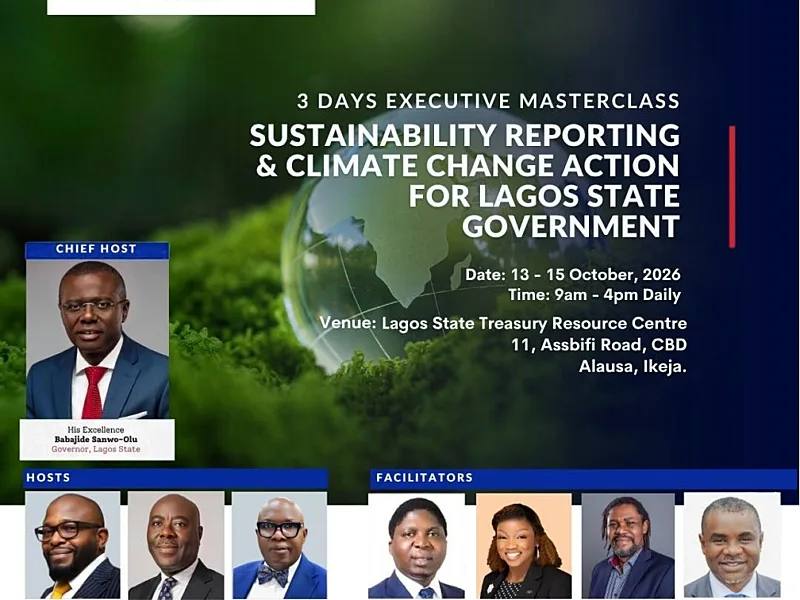
Lagos State’s forthcoming climate programme sets out a practical sequence: plan public investment, report sustainability information and assure the supporting evidence.
Its agenda links climate budget tagging with data governance, performance indicators and oversight of fiscal risk.
The approach will strengthen communication across government, provided the planned exercises become consistent departmental practice after the October 13 – 15 training.
Lagos Sets Out Connected Climate Reporting Curriculum
Lagos State Government’s Climate-Responsive Planning, Reporting & Assurance Programme sets out a three-day learning agenda to link climate priorities with public budgets, sustainability disclosures and oversight.
Scheduled for October 13 – 15, 2026, the training is organised around the sequence Plan, Report and Assure, with ExpertEdge Professionals and ACCA as delivery partners.
The agenda brings functions that often produce different parts of government reporting into one learning framework.
- Its modules move from climate risks and economic planning to MDA data responsibilities and audit procedures.
- This creates a basis for improving the quality of information used to explain climate action across ministries, departments and agencies.
The programme for employees of the Lagos State Government is at the Lagos State Treasury Resource Centre, 11 Assbifi Road, CBD, Alausa, Ikeja. Registration is scheduled from 8 am, with substantive sessions beginning at 9 am and each day ending at 4 pm.
Planning Links Climate Priorities With Budget Decisions
Day one starts with cross-functional thinking and the relationship between climate, the economy and public finance.
- This will address areas including the Lagos climate-risk profile, integration into economic planning, the Medium-Term Expenditure Framework and capital allocation.
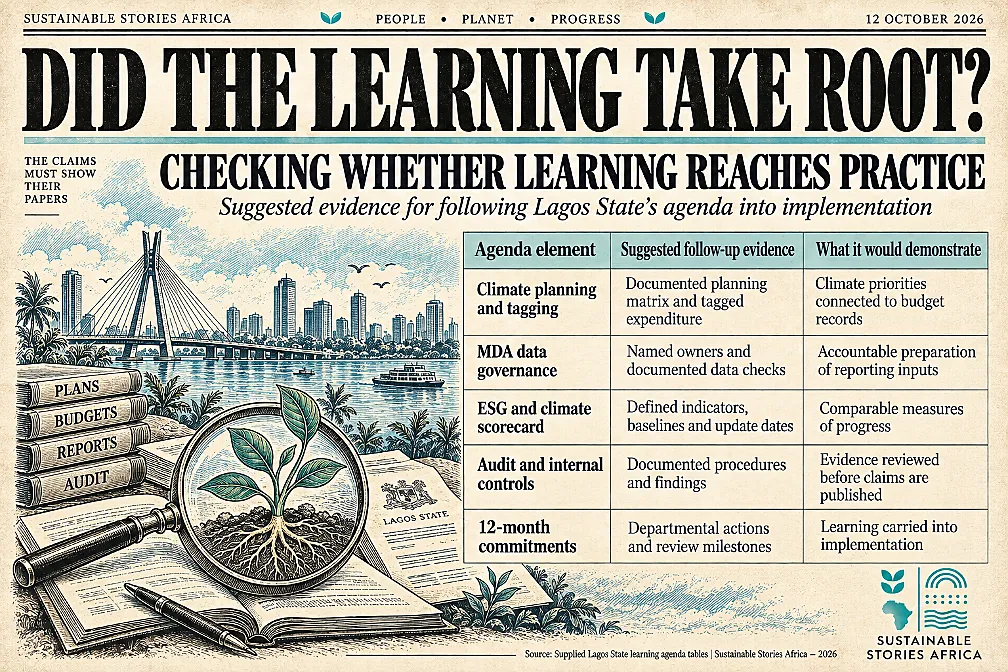
- A climate budget-tagging module focuses on identifying, tagging and tracking climate-related expenditure.
This is the starting point for more informative disclosures.
- If climate priorities are visible in planning records and expenditure classifications, departments can explain the connection between their objectives and resource decisions.
- Without that connection, reports may describe ambitions without showing how budgets support them.
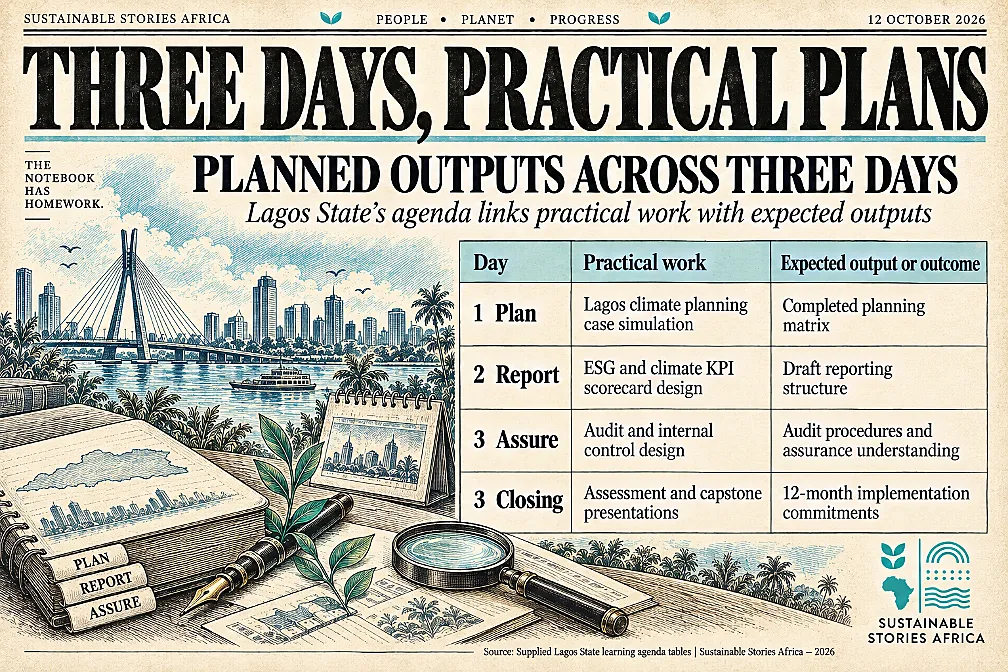
A Lagos case simulation is scheduled to produce a climate-integrated planning matrix.
- The exercise offers participants a way to apply the concepts to a structured planning task.
- Its inclusion makes practical application part of the programme design, while leaving real departmental adoption to the implementation phase.
Reporting Gives Departments A Shared Evidence Framework
Day two looks to designing a Lagos sustainability reporting architecture.
- Participants are scheduled to explore links between financial statements, fiscal data and sustainability disclosures, before considering ESG data governance and MDA reporting responsibilities.
- Establishing data ownership and controls is listed as an expected outcome.
These elements matter because reporting quality depends on how information is generated before publication.
- Departments need to know which records support an indicator, responsibility for submitting them and how inconsistencies are resolved.
- The agenda’s scorecard exercise will help organise that work into a reporting structure.
The proposed ESG and climate KPI scorecard bridges public communication.
- Consistent indicators could make it easier to explain progress over time and relate departmental activity to shared priorities.
- The programme agenda does not publish the scorecard’s final indicators, baselines or targets; these should not be treated as settled.
An interactive ESG and climate reporting challenge and a group workshop are intended to reinforce the concepts.
- Together, they offer a practical learning route for officials who will need to work across technical and administrative boundaries.
Assurance Helps Climate Claims Withstand Public Scrutiny
Day three concentrates on climate-responsive public finance governance, climate risk and fiscal exposure, climate risk audit, internal controls and sustainability assurance.
- Outcomes include clearer reporting and oversight lines, identification of material fiscal risks and developing audit procedures.
For communication, the benefit would be greater confidence in the evidence behind published claims.
Assurance learning can help officials understand what needs checking, where controls are weak and which limitations should be disclosed
- Attending the programme will provide further insight into understanding independent assurance of a future sustainability report.
The closing assessment and capstone presentations are linked to 12-month implementation commitments.
- This creates a follow-through horizon, although the programme materials do not set out the final commitments, responsible departments or review milestones.
MDA leaders should use that horizon to agree how workshop outputs will enter existing planning, finance and reporting routines.
Sharing methods with colleagues will extend the learning beyond attendees and support more consistent climate communication across departments.
Path Forward – Make Departmental Implementation The Shared Priority
The agenda provides a useful foundation for learning across government functions.
Its success depends on departments adopting the planned tools, maintaining reliable records and communicating findings in language residents can understand.
The next step should connect the 12-month commitments with named responsibilities and review milestones.
Publishing evidence of that follow-through would show how Lagos is converting capacity development into better sustainability reporting and climate accountability.