Social psychologist Jonathan Haidt has issued a stark warning about artificial intelligence, attention and childhood development.
In a World Economic Forum podcast, he argued that frictionless shortcuts could weaken learning, relationships and purpose if deployed without safeguards.
His intervention raises an urgent question for African education systems: how can countries capture AI’s productivity gains without outsourcing the difficult practice through which children build judgement and capability?
AI Convenience Meets Human Development Risk
Artificial intelligence may help adults work faster; however, children still need to do difficult things to learn, Jonathan Haidt has warned.
Speaking on the World Economic Forum’s Meet the Leader podcast, the author of The Anxious Generation said societies may have little time to establish safeguards before generative tools become embedded in childhood and education.
“Children have to do hard things thousands of times,” Haidt said, arguing that tools offering to summarise books or write papers can remove the practice through which literacy, attention and independent thought develop.
His language was deliberately severe: he described unchecked shortcutting as a threat to human capital and future flourishing.
Happiness Depends On Relationships Between People
Haidt’s wider argument is not that all technology is harmful.
He distinguished useful technology from engagement-driven platforms and framed happiness as a set of relationships: between a person and work, between people, and between the individual and something larger that provides meaning.
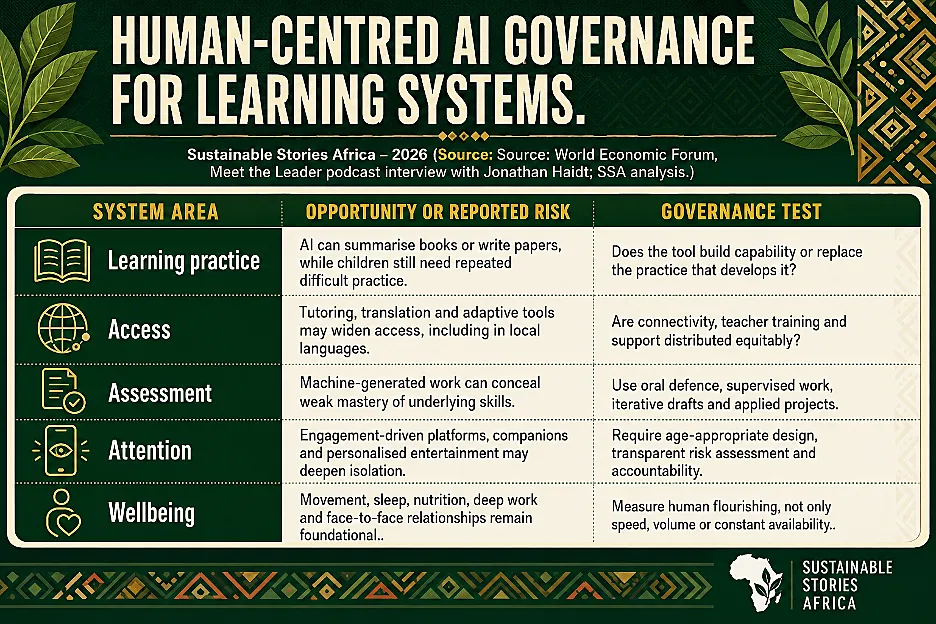
He fears that social media has already weakened shared understanding and that AI companions and personalised entertainment could further isolate users.
These are Haidt’s interpretations, not settled conclusions about every AI application. However, the governance questions are real: who tests child-facing systems, what evidence triggers intervention, and who bears responsibility when design choices create foreseeable harm?
The warning travels quickly into African classrooms.
- AI tutoring could increase access where teacher shortages and crowded classes constrain learning.
- Translation and adaptive tools may help pupils learn in local languages.
However, uneven connectivity, limited teacher training and weak procurement controls could also produce a two-tier system: well-supported students learning with AI, while others merely submit machine-generated work without mastering the underlying skill.
Use AI To Strengthen Human Agency
A better pathway is neither prohibition nor uncritical adoption.
- Schools can use AI to generate practice questions, explain difficult concepts and help teachers plan lessons, while keeping reading, writing, discussion and problem-solving visible.
The test is whether the tool expands a learner’s agency or quietly replaces it.
Haidt also offered practical advice for adults: protect the beginning and end of the day from notifications, remove applications that behave like slot machines and change the environment rather than relying on willpower alone.
He argued that movement, sleep, nutrition, deep work and face-to-face relationships remain foundational.
For employers, the same principle applies.
- Productivity metrics should not reward constant availability or machine-generated volume at the expense of judgement, collaboration and original thought.
AI literacy must include knowing when not to delegate.
Protect Childhood And Demand Platform Accountability
- Governments should require age-appropriate design, transparent risk assessments and meaningful accountability for platforms used by minors.
- Education ministries need procurement standards that assess learning outcomes, privacy, bias and teacher oversight before generative systems scale.
- Parents and schools can establish phone-free learning periods, delay unrestricted social media access and teach children how algorithms compete for attention.
- Universities should redesign assessment around oral defence, supervised work, iterative drafts and applied projects.
These measures do not reject innovation; they preserve the human effort that makes innovation useful.
Path Forward – Keep Human Effort Inside Learning Systems
Africa’s AI opportunities should be based on stronger teachers, more capable learners and wider access, rather than on how completely difficult work disappears.
Policymakers, technology companies, schools and families must build safeguards together, protect childhood development and measure whether AI deepens knowledge.
The durable goal is augmentation: machines extending human capability while practice, relationships, responsibility and meaning remain firmly human.