Written By Eyikojoka Diboku
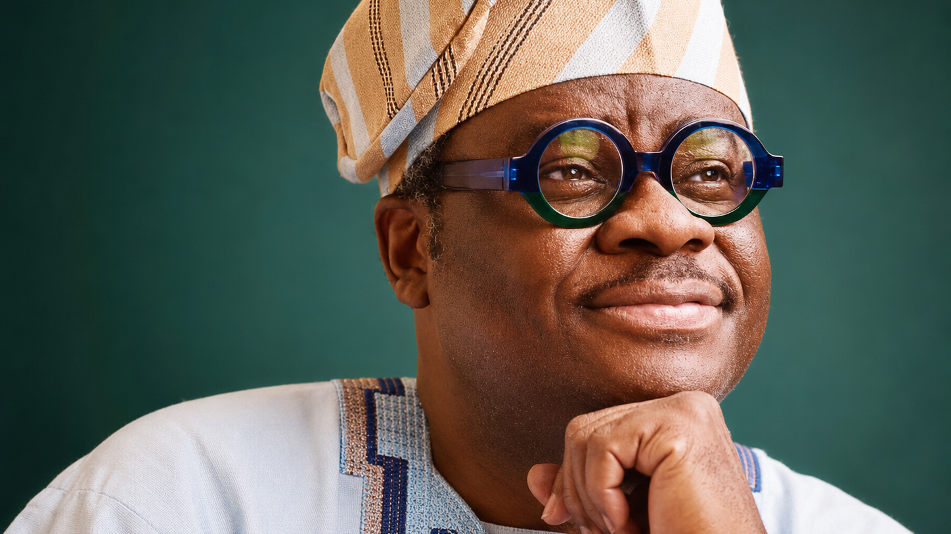
How Dr Kola Adesina Turned a Sales Desk Into a Continental Power Platform - "Kola Adesina did not wait for Africa's energy crisis to resolve itself. He walked into it and started building."
He began not with a megawatt or a mandate, but with a conversation, and the discipline to follow it through.
Dr Kola Adesina's journey from insurance brokerage floors to the commanding heights of Africa's energy sector is one of Africa's most instructive stories of reinvention with purpose.
It matters now because Nigeria's energy crisis is not simply a technical problem; it is a human one. The man helping to rewire it understands, from experience, what it costs when ambition meets no infrastructure at all.
The Room Where Everything Changes
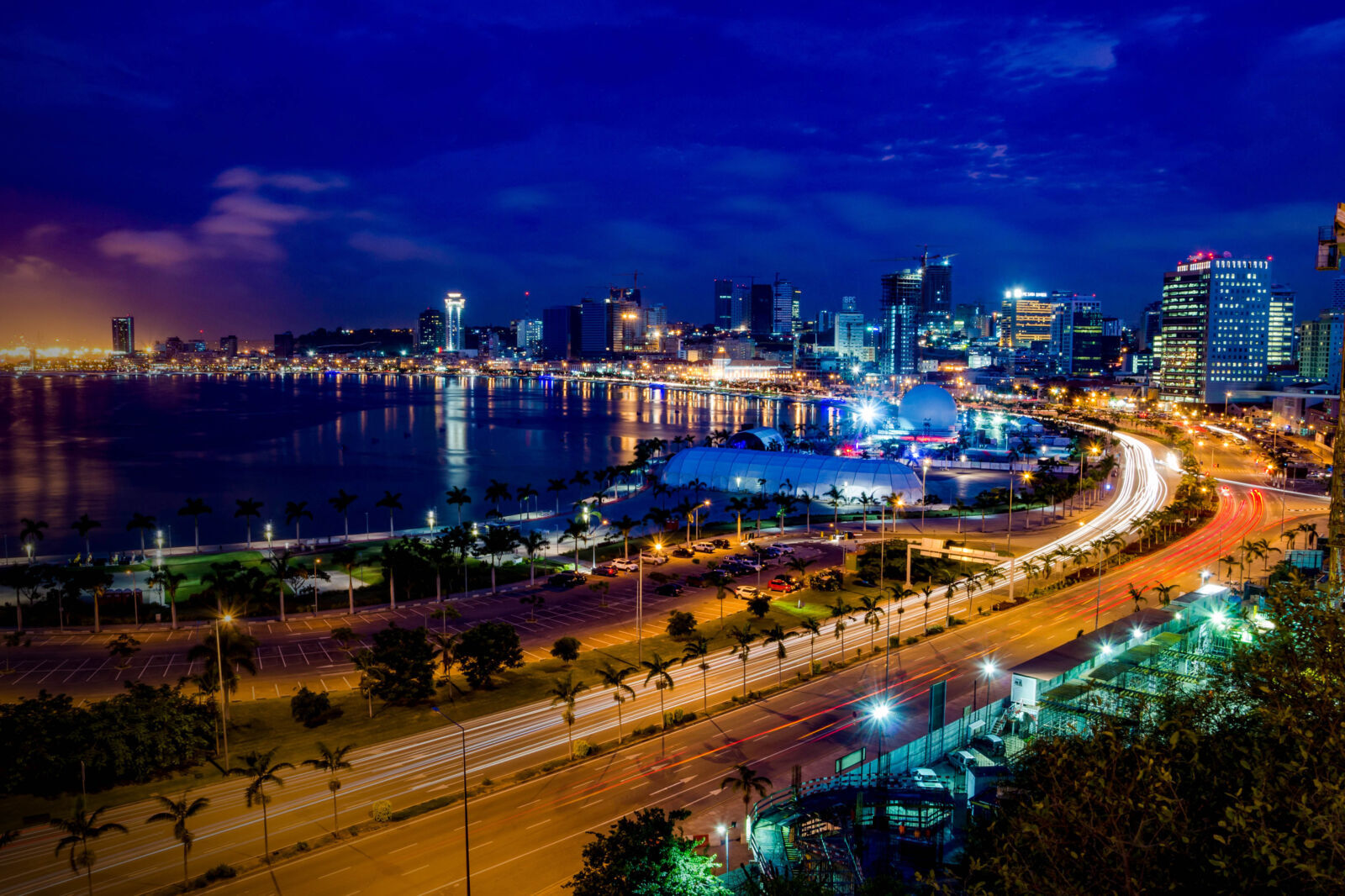
The boardroom is quiet. Outside, Lagos hums with its familiar, relentless energy, generators growling, traffic weaving, a city refusing to slow down despite itself. Inside, Dr Kola Adesina sits with the stillness of a man who has learned to read rooms before he speaks.
He has been in rooms like this before, not always at the head of the table, but always paying attention. That, as he will tell anyone who asks, is where it all began.
Born in 1964, Adesina grew up in Nigeria at a time when opportunity moved on instinct, rather than inheritance.
He built his academic foundation at the University of Lagos, earning a B.Sc. in Insurance, then an M.Sc. in Management, and later a Master's in International Law and Diplomacy.
These were not random choices. They sketched the outline of a man who wanted to understand risk, systems, and the architecture of how nations function.
However, credentials were never the point. What drove him was something quieter and more urgent: the belief that sustainable development begins not in policy papers, but in the willingness to show up and do the work.
That belief would carry him from a sales desk to a seat at the table where Africa's energy future is being decided.
The Discipline That Defines a Life
"Success starts with action, and action starts with observation." Dr Kola Adesina
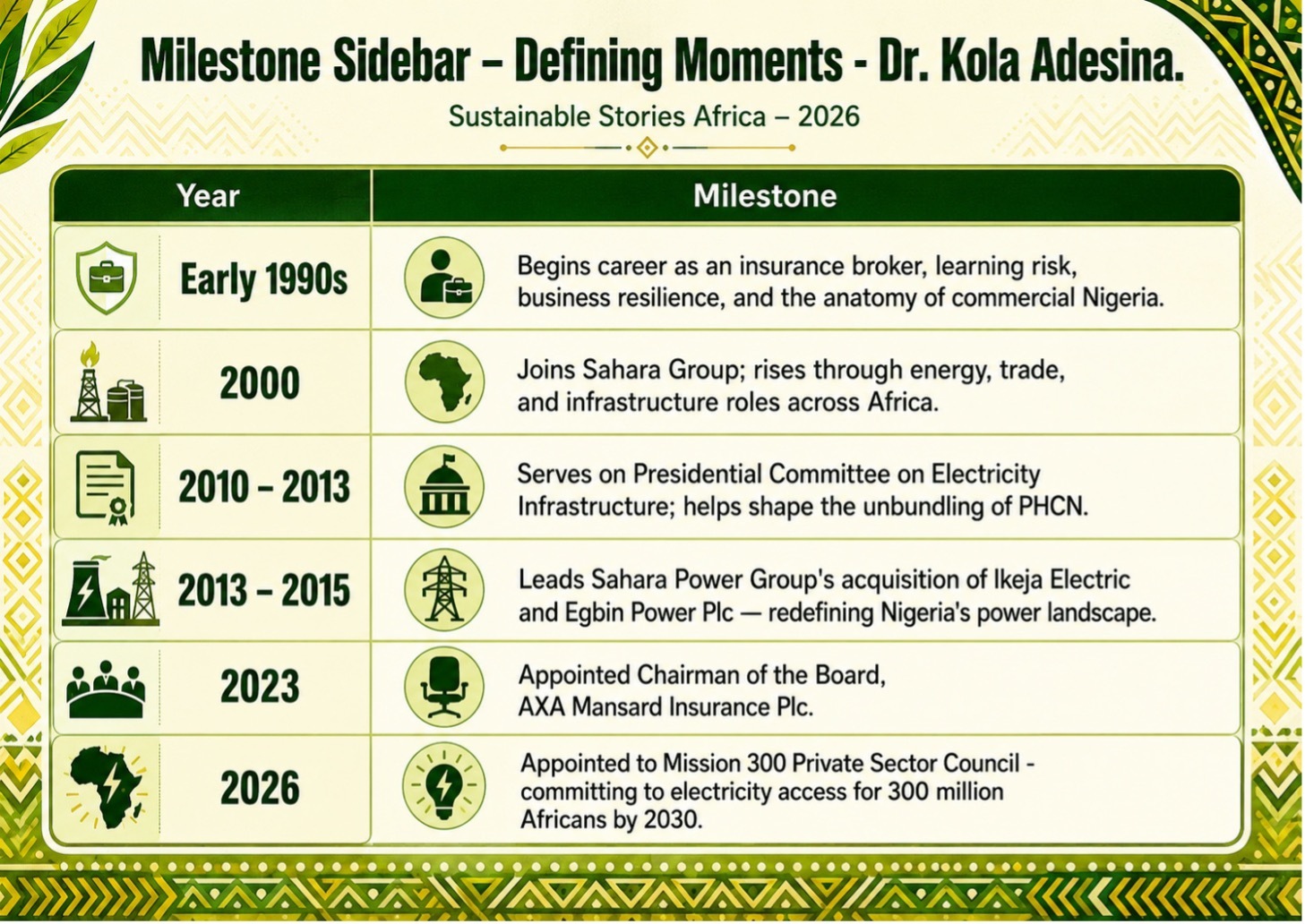
At the beginning, he was an insurance broker. Not an energy tycoon. Not a policy architect.
A man selling cover and managing risk for businesses across Nigeria's varied commercial landscape. It was an unglamorous work in many ways: cold calls, hard conversations, and the slow, instructive art of understanding what people actually fear losing.
However, it gave Adesina something that no executive programme could fully replicate: a granular understanding of how businesses breathe, fail, and survive.
When the opportunity to join the Sahara Group arrived, he carried that understanding with him. His selling skills, combined with what colleagues describe as exceptional project and relationship management acumen, quickly elevated his standing within the conglomerate.
He did not simply execute projects; he saw the connective tissue between them. He understood, early, that energy was not merely a commodity. It was a civic responsibility.
His journey at the Sahara Group was marked by increasingly consequential assignments. He led the nationwide strategic management of fuel supply chains to emergency power plants during the era of Nigeria's National Electric Power Authority (NEPA). He represented the Majestic Oil delegation in the acquisition of the Sierra Leone Refinery.
He managed crude oil contracts in Côte d'Ivoire and served as Director of Infrastructure, responsible for acquiring strategic assets across the continent. These were not stepping stones. They were a curriculum.
Adesina also completed executive education programmes at Harvard Business School and The Wharton School's Advanced Management Programme, not to validate what he had done, but to sharpen what he intended to do next.
The Power He Is Making Real
If there is one chapter that defines the arc of Adesina's purpose, it is the restructuring of Nigeria's power sector, and his role at the centre of it.
He served on the Presidential Committee on the Accelerated Expansion of Electricity Infrastructure in Nigeria under President Goodluck Jonathan.
That committee's work culminated in one of the most significant structural reforms in Nigeria's energy history: the unbundling of PHCN and the emergence of successor companies that brought private capital, accountability, and competition into a sector that had long suffocated under state monopoly.
Adesina did not stop at policy. He operationalised it. Under his leadership as Group Managing Director of Sahara Power Group, the organisation led the strategic acquisition of three landmark power assets: Ikeja Electric, the largest privately owned power distribution business in Sub-Saharan Africa; Egbin Power Plc, the largest thermal power plant in Sub-Saharan Africa, with 1,320MW of installed capacity and expansion plans that would more than double that figure; and First Independent Power Limited.
Together, these assets form the backbone of Nigeria's privatised power ecosystem.
Egbin alone provides a quarter of Nigeria's total generating capacity. That is not an abstraction.
- It is the difference between a factory that can run and one that cannot.
- Between a school with light and one in darkness.
- Between a clinic that can store vaccines and one that cannot guarantee the cold chain.
As Chairman of the Board at AXA Mansard, Adesina has added another dimension to his impact, bringing over a decade of risk management and product development expertise to Nigeria's insurance and financial services sector, creating structures that protect businesses and communities who have historically had the least coverage.
He was crowned the Vanguard Private Sector Icon of the Year in 2022. He holds national honour as a Member of the Order of the Federal Republic (MFR), is an Honorary Fellow of the Nigerian Society of Engineers, and has received honorary Doctorates of Science from both the University of Lagos and Veritas University.
These are not decorative achievements; they are the ledger of a career spent building things that last.
Building the Grid Africa Deserves
The story is not finished. If anything, it is arriving at its most consequential chapter.
In April 2026, Sahara Power Group was named to the Mission 300 Private Sector Council, a high-level initiative launched by the World Bank Group, the African Development Bank, and The Rockefeller Foundation, with the singular goal of delivering electricity access to 300 million Africans by 2030.
Dr Kola Adesina sits on that council not as a figurehead but as an operator who has spent two decades proving that private capital, properly directed, can do what a state monopoly could not.
In the era of the African Continental Free Trade Area (AfcFTA), Sahara Power Group is simultaneously advocating for the digital transformation of Nigeria's national grid, pushing for the deployment of smart meters, sensors, and battery storage systems, and calling on the government to grant import duty waivers on critical digital grid equipment.
It is a vision that connects Africa's immediate energy crisis to the infrastructure of its long-term economic sovereignty.
Adesina is equally vocal on the intersection of ESG leadership and national development. Nigeria's SME sector, worth an estimated $1.3 trillion in potential, cannot be unlocked without reliable, affordable energy and the kind of boardroom discipline that translates governance frameworks into real economic outcomes.
He calls it responsible leadership with structure: the insistence that ESG is not a compliance exercise but a development strategy.
A Legacy Still Being Written
Lighting Africa From the Inside Out
The man who started by selling insurance policies now shapes the energy policy of a continent. That journey — from broker to builder, from sales calls to state reform — is itself an ESG story: the story of an individual who leveraged discipline, access, and vision to create systemic impact at a scale few could have imagined at the outset.
What Dr Kola Adesina is building is not just infrastructure. It is the architecture of possibility, the quiet, unglamorous, essential work of ensuring that Africa's growth story has the power to run.
In a world where sustainability is increasingly understood as the precondition for all other progress, his life's work stands as both proof of concept and standing invitation: that when purpose meets preparation, entire continents can be illuminated.