Written By Eyikojoka Diboku
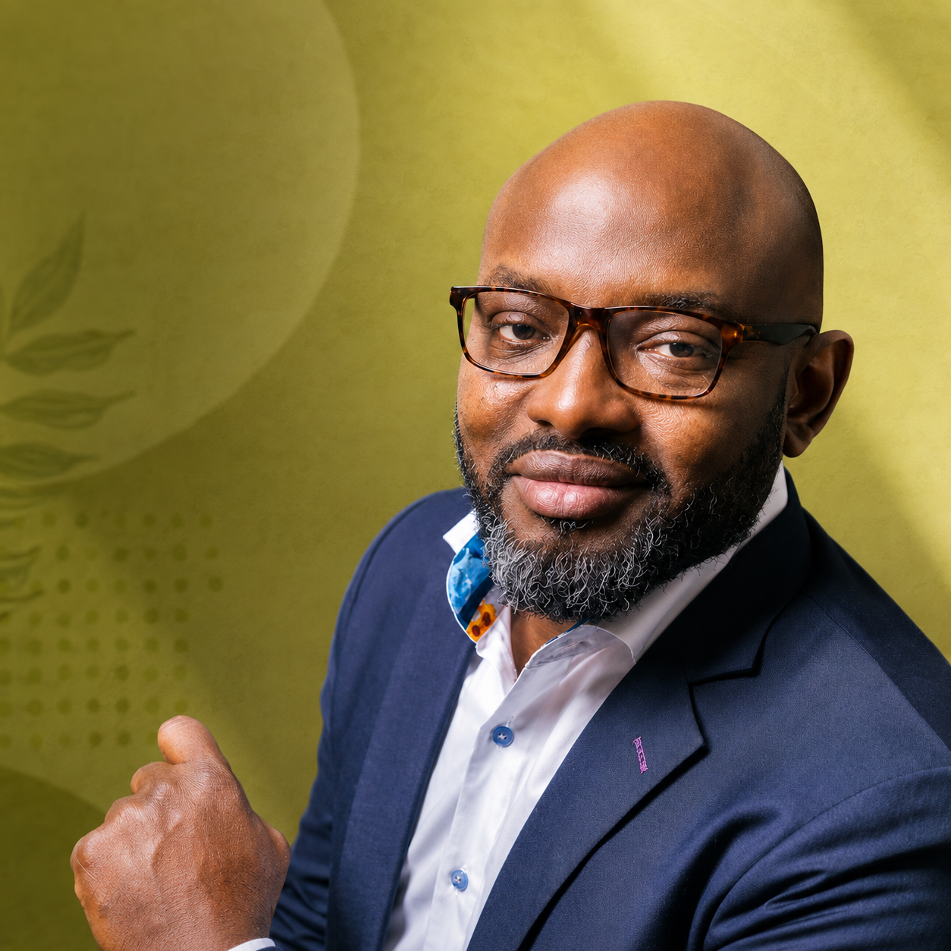
Otome Oyo spent three decades helping the world's biggest brands find their voice in Africa. Then he turned that same skill inward, toward the continent itself, its institutions, and the people inside them.
His is a story shaped not just by boardrooms and brand launches, but by a quiet, persistent conviction that Africa's next commercial leaders are already here, waiting.
In a moment when African markets are navigating the convergence of ESG accountability, economic transformation, and institutional reinvention, Oyo's career offers a compelling answer to a defining question: what does it mean to build, really build, something that lasts?
A Scene Before the Strategy
There is a classroom somewhere in Lagos, not the kind with polished floors and imported furniture, but one worn smoothly by the weight of ambition.
It is here, at the Alphabet Media Academy, that Otome Oyo sometimes finds himself standing in front of a room of young media managers and strategists: people who arrived with big ideas and borrowed confidence, waiting to be told they are enough.
He does not begin with a PowerPoint. He begins with a question.
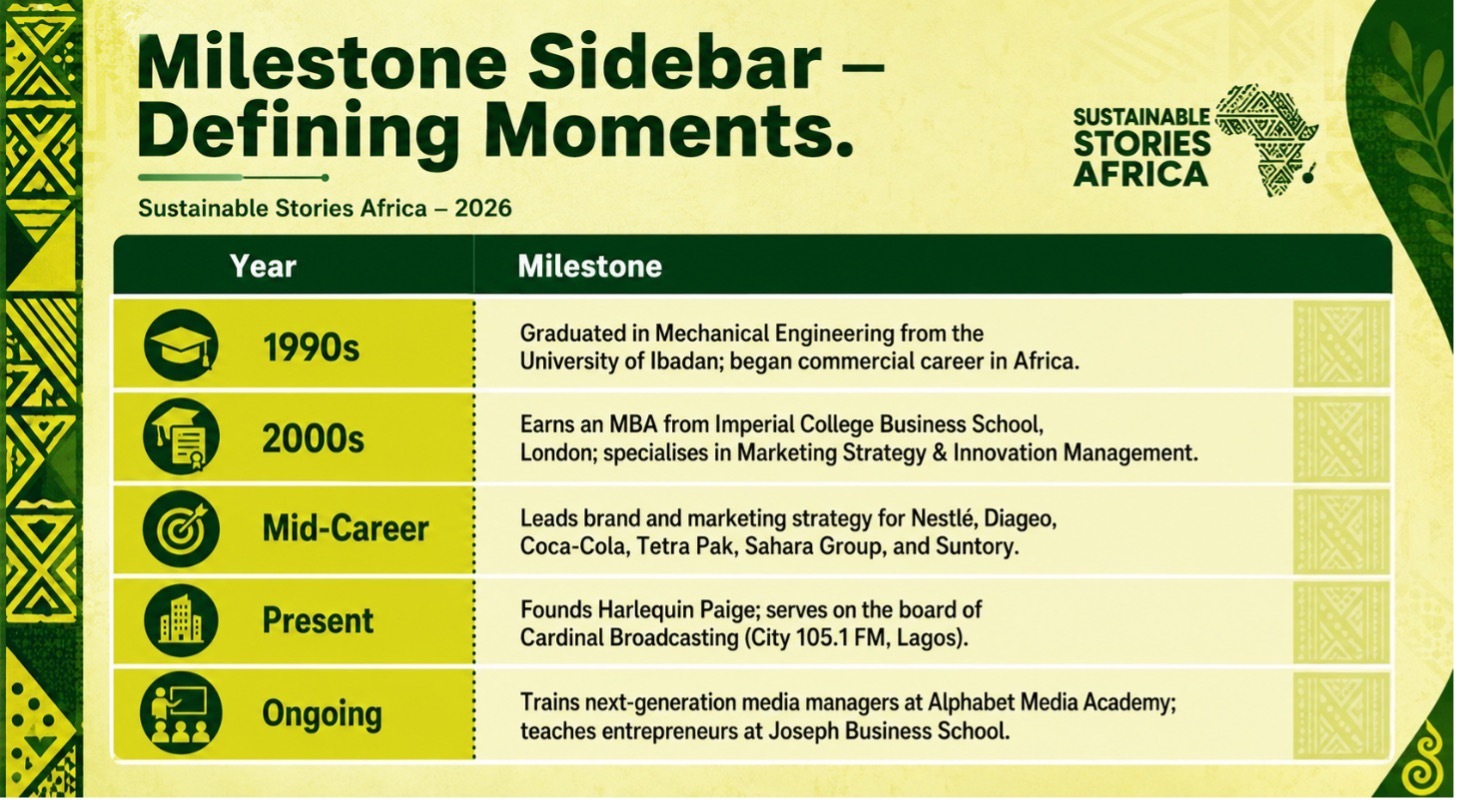
Oyo is a mechanical engineer by training, an MBA graduate of Imperial College Business School in London by application, and a commercial strategist by vocation, a combination that, in retrospect, feels almost inevitable.
He was formed at the University of Ibadan, sharpened by global multinationals, and ultimately drawn back to something that no boardroom metric could fully measure: the development of people.
This is the human thread that runs through his story. Not simply what he built for Nestlé or Diageo or The Coca-Cola Company, but what he chose to build after, and why.
In an Africa hungry for skilled, values-driven commercial leadership, Otome Oyo has made the quietest and most consequential pivot of his career: from selling to serving.
The Man Behind the Global Brands
"Building institutions matters more than building campaigns."
It takes a certain kind of professional courage to walk away from the prestige of multinational brand leadership and redirect your energy toward institutions that the market has not yet fully valued.
Otome Oyo has spent the better part of his career doing exactly that, first building brand equity for some of the world's most recognised names and then reimagining what equity might look like for African institutions themselves.
Over his decades of practice, Oyo has worked with Nestlé, Tetra Pak, The Sahara Group, Diageo, Suntory Beverage and Food, and The Coca-Cola Company. The roster that reads like a syllabus in global commercial excellence.
At each organisation, he led the development of marketing strategies that bridged regional and global scales, solving the perennial challenge that multinationals face in Africa: how to be relevant without being reductive.
His story belongs to the conversation about Africa's commercial and sustainability transformation precisely because of where it is heading.
In an era when ESG demands that businesses demonstrate genuine social value, not just profit extraction, Oyo's career arc from brand strategist to institution builder is both ahead of its time and urgently timely.
The Journey Behind the Story
A Curious Engineer Who Discovered the Power of Narrative
Otome Oyo did not set out to become a marketer. He set out to understand how things work, a disposition that a degree in Mechanical Engineering from the University of Ibadan did not so much instil as confirm.
He has always been a systems thinker: someone who looks at a machine, a market, a community, and asks not just what it does but why it was built that way, and how it could be better.
That analytical rigour carried him into the world of commercial strategy, where he found that the principles of engineering, precision, efficiency, and structural integrity translated remarkably well into brand architecture.
At Imperial College Business School, where he pursued his MBA with a focus on Business and Marketing Strategy and Innovation Management, his thinking grew further. London gave him a framework; Africa gave him purpose.
What followed was a career constructed at the intersection of global standards and African realities.
- For the Food and Beverage sector, he crafted campaigns that understood nutrition and aspiration in the same breath.
- For Oil and Gas, he navigated the complex reputational terrain of an industry that Africa both depends on and must eventually move beyond.
- For Telecommunications, he helped brands speak to consumers whose mobile phones were, in many cases, their first meaningful connection to the formal economy.
Through each chapter, one insight deepened: It was not that Africa's commercial institutions lacked ambition but were often under-resourced in the softer architecture of leadership, strategy, storytelling, and structured thinking.
It is this gap that has come to define the second act of his professional life.
The Change He Is Making Real
When Expertise Becomes Investment in African Futures
Today, Oyo channels his institutional knowledge through two primary vehicles. As Principal Consultant at Harlequin Paige, his boutique consulting firm, he works with African institutions to unlock commercial growth not through imported playbooks but through strategies that are rooted in African realities, calibrated for African markets, and designed to outlast any individual engagement.
However, it is his pro bono work that perhaps most clearly reflects the values beneath the vocation.
- At the Alphabet Media Academy, he trains aspiring media managers and strategists, people who will shape how Africa's stories are told, how its brands are built, and how its institutions are perceived.
- At the Joseph Business School, he teaches marketing strategy and tactics to entrepreneurs who are building from nothing, in markets that offer everything and forgive very little.
The impact is not yet counted in published statistics. However, it is in the graduates who run media operations, in the entrepreneurs who pivoted their positioning and found new customers, in the small institutions that now carry themselves with commercial confidence they did not previously know they had.
These are the compound returns that no balance sheet captures cleanly, but which any serious sustainability practitioner recognises as the foundation of durable economic transformation.
He also serves on the board of Cardinal Broadcasting Limited, the owners of City 105.1 FM in Lagos, a platform that reaches hundreds of thousands of Lagosians daily and carries an inherent responsibility to inform, shape, and reflect the community.
In this role, Oyo brings to media governance the same values-centred rigour he applies everywhere else: that institutions built on public trust must earn and re-earn that trust every day.
"Africa's next commercial leaders are already here. They need someone to show them the architecture of what's possible."
What He Is Building Next
An Architect of African Commercial Leadership, Still at Work
Oyo is not winding down; he is accelerating. Harlequin Paige continues to deepen its focus on African institutions, navigating a commercial landscape reshaped by ESG expectations, digital disruption, and post-pandemic market reconfiguration.
The consulting brief has evolved: clients are not simply asking how to grow, they are asking how to grow responsibly, in ways that generate stakeholder value rather than just shareholder returns.
This is terrain Oyo knows well. Having operated within some of the world's most scrutinised corporate brands, organisations that have had to reckon publicly with their environmental footprints, supply chain ethics, and community impact, he brings to his African clients a literacy in ESG that goes beyond compliance.
He understands that for African institutions, sustainability is not a new department or a reporting obligation. It is a survival language, and getting fluent in it early is a strategic advantage.
He is inviting collaboration: from institutions ready to invest in the commercial capacity of their people, from media organisations that want to align their governance with their public mandate, and from the next generation of African entrepreneurs willing to do the disciplined work of building something that endures.
Path Forward – A Legacy Still Being Written
The Blueprint That Outlives the Builder
Otome Oyo's ambition is clear in its intent, though demanding in its execution: to leave every African institution he engages with more strategically capable, commercially confident, and self-aware. He is, in essence, building human infrastructure, the kind absent from asset registers yet foundational to durable institutions.
In Africa's sustainable development story, the most consequential engineers are not always those building roads or grids. Some build people, quietly, compoundingly, until their work becomes the landscape itself. Otome Oyo is one of those engineers.
People, Purpose & Impact is a Sustainable Stories Africa editorial series profiling the individuals and institutions driving Africa's sustainability, ESG, and development transformation.