
Trust is no longer a soft metric buried in brand sentiment surveys. According to a landmark 2025 study by LinkedIn and Ipsos, surveying 1,500 senior B2B marketing leaders across six countries, 94% of marketers now agree that building trust is the single most important factor for achieving B2B brand success.
For African businesses navigating investor scrutiny, stakeholder scepticism, and a rapidly evolving ESG communications landscape, this finding carries direct strategic weight.
In the Trust Era, the question is no longer what you say; it is whether anyone believes you.
Credibility Has Become a Business Strategy
The most consequential shift in global B2B marketing and corporate communications in 2025 is not technological; it is trust.
LinkedIn and Ipsos' 2025 B2B Marketing Benchmark: Trust Is the New KPI, based on primary quantitative research with 1,500 senior marketing leaders across the US, UK, Brazil, Germany, India, and Australia, delivers an unambiguous verdict: trust is the engine of business performance, not a byproduct.
The report comes at a moment of acute relevance for African businesses. Trust deficits, between corporations and communities, between institutions and investors, between governments and citizens, are among the most consequential constraints on Africa's ability to attract sustainable capital and build long-term stakeholder relationships.
Across ESG reporting, corporate governance, sustainability communications, and investor relations, the credibility of what organisations say is under greater scrutiny than at any point in the continent's modern business history.
The LinkedIn-Ipsos framework offers not just data; it provides a replicable architecture for building trust, measuring and scaling.
The three tools it introduces, the Trust Flywheel, the Trust Maturity Index, and the Trust Funnel, are as applicable to an African development finance institution communicating climate commitments as to a global technology brand managing buyer confidence.
94% Agreement and a 39-Point Performance Gap
The headline statistic demands attention: 94% of 1,500 B2B marketing leaders globally agree that building trust is the most important factor for B2B brand success.
This is not a contested finding; it is a near-universal consensus from senior decision-makers across financial services, technology, professional services, and manufacturing.
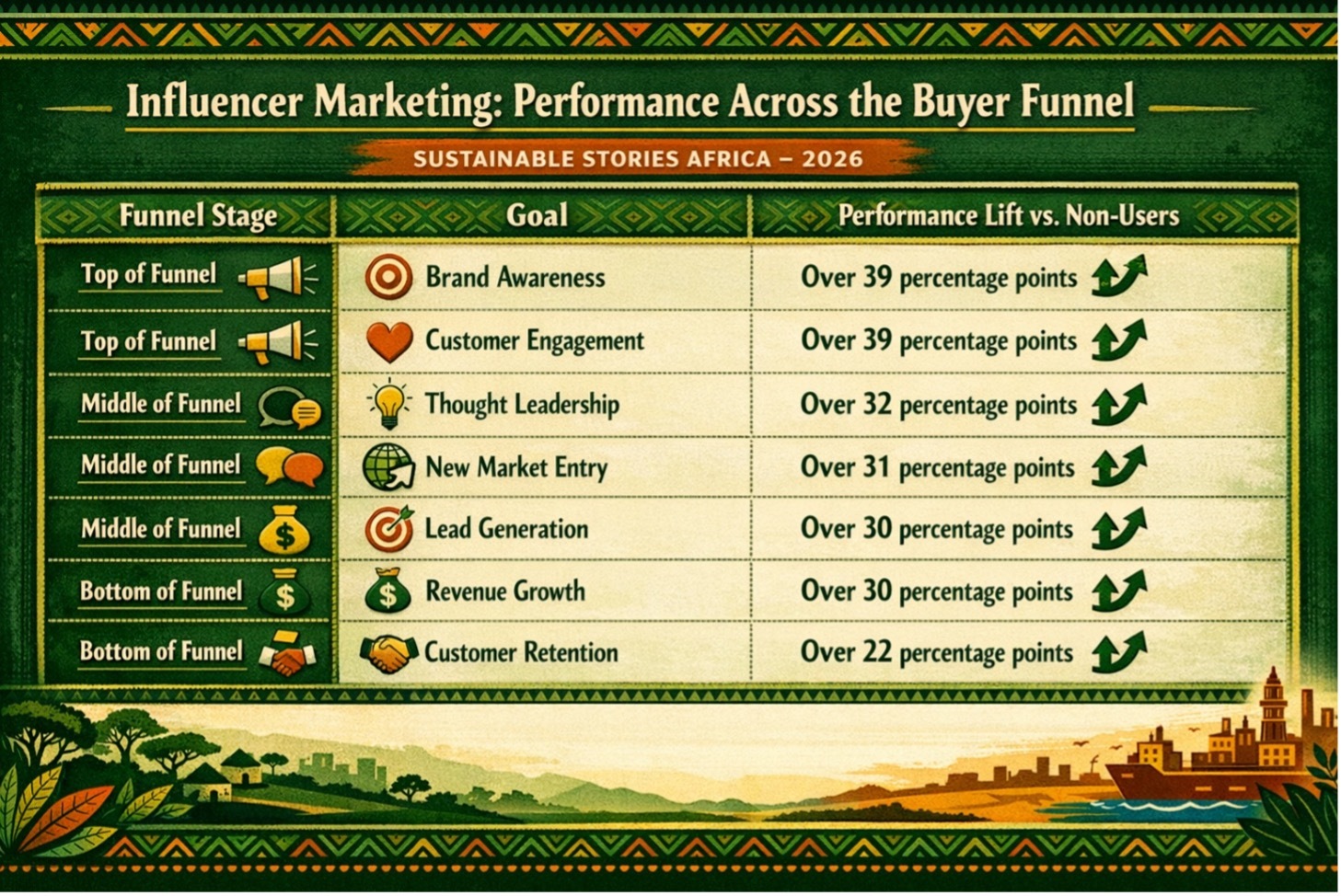
What makes the finding operational rather than aspirational is the performance gap it reveals. Brands that leverage trust-building tools, specifically video and creator/influencer content, outperform non-users by as much as 39 percentage points across key business metrics, including brand awareness, customer engagement, lead generation, and revenue growth.
This is the trust premium: measurable, reproducible, and strategically available to any organisation willing to invest in the mechanisms that build credibility at scale.
What the Data Reveals About Trust, Video, and Influence
The report's findings are built on three interlocking insights.
- Video is now table stakes – Video has become central to B2B communication, with 78% of marketers already using it and 56% planning to increase investment. Short-form social video leads ROI at 41%, ahead of brand storytelling at 38% and testimonials and demos at 34%.
- For African communicators, LinkedIn’s over 44% view-through lift, 2x completions, over 26% brand favourability, and over 19% purchase intent make video a strategic editorial tool.
- Influencer marketing is growing, and trust is why – creator partnerships are becoming more central to B2B communication, with 55% of marketers now using them, and trust emerging as the primary objective ahead of reach, lead generation and awareness.
- When choosing creators, 58% prioritise authenticity and credibility, 49% focus on industry relevance, and 47% value brand alignment.
- Thought leaders and industry analysts perform best at 28%, followed by company customers at 23% and independent creators at 20%.
Influencer Marketing: Performance Across the Buyer Funnel
| Funnel Stage | Goal | Performance Lift vs. Non-Users |
|---|---|---|
| Top of Funnel | Brand Awareness | Over 39 percentage points |
| Top of Funnel | Customer Engagement | Over 39 percentage points |
| Middle of Funnel | Thought Leadership | Over 32 percentage points |
| Middle of Funnel | New Market Entry | Over 31 percentage points |
| Middle of Funnel | Lead Generation | Over 30 percentage points |
| Bottom of Funnel | Revenue Growth | Over 30 percentage points |
| Bottom of Funnel | Customer Retention | Over 22 percentage points |
What a Trust-First Strategy Delivers
The report introduces three frameworks that convert trust from an aspiration into an operational system.
- The Trust Flywheel maps the mechanics: video sparks attention, creators deepen credibility, valuable content delivers on expectations, and advocates amplify the message. At the centre of the flywheel, the asset that compounds across every cycle is trust itself.
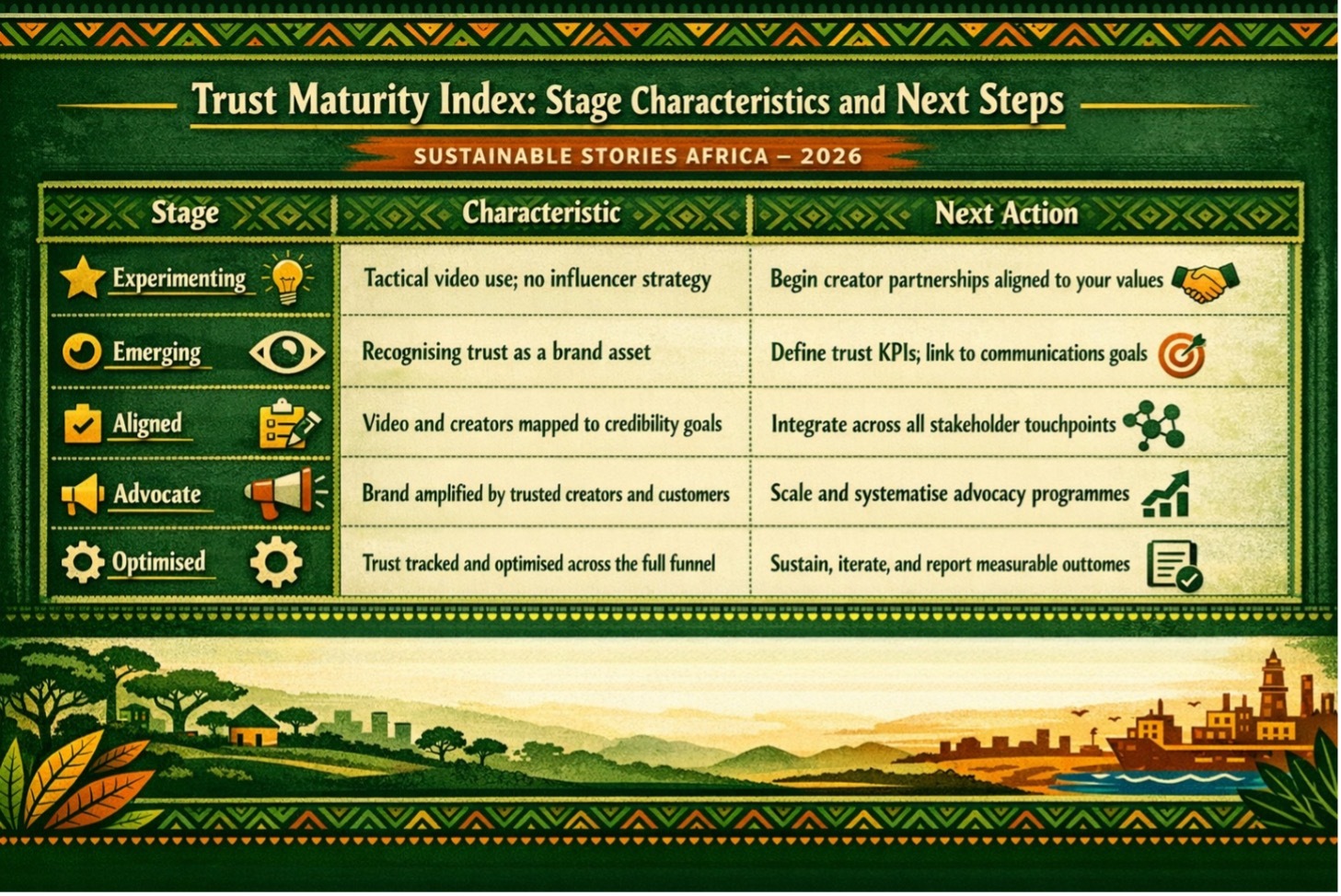
- The Trust Maturity Index benchmarks where an organisation sits on a five-stage spectrum: Experimenting → Emerging → Aligned → Advocate → Optimised. Most African corporations today sit at the Experimenting or Emerging stages: using content tactically, without a coherent trust architecture linking communications to credibility outcomes.
- Moving to the Aligned and Advocate stages, where video and creator voices are mapped to business goals and stakeholder confidence is actively measured, represents the most direct path to sustainable brand equity.
Trust Maturity Index: Stage Characteristics and Next Steps
| Stage | Characteristic | Next Action |
|---|---|---|
| Experimenting | Tactical video use; no influencer strategy | Begin creator partnerships aligned to your values |
| Emerging | Recognising trust as a brand asset | Define trust KPIs; link to communications goals |
| Aligned | Video and creators mapped to credibility goals | Integrate across all stakeholder touchpoints |
| Advocate | Brand amplified by trusted creators and customers | Scale and systematise advocacy programmes |
| Optimised | Trust tracked and optimised across the full funnel | Sustain, iterate, and report measurable outcomes |
Inaction now carries a measurable cost. Companies investing in influencer programmes are widening the gap, with 83% expecting higher budgets compared to 58% of non-users.
In Africa’s competitive markets, that credibility deficit shapes talent, capital and legitimacy.
Assess, Align, Activate
The report's playbook is direct and sequential. For African businesses and communicators, three steps apply immediately:
- Assess – Audit your current content and communications architecture. Where are you building trust, and where are gaps appearing? Map your organisation against the Trust Maturity Index honestly.
- Align – Content strategy must follow the stakeholder journey: short-form video and thought leadership first, customer proof and explainers next, then impact-led case studies where investment, regulatory and community judgements are formed.
Activate — Invest in video and trusted expert voices, with authenticity as the first filter. With 71% of marketers influenced by subject-matter recommendations, Africa’s deep sustainability and expertise in governance can become a powerful credibility asset.
Path Forward – Earn It Before You Need It
Trust cannot be built in the middle of a crisis; it must be earned before pressure arrives. For African businesses, communicating ESG, sustainability and governance reform, the evidence is clear: credibility grows through consistent, human and evidence-backed content delivered by trusted voices.
The tools already exist, and the performance case is settled. The decade’s strongest businesses will be the ones people believe in.