A staggering 251 million children remain out of school globally, a number that has fallen by just 1% since 2015.
Even those who attend school face a learning crisis: three in four children in developing countries cannot read a simple text by age 10.
UNESCO's Global Education Monitoring Report 2024/5 identifies the most often overlooked causes.
Leadership. At every level, including school, system, and political, weak, under-trained, and politically compromised leadership is quietly costing Africa and the Global South entire generations of learning.
Africa's Education Crisis Starts at the Top
The numbers are stark, and they do not lie. Sub-Saharan Africa accounts for more than half of all out-of-school children and adolescents globally, while commanding only 1.6% of global public education expenditure, despite housing 21% of the world's school-age population.
In the continent's poorest countries, only 1 in 10 children can read with comprehension by the end of primary school.
UNESCO's Global Education Monitoring (GEM) Report 2024/5, titled Lead for Learning, is the seventh in this landmark series and the most comprehensive assessment yet of education leadership.
Prepared by an independent team hosted by UNESCO and presented under the mandate of the Education 2030 Incheon Declaration, it examines how leadership, at school, district, system, and political levels, is the single most consequential and most underinvested lever for transforming learning outcomes in Africa and globally.
The report's central argument is direct: there are virtually no documented instances of troubled schools being turned around without the intervention of a good leader.
For African education systems carrying a century of structural debt, this is not an academic observation; it is an operational diagnosis that demands immediate policy response.
A Leadership Crisis Hiding Inside a Learning Crisis
Here is the number that should reframe every education budget debate in Africa: a $100 billion annual education finance gap persists across the world's 80 poorest countries.
However, within that gap lies a deeper structural failure, not simply the absence of classrooms, textbooks, or connectivity, but the absence of well-selected, well-trained, and well-supported leaders to turn resources into results.
"School leaders are second only to teachers for transforming student outcomes," the report states. In the United States, where the most comprehensive research exists, principal and teacher leadership inputs contributed up to 27% of the variance in student outcomes.
In England, replacing an ineffective head teacher with an effective one produced the equivalent of three additional months of learning in primary schools.
In Rwanda, a leadership diploma programme raised examination scores by 0.11 standard deviation, with the greatest impact in rural, poor, and under-resourced schools.
The impact of good leadership is not marginal. It is measurable, and it is disproportionately powerful precisely where Africa's most vulnerable students sit.
The Data Behind the Leadership Deficit
The GEM Report quantifies the scale of the leadership deficit with uncomfortable precision. Key findings include:
- Only 63% of countries globally have open and competitive school principal recruitment processes.
- More than a third of countries do not have open school leader recruitment at all.
- Only 31% of countries have regulations for the induction of new principals.
- Just one-third of all leadership training programmes focus on all four core dimensions: setting expectations, focusing on learning, fostering collaboration, and developing people.
- Education ministers globally have average tenures of under two years, meaning reforms rarely outlast the person who launched them; only 23% of ministers since 2010 have had prior teaching experience.
For Africa specifically, the gender dimension is both a problem and an opportunity. The share of female principals in primary and secondary education is, on average, at least 20 percentage points lower than the share of female teachers, and only 11% of countries globally have measures to address gender diversity in principal recruitment.
However, in francophone Africa, primary school students in female-led schools outperformed peers in male-led schools by 25 points in mathematics and 36 points in reading.
Research in West and Central Africa shows female-led schools have lower teacher absenteeism.
The evidence is clear: more women in school leadership improves outcomes for everyone.
What Well-Led Schools Deliver for Communities and Countries
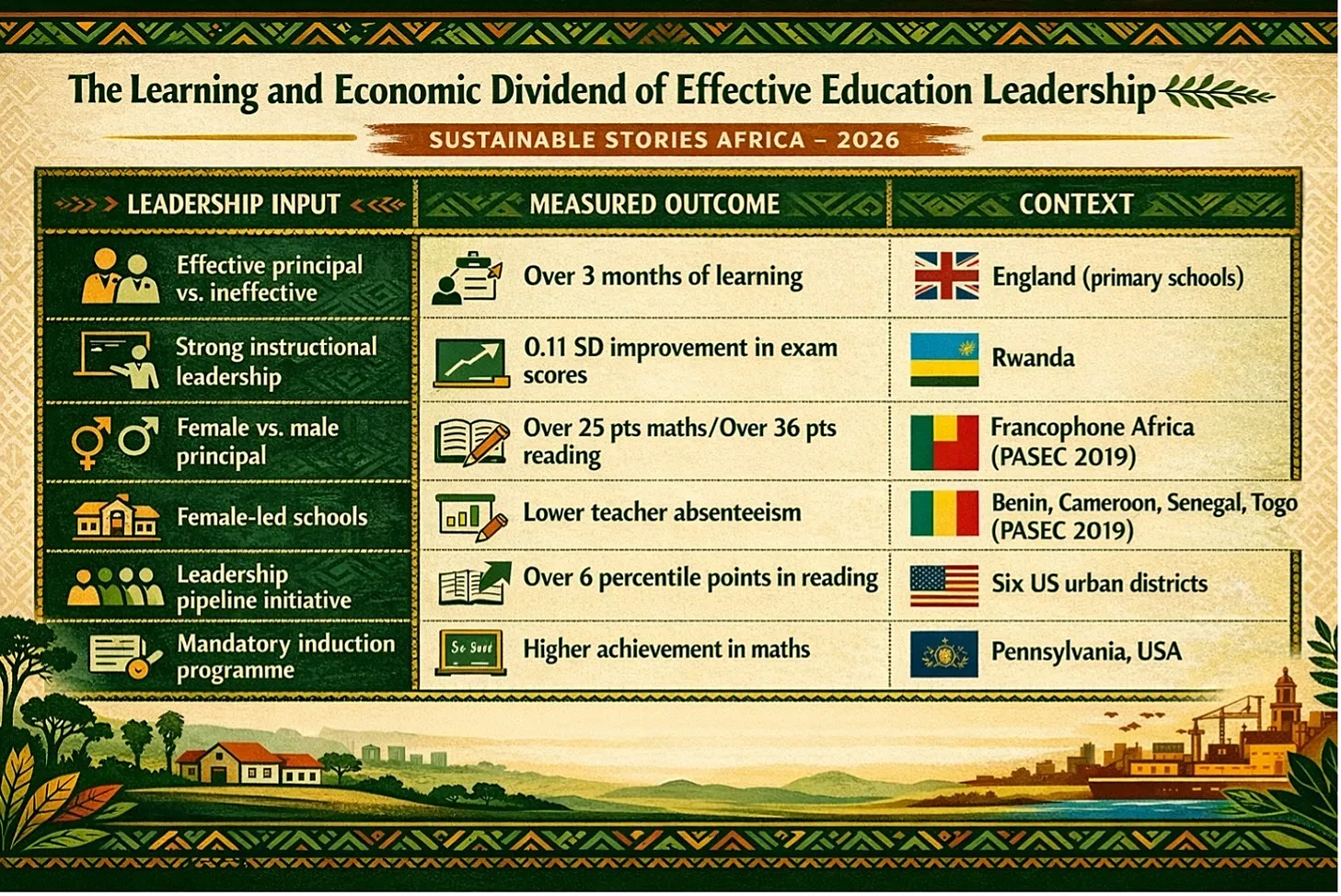
The Learning and Economic Dividend of Effective Education Leadership
| Leadership Input | Measured Outcome | Context |
|---|---|---|
| Effective principal vs. ineffective | Over 3 months of learning | England (primary schools) |
| Strong instructional leadership | 0.11 SD improvement in exam scores | Rwanda |
| Female vs. male principal | Over 25 pts maths / Over 36 pts reading | Francophone Africa (PASEC 2019) |
| Female-led schools | Lower teacher absenteeism | Benin, Cameroon, Senegal, Togo |
| Leadership pipeline initiative | Over 6 percentile points in reading | Six US urban districts |
| Mandatory induction programme | Higher achievement in maths | Pennsylvania, USA |
When education leadership is professionalised, the social and economic returns compound.
Better-led schools mean fewer dropouts, higher completion rates, stronger literacy, and graduates better prepared for a labour market undergoing rapid disruption from climate change and digital transformation.
In Africa, where demographic growth is adding 40 million young people to the workforce annually, the quality of school leadership now directly shapes the continent's economic competitiveness over the next generation.
The report identifies a $1.3 trillion global climate finance market that education has barely tapped.
Mobilising even a fraction of that capital toward climate-resilient, leadership-strengthened schools would create a reinforcing cycle, better infrastructure, better leaders, better outcomes, and a more resilient human capital base for Africa's green economy.
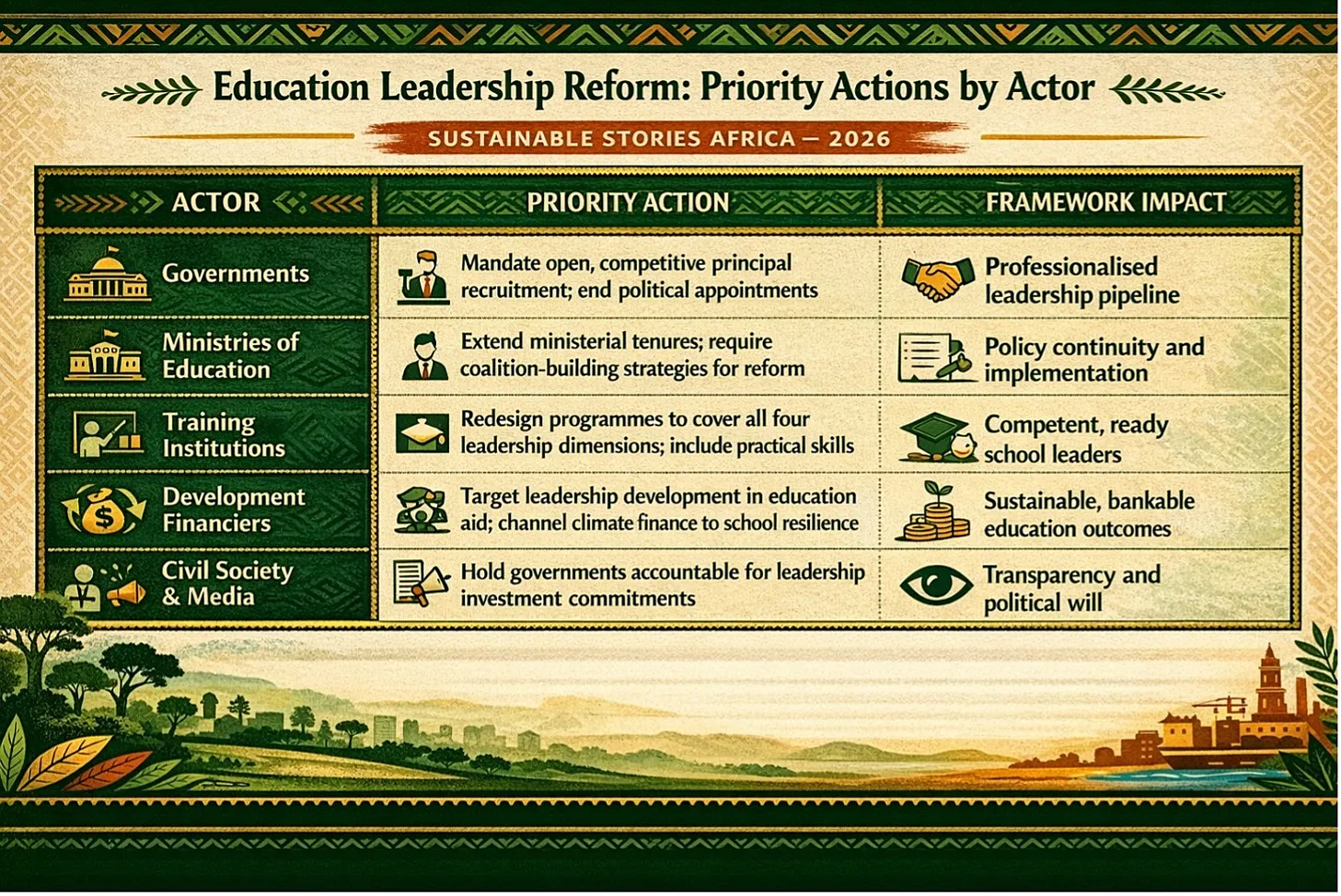
What Must Happen Across Five Actor Categories
Education Leadership Reform: Priority Actions by Actor
| Actor | Priority Action | Framework Impact |
|---|---|---|
| Governments | Mandate open, competitive principal recruitment; end political appointments | Professionalised leadership pipeline |
| Ministries of Education | Extend ministerial tenures; require coalition-building strategies for reform | Policy continuity and implementation |
| Training Institutions | Redesign programmes to cover all four leadership dimensions; include practical skills | Competent, ready school leaders |
| Development Financiers | Target leadership development in education aid; channel climate finance to school resilience | Sustainable, bankable education outcomes |
| Civil Society & Media | Hold governments accountable for leadership investment commitments | Transparency and political will |
The report's recommendations are both specific and urgent. Education systems must shift from heroic individual leadership to systematic processes that attract, train, and retain diverse leaders.
Leadership must be shared with deputy principals, teacher leaders, parents, and communities embedded as active participants in school governance.
Political leaders must be given the tools to build cross-party coalitions for education reform, and civil servants at district and system levels, often invisible in education discourse, must be recognised and empowered as frontline change agents.
Path Forward – Lead for Learning, Now
Africa’s education crisis will not be solved by infrastructure alone, but by backing the leaders who unlock the full value of schools, teachers and students.
The GEM Report’s message is clear: reform recruitment, fund training, lengthen ministerial tenure and distribute leadership across education systems.
Governments, financiers, and civil society must treat education leadership as a core development investment. Africa’s children cannot wait.