Geopolitical risk is no longer a background variable in corporate strategy; it is the defining pressure test of ESG resilience.
From volatile energy markets to fractured supply chains, organisations that treat sustainability as optional are discovering it is, in fact, their most critical architecture for risk management.
The question reshaping boardrooms globally: Is ESG just sustainability reporting or is it a framework for managing strategic risk? has never been more urgent. For Africa, the answer carries billion-dollar consequences.
ESG Resilience – Africa's Strategic Shield
The world's geopolitical fault lines are shifting fast. Armed conflicts in the DRC and Sudan, tensions along critical shipping corridors, trade protectionism, and climate-driven disruptions are no longer discrete events; they are converging shocks testing every link in the global economy.
The World Economic Forum's Global Risks Report 2025 – 2026 identifies environmental, geopolitical, economic, and societal risks as the most deeply interconnected cluster of threats on record.
For Africa, simultaneously navigating rapid industrialisation, energy transition, and exposure to external geopolitical pressures, ESG is emerging not merely as a disclosure obligation, but as a fundamental architecture for resilience.
The framework "Geopolitical Risk & ESG Resilience," advanced by sustainability strategist Subramanian Shanmugam, makes the case with clarity: structured around four operational pillars, sustainability is a strategic part of self-defence.
The stakes are financial, institutional, and human. Companies that fail to embed ESG capabilities face restricted access to the capital market, higher financing costs, regulatory exposure, and an eroding social licence to operate.
Those that do build ESG resilience are measurably better positioned to absorb geopolitical shocks and sustain investor, regulator, and community confidence.
The Risk Framework You Are Missing
Here is the contrast that should concentrate every boardroom's focus: geopolitical risk is at its highest level in decades; however, a majority of organisations still treat ESG as a reporting calendar item rather than a risk architecture.
The Shanmugam framework reframes this entirely. Energy security, supply chain stability, workforce protection, and governance and crisis management are not sustainability aspirations; they are the structural conditions under which businesses survive geopolitical turbulence.
The core question the framework poses is direct: Is ESG just sustainability reporting, or a framework for managing strategic risk? The data increasingly gives one answer.
Four Pillars, Four Pressure Points
- Energy Security. Africa's dependence on volatile fossil fuel imports is a direct financial vulnerability. A diversified energy mix anchored in renewables insulates economies from price shocks, sanctions, and supply disruptions. Decarbonisation is therefore both a climate priority and a resilience strategy. The WEF ranks extreme weather events that directly threaten energy infrastructure among the top three global risks over the next decade.
- Supply Chain Stability. Geopolitical instability, exchange rate volatility, and regulatory uncertainty are among the most significant supply chain risks in Africa today. ESG-aligned supply chains built on responsible sourcing and diversified procurement are measurably less prone to regional disruptions. Companies with ESG-screened Tier 1 suppliers manage instability more effectively than those operating on unverified vendor relationships.
- Workforce Protection. In geopolitically active zones, from the Sahel to the Gulf of Aden, worker safety protocols determine the difference between operational continuity and humanitarian liability. Transparent labour practices and community engagement strengthen social stability and reduce the reputational exposure that increasingly deters institutional capital.
- Governance & Crisis Management. Transparent communication, accountability structures, and robust crisis response frameworks preserve stakeholder trust when uncertainty peaks. Emerging market economies that have strengthened governance and institutional frameworks have held up "remarkably well" during periods of acute global turmoil, according to an October 2025 IMF study.
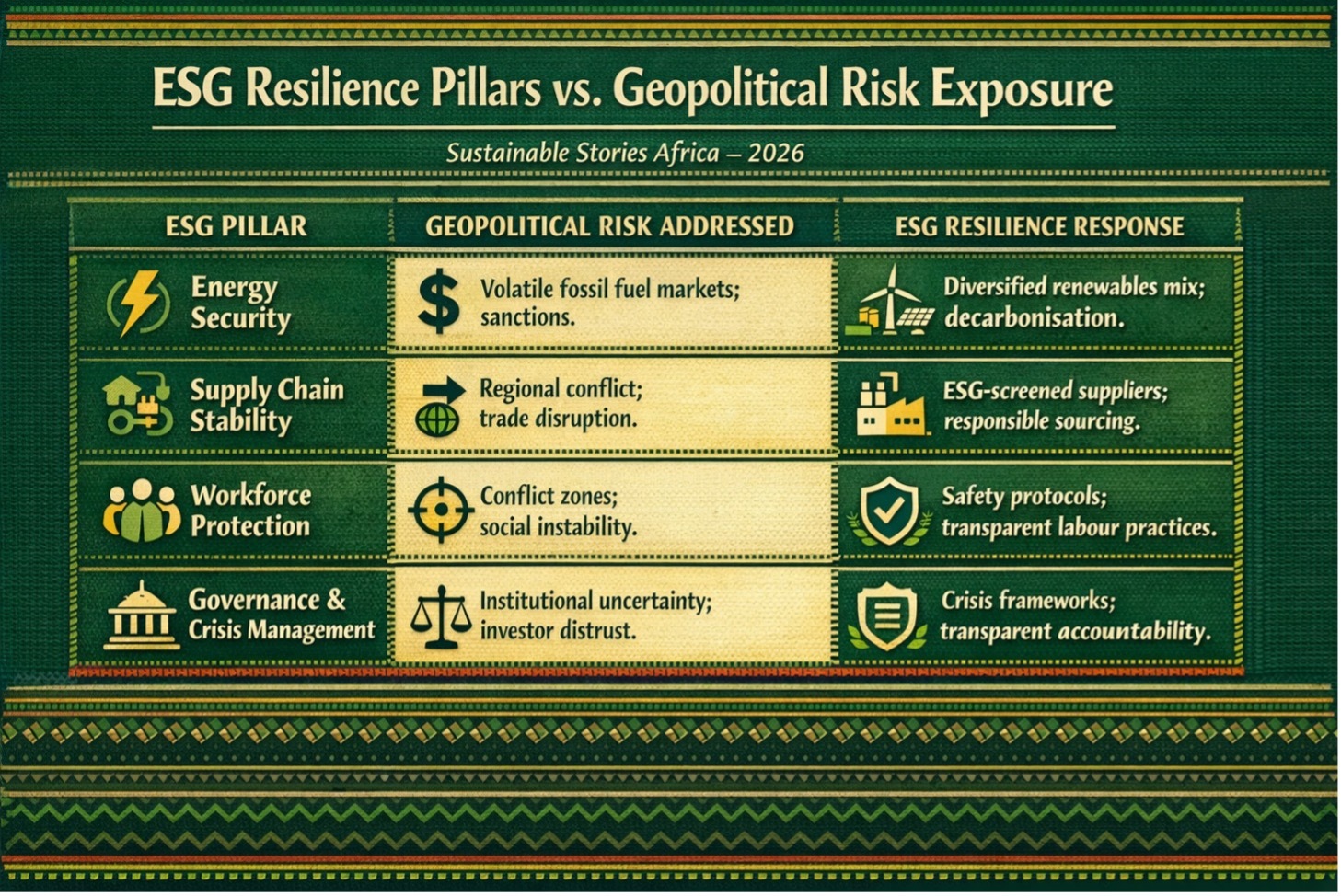
ESG Resilience Pillars vs. Geopolitical Risk Exposure
| ESG Pillar | Geopolitical Risk Addressed | ESG Resilience Response |
|---|---|---|
| Energy Security | Volatile fossil fuel markets; sanctions | Diversified renewables mix; decarbonisation |
| Supply Chain Stability | Regional conflict; trade disruption | ESG-screened suppliers; responsible sourcing |
| Workforce Protection | Conflict zones; social instability | Safety protocols; transparent labour practices |
| Governance & Crisis Management | Institutional uncertainty; investor distrust | Crisis frameworks; transparent accountability |
What ESG Preparedness Actually Delivers
The framework identifies six operational outputs of ESG preparedness that transcend annual reporting: risk monitoring, accountability, supply-chain resilience, energy independence, crisis readiness, and governance transparency.
The business case is compelling. In emerging markets, organisations with strong ESG governance are attracting lower-cost capital, deeper engagement of institutional investors, and stronger access to sovereign and multilateral financing.
For African businesses, ESG integration directly increases access to the AfDB's ESG-linked financing criteria and positions organisations to meet IFRS S1 and S2 standards, reshaping global investor expectations.
The risk of inaction is equally measurable: carbon pricing regulation carries financial exposure of between $2.4 million and $6.0 million for unprepared organisations, supply chain disruptions in Africa's oil sector have eroded multi-billion-dollar asset values during geopolitical shock cycles, and workforce incidents in high-risk zones tend to destroy both productivity and social licence.
Embed ESG Into Risk Management Now
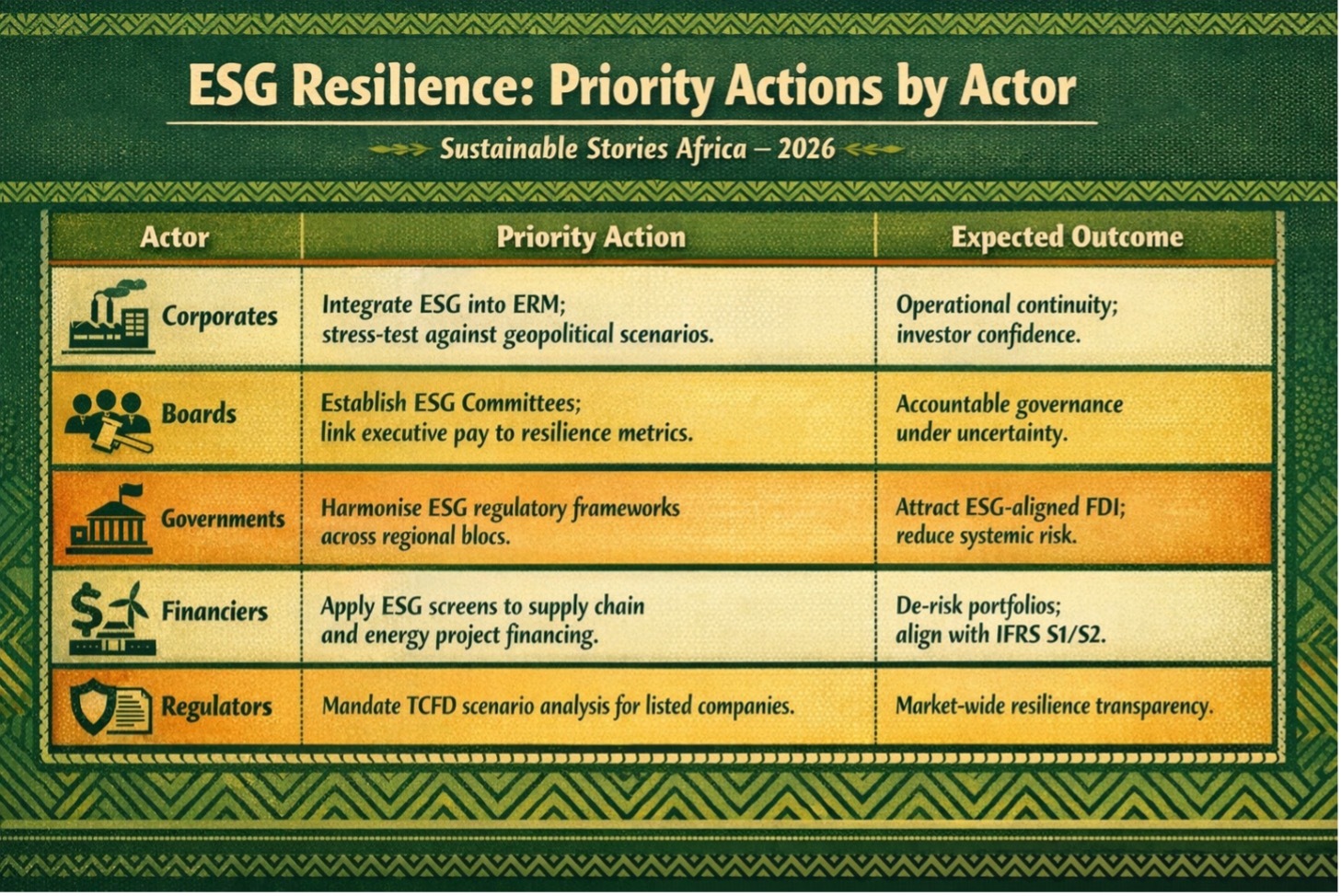
ESG preparedness demands five concrete shifts across institutions:
ESG Resilience: Priority Actions by Actor
| Actor | Priority Action | Expected Outcome |
|---|---|---|
| Corporates | Integrate ESG into ERM; stress-test against geopolitical scenarios | Operational continuity; investor confidence |
| Boards | Establish ESG Committees; link executive pay to resilience metrics | Accountable governance under uncertainty |
| Governments | Harmonise ESG regulatory frameworks across regional blocs | Attract ESG-aligned FDI; reduce systemic risk |
| Financiers | Apply ESG screens to supply chain and energy project financing | De-risk portfolios; align with IFRS S1/S2 |
| Regulators | Mandate TCFD scenario analysis for listed companies | Market-wide resilience transparency |
Path Forward – Resilience Is the Return on ESG
ESG is not a reporting burden; it is a strategic resilience system. The four pillars of energy security, supply chain stability, workforce protection, and governance form the operational architecture Africa's institutions need to absorb geopolitical shocks and convert disruption into competitive advantage.
Governments must harmonise ESG frameworks, boards must own resilience metrics, and corporates must embed ESG into every risk function, not as compliance, but as the structural foundation of long-term viability and inclusive growth in an increasingly fractured world.