The global demand for ESG and sustainability professionals has never been higher. For the first time, Africa's youth-rich workforce is positioned at the centre of this career revolution.
With sustainability roles growing faster than almost any profession, the question is not whether ESG careers have a future, but whether Africa can build the pipeline to claim its share.
The continent's demographic dividend could either become its greatest competitive advantage or its most costly missed opportunity.
The Green Economy Needs You
A structural shift is redefining the global workforce. Across boardrooms, regulators, financial markets and supply chains, demand is rising for professionals who can manage climate risk, governance complexity and environmental accountability with discipline and strategic insight. ESG and sustainability roles are no longer peripheral; they are becoming central to how organisations hire, plan and compete.
For Africa, the timing is especially significant. The continent’s young and fast-growing workforce gives it a potential advantage as green sectors expand, with millions of new jobs expected across renewable energy, sustainable agriculture, green finance and climate-smart construction by 2030.
However, opportunity alone is not enough. Without stronger investment in ESG education, practical skills and career pathways, Africa risks ceding this labour-market transition to imported expertise rather than building its own talent base.
A Career Revolution in Real Time
Between 2021 and 2025, green hiring expanded at twice the rate at which green-skilled workers entered the labour market, exposing a widening talent gap.
In 2023 alone, jobs requiring green expertise rose 23%, while the skilled workforce grew just 12%.
That imbalance is now shaping sectors from finance and infrastructure to agriculture and consumer goods.
The pressure is intensifying as sustainable investment assets expand to $50 trillion, and ESG considerations become mainstream in capital allocation.
Employers increasingly need professionals who can measure, report and communicate sustainability performance.
As a result, ESG careers now span advisory, climate science, engineering, governance, social impact and analytics.
The Six Pathways and What They Demand
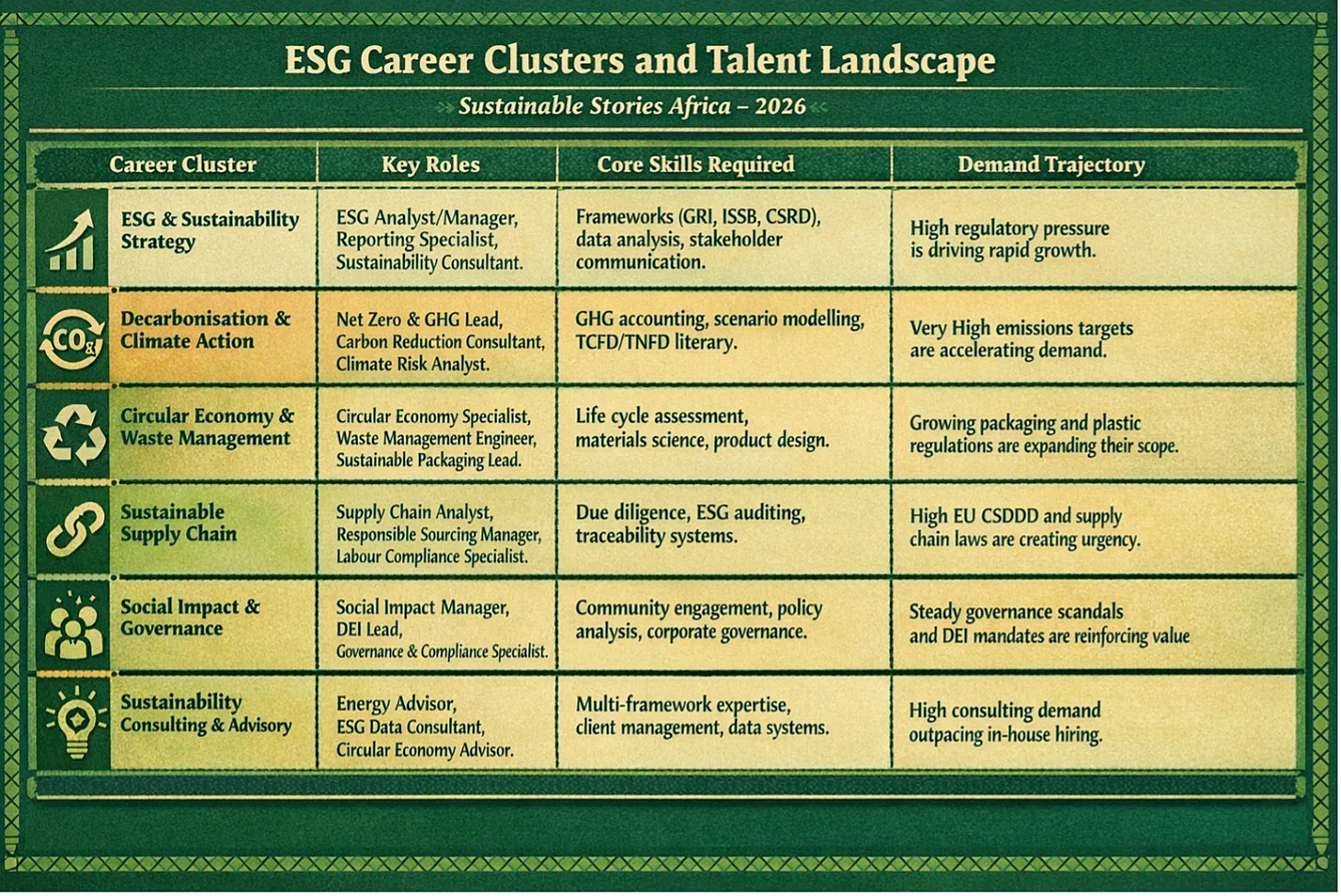
The infographic ESG careers feature maps the professional landscape into six functional clusters, each representing a distinct and growing career trajectory.
ESG Career Clusters and Talent Landscape
| Career Cluster | Key Roles | Core Skills Required | Demand Trajectory |
|---|---|---|---|
| ESG & Sustainability Strategy | ESG Analyst/Manager, Reporting Specialist, Sustainability Consultant. | Frameworks (GRI, ISSB, CSRD), data analysis, stakeholder communication. | High regulatory pressure is driving rapid growth. |
| Decarbonisation & Climate Action | Net Zero & GHG Lead, Carbon Reduction Consultant, Climate Risk Analyst. | GHG accounting, scenario modelling, TCFD/TNFD literacy. | Very High emissions targets are accelerating demand. |
| Circular Economy & Waste Management | Circular Economy Specialist, Waste Management Engineer, Sustainable Packaging Lead. | Life cycle assessment, materials science, product design. | Growing packaging and plastic regulations are expanding their scope. |
| Sustainable Supply Chain | Supply Chain Analyst, Responsible Sourcing Manager, Labour Compliance Specialist. | Due diligence, ESG auditing, traceability systems. | High EU CSDDD and supply chain laws are creating urgency. |
| Social Impact & Governance | Social Impact Manager, DEI Lead, Governance & Compliance Specialist. | Community engagement, policy analysis, corporate governance. | Steady governance scandals and DEI mandates are reinforcing value. |
| Sustainability Consulting & Advisory | Energy Advisor, ESG Data Consultant, Circular Economy Advisor. | Multi-framework expertise, client management, and data systems. | High consulting demand outpacing in-house hiring.. |
ESG roles are becoming one of the fastest-expanding segments of the global labour market.
Sustainability analyst positions are rising quickly, with specialist and environmental protection roles projected to add roughly one million jobs.
Overall, ESG-related roles have grown from about 25,000 globally in 2018 to an estimated 75,000, a whooping 300% growth by 2025, signalling a sharp shift in how organisations value sustainability expertise.
Pay is rising alongside demand. While compensation is highest in the United States and Europe, African markets such as South Africa, Kenya, Nigeria and Mauritius are also seeing stronger benchmarks, especially in finance and extractives.
Increasingly, Africa is not just hiring ESG talent; it is beginning to export it.
What Africa Could Become
If Africa invests deliberately in ESG talent now, the gains will reach beyond individual careers.
It will build a global pipeline of analysts, reporting specialists, and climate-risk professionals, which could create jobs, earn foreign exchange, deepen knowledge transfer and strengthen domestic sustainability capacity.
Localised Green Talent Forum, which drew more than 7,500 mostly African participants, shows both the demand and the scale that digital platforms can unlock.
Replicated across key markets and embedded in universities, that model could reposition Africa as a net exporter of high-value ESG talent.
Without that investment, brain drain will deepen, and domestic firms will fall behind on disclosure and competitiveness.
What Must Move Now
Translating ESG career potential into the African talent reality requires coordinated action across four domains.
- Governments and regulators must integrate green skills into national education and workforce strategies, aligning secondary and tertiary curricula with ESG frameworks, carbon accounting standards, and sustainability reporting methodologies. Countries with credible human capital roadmaps will attract companies seeking cost-competitive, high-quality ESG talent.
- Universities and professional bodies must accelerate the development of accredited ESG and sustainability programmes, partnering with global certification bodies including GRI, the CFA Institute's ESG Certificate, and GARP's Sustainability and Climate Risk (SCR) designation. Practical, industry-linked training, not theoretical compliance courses, will produce professionals employers actually hire.
- Corporations and development finance institutions must invest in structured fellowship programmes, apprenticeships, and graduate recruitment pipelines focused explicitly on ESG roles. They must also resist the default of importing international consultants when local talent gaps emerge and instead participate in building the infrastructure that closes those gaps.
- Young professionals themselves must approach ESG careers with cross-disciplinary ambition, combining finance, data literacy, climate science, and communication skills in ways that make them competitive across sectors and geographies. The most in-depth ESG professionals in 2026 are not single-discipline specialists; they are integrative thinkers who can connect sustainability data to business strategy.
Path Forward – Africa’s ESG Talent Window Is Now
Africa's green career revolution is not on the horizon; it is already underway, and the window to shape its direction is narrow. Building structured ESG talent pipelines, aligning education with industry demand, and connecting African professionals with global employers must become urgent national and institutional priorities.
The continent that becomes the world's ESG talent hub will do more than create jobs; it will gain influence over how sustainability is defined, measured, and valued in the global economy. Africa's youth are ready; the investment in their potential cannot wait.