Global warming is no longer just rising; it is accelerating, according to new scientific analysis. The implications extend beyond climate science into economic resilience, policy urgency, and development pathways, especially for Africa.
With warming rates now exceeding previous decades and the 1.5°C threshold approaching faster than expected, the central question shifts: can global and African systems respond quickly enough to avoid systemic disruption?
Acceleration Redefines Climate Risk Landscape
The latest climate evidence confirms a critical shift: global warming is not only continuing but accelerating at a statistically significant pace.
For policymakers, investors, and communities, this marks a transition from gradual risk to compounding urgency.
Recent analysis shows that, after adjusting for natural climate variability, the rate of warming over the past decade is higher than at any point in recorded history.
This finding reframes climate change from a linear challenge into a nonlinear, accelerating threat with direct implications for economic stability and governance systems.
For Africa and other emerging markets, where exposure to climate shocks is high and adaptive capacity uneven, this acceleration intersects directly with development priorities, from energy systems and food security to financial resilience and ESG integration.
The Climate Curve Is Steepening
The defining insight is stark: the rate at which Earth is warming has increased significantly, with more than 98% statistical confidence, after removing natural variability.
This means recent temperature spikes are not random anomalies but part of a structural shift in the climate system.
The last decade has recorded faster warming than any previous period, with change points identified around 2013 – 2015.
At current rates, global temperatures are projected to exceed the 1.5°C threshold before 2030, far earlier than many policy pathways had anticipated.
For African economies already grappling with climate-linked volatility, droughts in the Horn, flooding in West Africa, and heat stress across urban centres, this acceleration signals a new baseline of risk.
What the Data Reveals and Why It Matters
The study underpinning this shift uses five major global temperature datasets, including NASA, NOAA, and ERA5. It eliminates the influence of short-term natural drivers such as El Niño, volcanic activity, and solar variation.
Once these “noise factors” are stripped out, a clearer signal emerges, warming trends are not just continuing but intensifying.
Key Climate Metrics from the Study
Indicator | Historical Trend | Recent Shift |
|---|---|---|
Average warming (since 1970s) | 0.2°C per decade | Accelerating beyond trend |
Adjusted warming rate (recent decade) | 0.34 – 0.42°C per decade | Highest on record |
Statistical confidence of acceleration | Below 95% (previously) | Above 98% (current analysis) |
Projected 1.5°C threshold breach | Mid-century estimates | Before 2030 |
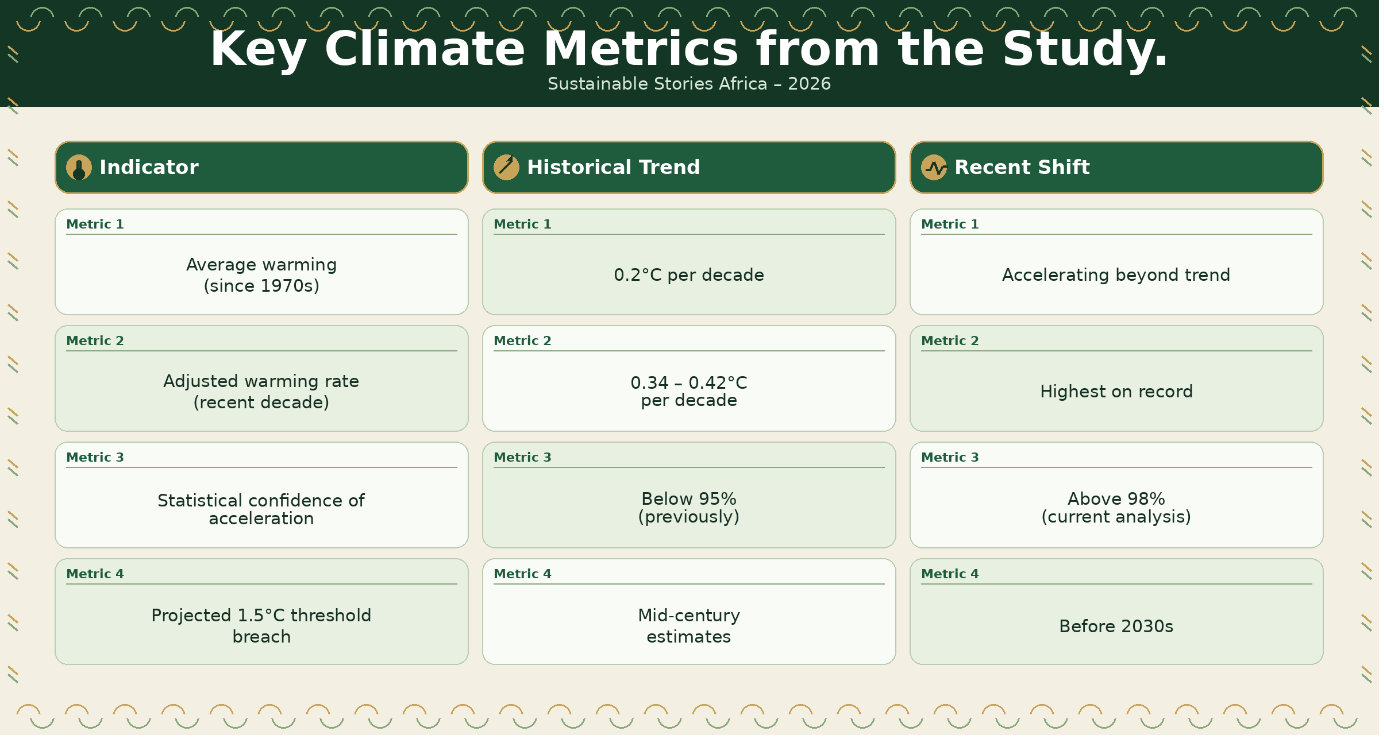
These figures highlight a critical shift: climate change is moving faster than governance and economic systems are currently structured to handle.
The drivers are complex but increasingly understood. A key factor is the reduction of aerosol pollution, historically a cooling agent, which has inadvertently exposed the full warming effect of greenhouse gases. Meanwhile, anthropogenic radiative forcing has increased by roughly 50% since 2000.
For African markets, the implications are immediate:
- Increased frequency of extreme weather events
- Rising costs for infrastructure resilience
- Pressure on agricultural productivity
- Heightened fiscal and sovereign risk
Turning Risk Into Strategic Opportunity
While the acceleration of warming presents systemic risks, it also sharpens the case for strategic transformation.
For governments, faster warming enforces the urgency of climate-aligned industrial policy, from scaling renewable energy to climate-smart agriculture.
For investors, it strengthens the rationale for integrating climate risk into capital allocation decisions.
There is also a significant opportunity for Africa to leapfrog legacy systems. With over 80 million people lacking reliable electricity, distributed renewable energy systems, particularly solar and mini grids, can simultaneously address development gaps and climate goals.
From an ESG perspective, the shift from voluntary reporting to mandatory climate disclosure frameworks (such as IFRS S1 and S2) becomes more than compliance; it becomes a tool for resilience and competitiveness.
The upside is clear: economies that align early with climate realities can unlock:
- Lower long-term infrastructure costs
- Increased access to green finance
- Stronger positioning in global value chains
What Must Happen Now
The acceleration of global warming demands a corresponding acceleration in response. The actions required are no longer incremental; they are structural.
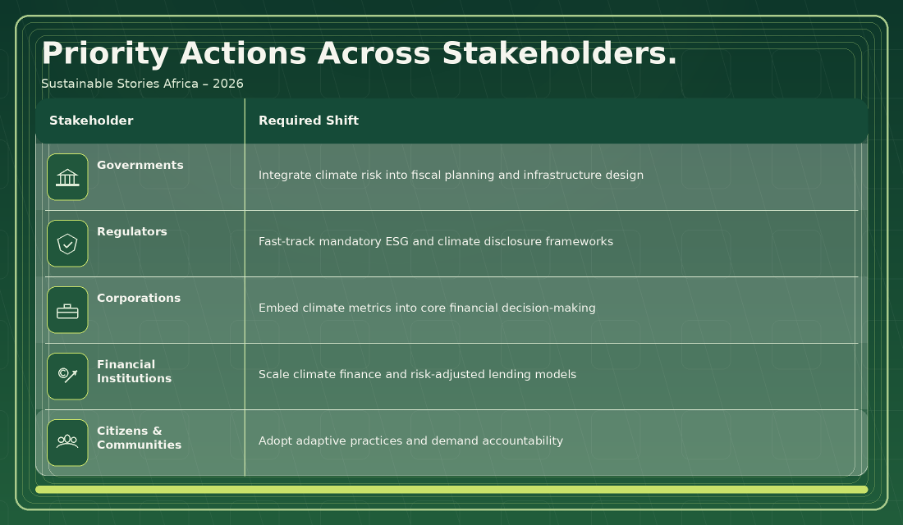
Priority Actions Across Stakeholders
Stakeholder | Required Shift |
|---|---|
Governments | Integrate climate risk into fiscal planning and infrastructure design |
Regulators | Fast-track mandatory ESG and climate disclosure frameworks |
Corporates | Embed climate metrics into core financial decision-making |
Financial Institutions | Scale climate finance and risk-adjusted lending models |
Citizens & Communities | Adopt adaptive practices and demand accountability |
The data underscores a central reality: warming will only stabilise when global emissions reach net zero.
This places Africa at a strategic crossroads, balancing development needs with climate commitments while navigating global capital flows increasingly tied to sustainability metrics.
Path Forward – Accelerating Response, Not Just Warming
Global warming acceleration demands a systemic response that matches its speed and scale. Africa’s policy, financial, and corporate systems must pivot from reactive adaptation to proactive transformation.
The priority is clear: align development pathways with climate realities, embed ESG into economic decision-making, and mobilise capital at scale. The window for gradual transition is closing; what remains is the opportunity for decisive, coordinated action.