
Europe's landmark regulatory framework for ESG rating providers enters full force in July 2026, establishing the most rigorous oversight regime for sustainability scores ever enacted by a major market authority.
As ESMA enforces mandatory authorisation, transparency, and conflict-of-interest safeguards, the question for African and emerging-market players is no longer whether to comply, but how quickly.
For the continent where ESG investment flows are actively reshaping capital allocation, from Nigeria's nascent rating sector to Mauritius' thriving green finance hub, the clock is ticking.
Rules That Reach Beyond Europe
The EU has now moved ESG ratings out of a regulatory grey zone and into a formal compliance regime.
With the ESG Rating Regulation taking effect from 2 July 2026, providers seeking access to the European market face a stricter rulebook, ending years of fragmented oversight and raising the bar for credibility, transparency and market entry.
For Africa, the implications are immediate. Sustainable capital flows into countries such as Mauritius, South Africa, Kenya and Rwanda are expanding, and the continent’s capital markets remain relatively shallow, making access to European institutional finance especially important for growth.
That is why the regulation matters beyond Europe. Its third-country provisions will shape how African rating firms, corporates and financial institutions engage with Europe’s sustainable finance market.
For African market actors, understanding the new framework is no longer optional; it is strategic.
A Deadline That Cannot Be Ignored
From 2 August 2026, ESG rating providers seeking to continue operating in the EU must notify ESMA of their intention to continue, with full authorisation applications due by 2 November 2026.
For smaller providers, the recognition pathway offers a separate route, but the compliance window is narrow, and the regulatory shift is now immediate.
The deeper significance lies in the new operating standard. ESG rating firms must meet stricter rules on independence, conflict management and transparency, including clearer disclosure of methodologies, data sources and assumptions.
For African providers and corporations rated by global agencies, this marks a decisive change in how sustainability scores will be governed, scrutinised and trusted.
What the Roadmap Reveals
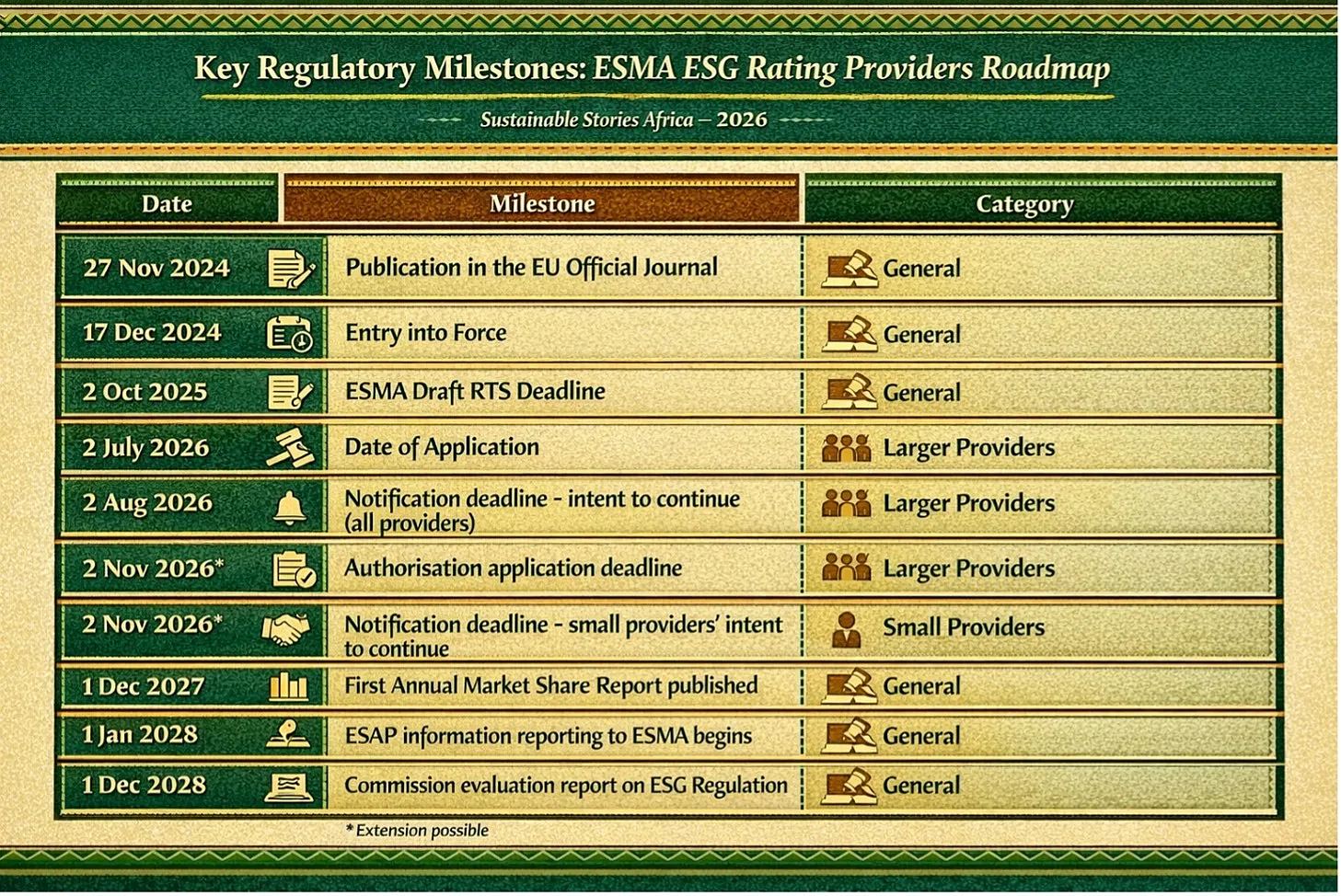
ESMA’s roadmap sets out a phased regulatory transition running from 2024 to 2028. After the ESG Ratings Regulation entered into force in December 2024, ESMA completed draft Regulatory Technical Standards in October 2025 following public consultation.
Those standards define the detailed rules for authorisation, non-EU recognition, conflict-of-interest controls and transparency disclosures.
Key Regulatory Milestones: ESMA ESG Rating Providers Roadmap
| Date | Milestone | Category |
|---|---|---|
| 27 Nov 2024 | Publication in the EU Official Journal | General |
| 17 Dec 2024 | Entry into Force | General |
| 2 Oct 2025 | ESMA Draft RTS Deadline | General |
| 2 July 2026 | Date of Application | Larger Providers |
| 2 Aug 2026 | Notification deadline – intent to continue (all providers) | Larger Providers |
| 2 Nov 2026 | Authorisation application deadline | Larger Providers |
| 2 Nov 2026* | Notification deadline – small providers' intent to continue | Small Providers |
| 1 Dec 2027 | First Annual Market Share Report published | General |
| 1 Jan 2028 | ESAP information reporting to ESMA begins | General |
| 1 Dec 2028 | Commission evaluation report on ESG Regulation | General |
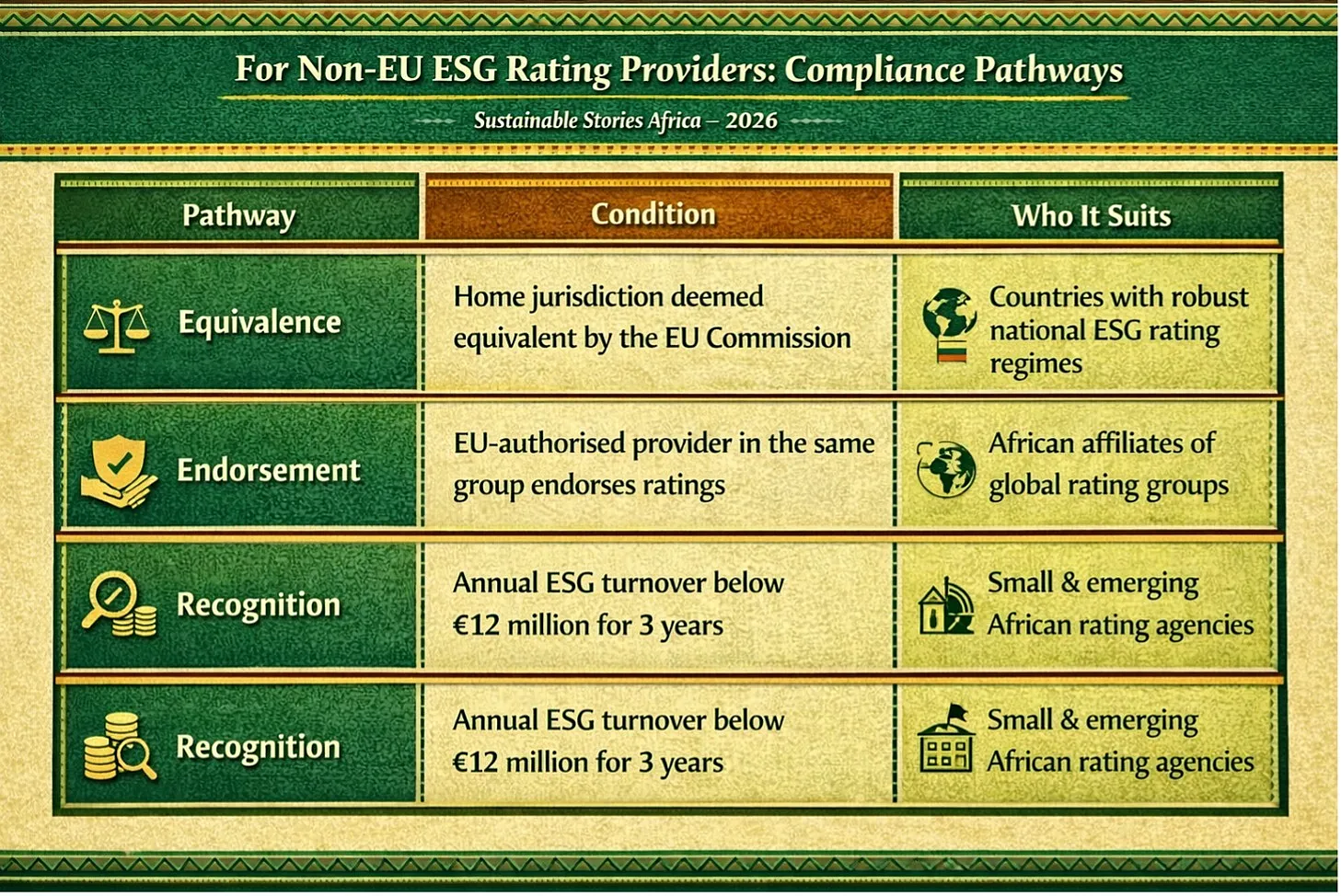
For non-EU providers, including African rating agencies, the EU framework creates three routes into the market:
- Equivalence.
- Endorsement.
- Recognition.
Together, they define how non-European firms can continue serving investors under stricter regulatory oversight, while proportionate fees and exemptions for the smallest providers help reduce entry barriers.
The stakes for Africa are substantial. In Nigeria, local ESG rating providers already see rising demand for credible assessments from international investors, but regulatory misalignment could limit access to Europe’s sustainable finance market.
South Africa faces a related challenge: aligning its comparatively advanced capital markets with EU expectations while navigating the pressures of its own energy transition.
The Opportunity in Compliance
For African market actors willing to move early, the new EU ESG ratings regime is not only a compliance hurdle, but also a strategic opening.
By creating clearer, more transparent and globally comparable ratings standards, the framework gives smaller and more innovative providers a chance to build credibility and compete for institutional capital that has historically flowed to the largest Western agencies.
For an African provider, ESMA recognition, or endorsement through an authorised EU partner, could become a powerful market signal with direct implications for access to European sustainable finance.
The wider opportunity is even bigger. As ESG investment flows into Africa continue to grow, regulators and capital market authorities that align domestic frameworks with emerging global standards can position their markets more competitively.
By doing so, the continent can shift from being seen as a regulatory exception to becoming a stronger destination for sustainability-focused investors.
What Must Happen Now
The space for reactive compliance is narrowing. African regulators, including market authorities in Nigeria, Kenya, Ghana and South Africa, need to urgently assess how the EU framework will affect domestic ESG rating activity and cross-border capital flows.
At a minimum, they should determine whether local oversight regimes could eventually meet the conditions for EU equivalence.
For Non-EU ESG Rating Providers: Compliance Pathways
| Pathway | Condition | Who It Suits |
|---|---|---|
| Equivalence | Home jurisdiction deemed equivalent by the EU Commission | Countries with robust national ESG rating regimes |
| Endorsement | EU-authorised provider in the same group endorses ratings | African affiliates of global rating groups |
| Recognition | Annual ESG turnover below €12 million for 3 years | Small & emerging African rating agencies |
African corporations need to act quickly: verify whether the ESG rating providers assessing them hold ESMA authorisation, understand disclosed methodologies and prepare for stricter transparency demands for sustainability data.
Investors and development finance institutions must also update due diligence, ensuring ESG ratings used in decisions come from authorised or recognised providers.
Path Forward
The EU ESG Rating Regulation is not a distant European concern; it is a present African business reality.
With the July 2026 application date now passed, the authorisation clock running, and the first ESMA market share report due in December 2027, African markets face a narrow window to align, adapt, and advocate for fair access to the global sustainable finance system.
The path forward demands coordinated action across regulators, capital market bodies, rating providers, and corporate issuers. Africa cannot afford to be rated on terms it did not help to shape. The continent's growing ESG investment story deserves infrastructure, standards, and recognition to match its ambition.