ESG, CSR, and the UN Sustainable Development Goals are the three most cited frameworks in global sustainability; however, they are routinely conflated, misapplied, or treated as interchangeable. They are not. Each plays a distinct and non-negotiable role.
For African businesses navigating investor scrutiny, regulatory acceleration, and development imperatives simultaneously, understanding where ESG, CSR, and the SDGs diverge and converge at the core of sustainability is the difference between strategic leadership and costly confusion.
Same Language, Different Roles Entirely
Sustainability is no longer a reputational strategy; it is the structural condition for long-term business viability in Africa and globally.
However, the three frameworks designed to advance it, Environmental, Social and Governance (ESG), Corporate Social Responsibility (CSR), and the United Nations Sustainable Development Goals (SDGs), are routinely conflated in boardroom discussions, investor decks, and policy documents.
The ESG vs CSR vs SDGs framework, developed by sustainability strategist Vishal Pagar, resolves this confusion with analytical clarity.
Represented as three interlocking circles unified at sustainability's centre, the framework maps each instrument to its distinct function: ESG measures performance, CSR drives action, and the SDGs set the global direction.
Together, they are not competing frameworks; they are interdependent layers of the same architecture.
For African businesses, where ESG credentials now determine access to capital, where CSR commitments shape social licence to operate, and where SDG alignment increasingly drives multilateral financing decisions, mastering all three is not academic. It is existential.
Three Frameworks, One Dangerous Confusion
Africa's ESG, CSR, and sustainability landscape are accelerating sharply, and the institutions that cannot navigate its architecture are already paying a price.
The African Development Bank's vice-president, Solomon Quaynor, put it plainly at the inaugural Africa ESG Forum in 2024: ESG disclosure is "no longer merely good practice, but essential for Africa's ability to secure capital and thrive in the 21st century."
However, the confusion between ESG, CSR, and the SDGs remains pervasive.
Organisations report CSR spend as ESG performance. SDG goals are cited without SDG indicators.
The result is a dangerous credibility gap, one that is narrowing access to capital, reducing investor confidence, and weakening the social contract between business and community.
In 2026, that confusion is a strategic liability African organisations can no longer afford.
Understanding What Each Framework Actually Does
The Vishal Pagar Venn diagram makes the distinction precise, visible, and actionable.
- ESG – The Measurement Tool. ESG spans Environment, Society, and Corporate Governance with a defining emphasis on performance metrics.
- Its function is to provide investors, regulators, and stakeholders with quantifiable data on how a business manages sustainability risk and generates long-term value.
- ESG is not about what companies give; it is about how they operate and what they can prove.
- In Africa, financial institutions are now systematically incorporating ESG metrics into lending decisions, with ESG performance emerging as a key determinant of access to global markets.
- CSR – The Action Engine. CSR encompasses People, Planet, and Profit, anchored in commitment, voluntary initiatives through which companies invest in social, environmental, and community outcomes.
- CSR is how organisations give back: community programmes, environmental projects, education, health, and social impact investments.
- In 2025, CSR and sustainability performance in Africa showed notable resilience, even as inflationary pressures, policy uncertainty, and climate shocks tested operations across the continent.
- Where boardroom leadership was strong, CSR programmes produced measurable, consistent impact.
- SDGs – The Global Direction. The 17 UN Sustainable Development Goals, backed by 247 indicators, represent the universal roadmap for human development and planetary health by 2030.
- The SDGs do not instruct businesses on how to operate; they define the outcomes that investment, policy, and corporate action must collectively achieve.
- Successful ESG integration in Africa directly advances national SDG targets, creating a multiplier effect that benefits businesses, governments, and communities simultaneously.
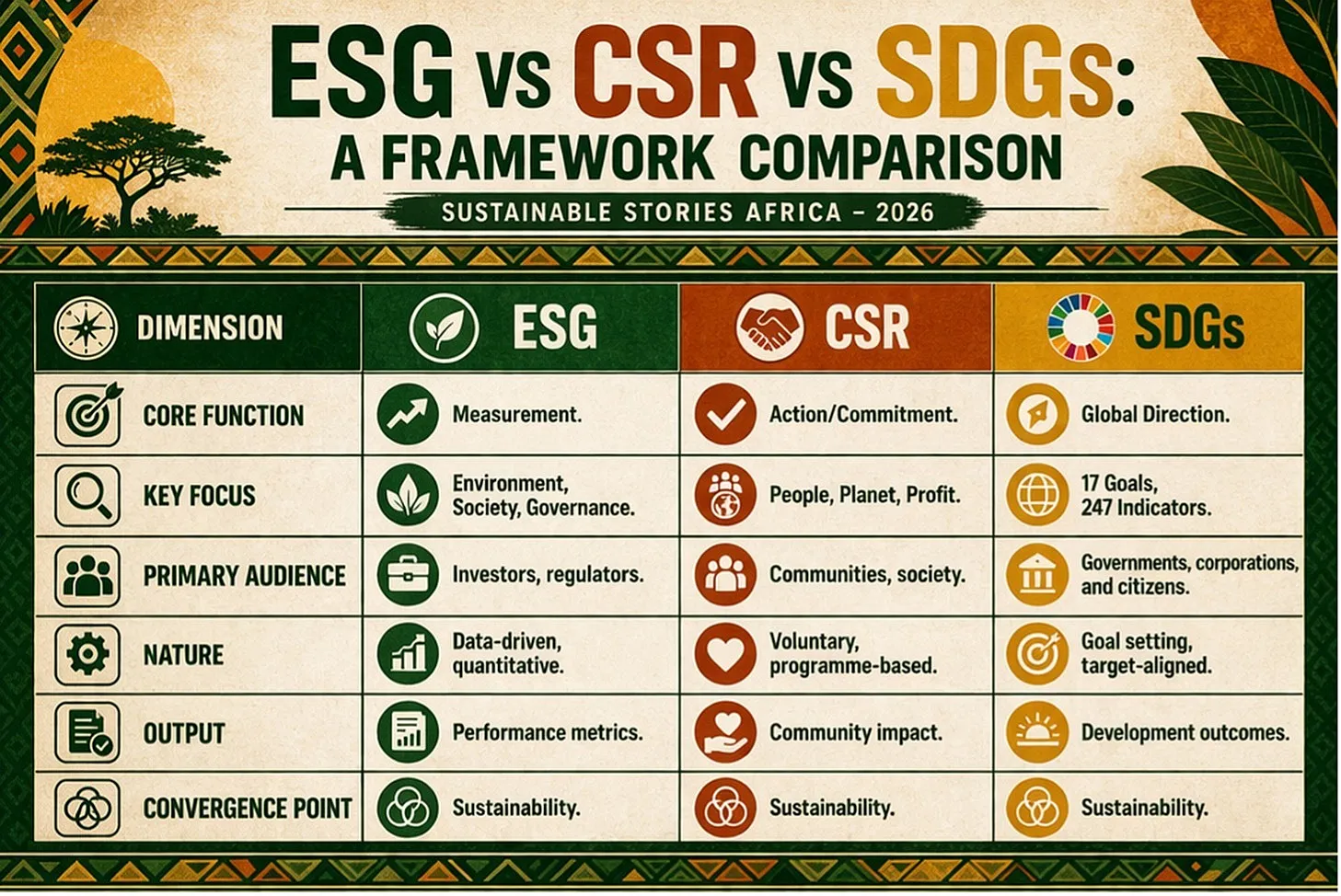
ESG vs CSR vs SDGs: A Framework Comparison
| Dimension | ESG | CSR | SDGs |
|---|---|---|---|
| Core Function | Measurement | Action/Commitment | Global Direction |
| Key Focus | Environment, Society, Governance | People, Planet, Profit | 17 Goals, 247 Indicators |
| Primary Audience | Investors, regulators | Communities, society | Governments, corporations, and citizens |
| Nature | Data-driven, quantitative | Voluntary, programme-based | Goal setting, target-aligned |
| Output | Performance metrics | Community impact | Development outcomes |
| Convergence Point | Sustainability | Sustainability | Sustainability |
What Alignment Unlocks for Africa
The intersection of ESG, CSR, and the SDGs, at the framework's centre, is sustainability: the long-term growth model that does not deplete the environment, divide society, or undermine future generations.
When these three frameworks are aligned, the outcomes are compounding and concrete.
In Kenya, green bond initiatives are funding climate-smart housing backed by international investors, combining ESG-structured financing with CSR community impact and SDG 11 (Sustainable Cities) targets.
In Nigeria, Access Bank is embedding ESG into core operations through sustainability-linked loans and assured third-party reports, translating CSR legacy commitments into investor-grade ESG credentials.
M-KOPA, operating across Kenya, Uganda, and Nigeria, is expanding clean energy and financial inclusion to over three million users, a model that delivers SDG 7 (Clean Energy), SDG 10 (Reduced Inequality), and measurable ESG performance simultaneously.
The risk of non-alignment is equally measurable. Organisations that treat CSR as their ESG response miss the investor metrics that unlock capital.
Those that cite SDGs without performance indicators lose credibility with multilateral lenders. Those that report ESG without community outcomes erode their social licence.
Integrate, Don't Separate
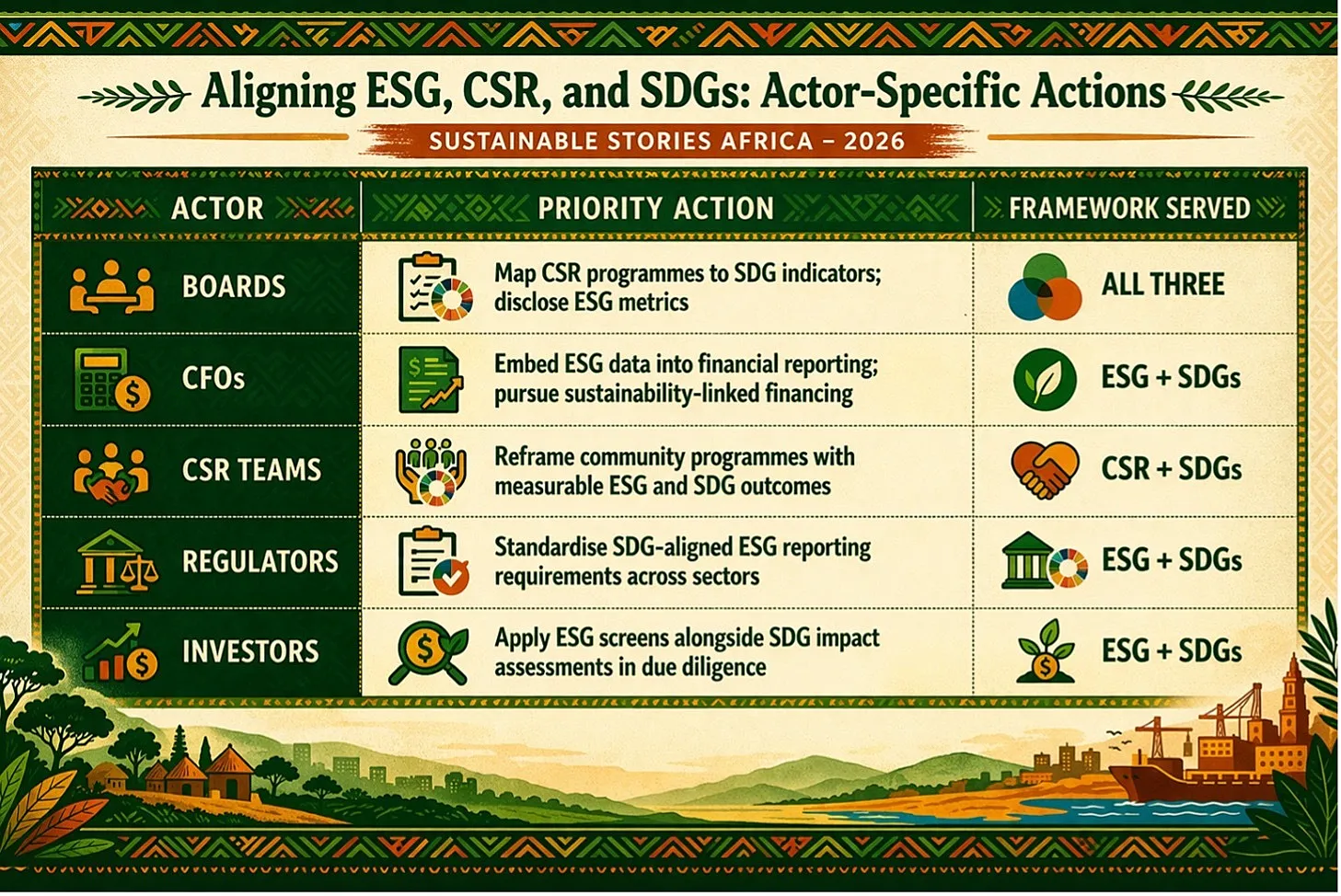
Aligning ESG, CSR, and SDGs: Actor-Specific Actions
| Actor | Priority Action | Framework Served |
|---|---|---|
| Boards | Map CSR programmes to SDG indicators; disclose ESG metrics | All three |
| CFOs | Embed ESG data into financial reporting; pursue sustainability-linked financing | ESG + SDGs |
| CSR Teams | Reframe community programmes with measurable ESG and SDG outcomes | CSR + SDGs |
| Regulators | Standardise SDG-aligned ESG reporting requirements across sectors | ESG + SDGs |
| Investors | Apply ESG screens alongside SDG impact assessments in due diligence | ESG + SDGs |
Six specific shifts are required.
- Boards must treat ESG, CSR, and SDGs not as separate departments, but as an integrated accountability architecture.
- CSR programmes must be redesigned to deliver measurable outcomes, not just spend.
- ESG reporting must achieve third-party assurance to attract the calibre of capital African markets need.
- SDG indicators must be mapped to every material business activity.
- Regulators must accelerate the harmonisation of reporting standards that make cross-border comparisons meaningful.
Path Forward – One Vision, Three Instruments
Africa's sustainability leadership depends on mastering three frameworks simultaneously. ESG provides the measurement rigour investors demand.
CSR delivers the community action that social licence requires. The SDGs define the development outcomes that capital must fund.
Together, they form one integrated strategy, not three competing priorities.
The organisations that will lead Africa's next decade are those that align all three: measuring, acting, and orienting toward a global direction, with the discipline, transparency, and governance to prove every claim they make.