
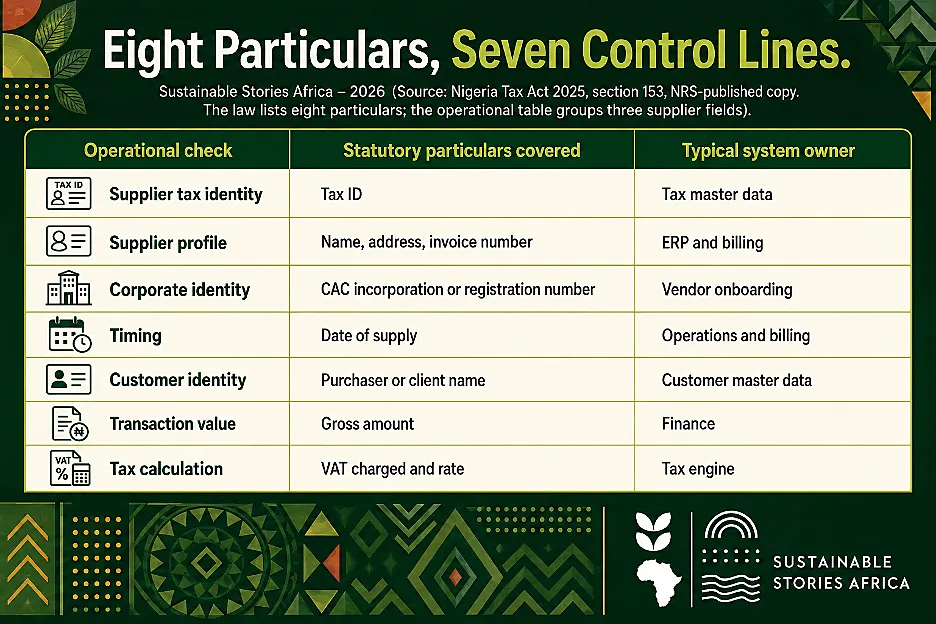
Nigeria’s VAT invoice rule lists eight statutory particulars, commonly grouped into seven operational checks when the supplier’s name, address and invoice number are reviewed together.
As fiscalisation expands, clean master data and invoice validation become essential to tax evidence, payment controls and trustworthy transaction records.
Every Invoice Field Now Carries Risk
FinPolNomics Green Finance originated the Tax & Transfer Pricing Nugget behind this explainer, translating Nigeria’s VAT invoice requirements into a seven-line operational checklist.
Sustainable Stories Africa has applied its Metrics and Insights & Data standards to reconcile that checklist with the current NRS-published Act, which sets out eight statutory particulars, because name, address and invoice number appear as separate legal items.
The difference is not a contradiction in substance; it is a reminder that practical controls may group fields while the law lists them individually.
Businesses need both views to validate invoices consistently and support an increasingly digital tax system.
A Small Document Holds Large Consequences
A VAT invoice is the transaction record that connects a taxable supply, the supplier, the customer, the amount and the tax charged.
- When fields are missing or inconsistent, the weakness can move through accounts payable, VAT reporting, audit evidence, supplier reconciliation and cash-flow management.
The current Nigeria Tax Act places the invoice rule in section 153.
- Earlier circulated numbering, reflected in the FinPolNomics artwork, referred to section 152.
- The present section requires a VAT invoice to include the supplier’s Tax ID; invoice number; supplier name and address; incorporation or registration number; date of supply; purchaser or client name; gross transaction amount; and VAT charged with the applicable rate.
That is eight statutory particulars.
- The nugget’s seven checks remain a useful operational format because the supplier’s name, address and sequential invoice number are combined in one line.
- An internal checklist can group fields for workflow efficiency, but an audit test should confirm all eight legal particulars.
The Act also links invoicing to the time of supply rather than the date cash is eventually collected.
- This makes invoice discipline part of revenue recognition and period-end controls, rather than an afterthought performed when the VAT return is due.
Credit notes and corrections belong in the same control environment.
- A replacement document should refer to the original invoice, preserve the audit trail and adjust VAT in the correct period.
- Deleting and reissuing documents without a visible link can create duplicate claims, unexplained sequence gaps and mismatches between trading partners.
Master Data Is The Hidden Control
Most invoice defects begin before an invoice is issued.
- An incorrect Tax ID, outdated address, missing CAC number or duplicate supplier record is usually a master-data problem.
- If that data feeds every invoice automatically, one weak onboarding decision can create hundreds of defective documents.
Businesses should therefore treat supplier and customer onboarding as a tax process.
- Tax IDs should be validated, legal names matched to registration documents, addresses standardised, and changes independently approved.
- The sequence logic for invoice numbers should prevent duplicates and unexplained gaps while preserving cancelled-document histories.
The date of supply needs special attention in service, milestone and subscription contracts.
- The commercial invoice date may not always capture the statutory time of supply.
- Billing rules should reflect delivery milestones, advance payments and other triggers relevant to VAT, with exceptions routed for tax review.
The VAT rate and amount should be calculated by controlled system logic rather than manual spreadsheets wherever possible.
- Product and service codes must distinguish taxable, zero-rated and exempt treatment.
- When a user overrides the rate, the system should demand a reason and send the transaction into a review queue.
Supplier remediation should be risk-based.
- High-value and high-volume vendors may justify automated portal checks and periodic revalidation, while occasional suppliers can follow a simpler workflow.
- The standard of evidence remains the same; the intensity of monitoring changes with exposure.
- Procurement dashboards should show rejection rates and recurring field failures by vendor.
Vendor scorecards can reinforce the standard.
- Share recurring errors with suppliers, agree correction targets and suspend automated payment where defects remain unresolved.
- Improvement should be visible in first-pass validity, not just in promises made during onboarding.
Digital Fiscalisation Raises The Business Data Standard
Nigeria’s fiscalisation direction moves invoice compliance closer to real-time digital reporting.
The Act empowers the tax authority to prescribe fiscal systems and electronic processes, meaning data quality will increasingly be tested at the point of transaction rather than years later during an audit.
That shift can reduce paper handling and ensure better reconciliation, but it also exposes system inconsistencies.
- A business with multiple billing platforms, manual branches or disconnected e-commerce channels may discover that the same customer or product is represented differently across systems.
- Integration becomes a compliance project as much as an information-technology project.
The opportunity is wider than tax.
- A single reliable invoice record can support procurement analytics, revenue assurance, fraud detection and environmental accounting.
- For example, product-level transaction data can later connect spending or sales to emissions factors, local-content indicators or circular-economy metrics.
- Fiscal data infrastructure can become sustainability data infrastructure when governance is designed well.
Privacy and cybersecurity must be scaled with the system.
- Tax IDs, addresses and transaction details are sensitive business data.
- Access controls, encryption, incident response and vendor security should be built into fiscalisation plans so that compliance does not create a new vulnerability.
Small businesses may need support during the transition.
- Large customers should publish clear invoice requirements, provide correction channels and avoid using technical defects to delay legitimate payment indefinitely.
- Regulators can reinforce compliance with templates, testing environments and phased guidance that make the digital standard easier to meet.
Validate Every Invoice Before Payment And Filing
Accounts payable should run an automated pre-payment test across all eight particulars. Invoices that fail should be quarantined, rather than silently repaired by the buyer.
The supplier should issue a corrected document so both parties retain matching records.
Accounts receivable should perform the mirror test before release.
- Templates, tax engines and invoice sequences should be version-controlled.
- Sample invoices from every business unit, product class and system should be tested after configuration changes, acquisitions or regulatory updates.
VAT return preparation should reconcile invoice-level data to the ledger and return totals.
- Differences should be classified by timing, credit note, cancellation, manual journal or data error.
- A clear reconciliation allows management to see whether a problem is isolated or systemic.
Finally, assign ownership.
- Tax interprets the rule; finance owns reporting; operations confirm supply; commercial teams maintain customer data; and technology keeps the controls working.
- A one-page responsibility matrix, tested quarterly, is more valuable than a checklist that belongs to everyone and therefore to no one.
Data retention completes the chain.
- The business should preserve the issued or received invoice in an accessible format together with any validation result, correction and payment record.
- If an invoice is represented only by a live portal link, an expiry or vendor failure may remove evidence years before the tax review window closes.
Performance metrics should go beyond the number of invoices processed.
- Track first-pass validity, correction time, duplicate rate, manual overrides and supplier recurrence.
- A rising invoice volume with falling first-pass quality is not digital progress; it is a growing backlog of tax risk.
Path Forward – Make Clean Invoices A Daily Habit
Businesses should configure all eight statutory particulars, keep the seven-line operational check and reject defects before payment or posting.
That rhythm makes VAT compliance continuous rather than seasonal.
The invoice is a small document with system-wide reach.
When its data is complete, tax reporting, supplier trust and financial insight all become stronger.
EDITOR’S DATA NOTE
This explainer provides general public-interest information. They are not legal, tax, investment or accounting advice. Readers should verify current law, Gazette orders and NRS guidance and obtain advice for specific facts.
Current-reference correction: the NRS-published Act uses section 153. It lists eight statutory particulars; however, they can be grouped into seven operational checks, as shown in the nugget.
LEGAL NOTE: General editorial information only. Tax outcomes depend on current law, guidance and specific facts; obtain professional advice before acting.