Nigeria’s solar mini-grid industry employs a predominantly young workforce in the companies interviewed by APRI.
However, young people are less represented among chief executives, pointing to barriers between employment and ownership.
The report links future expansion with finance, practical skills and more accessible procurement.
Its job-creation model shows considerable potential; however, realising it requires viable projects and support extending beyond electricity connections.
Nigeria’s Mini Grids Need Wider Ownership
Nigeria’s solar mini-grid expansion could create jobs and stimulate rural businesses, but young workers need clearer routes into leadership and enterprise ownership.
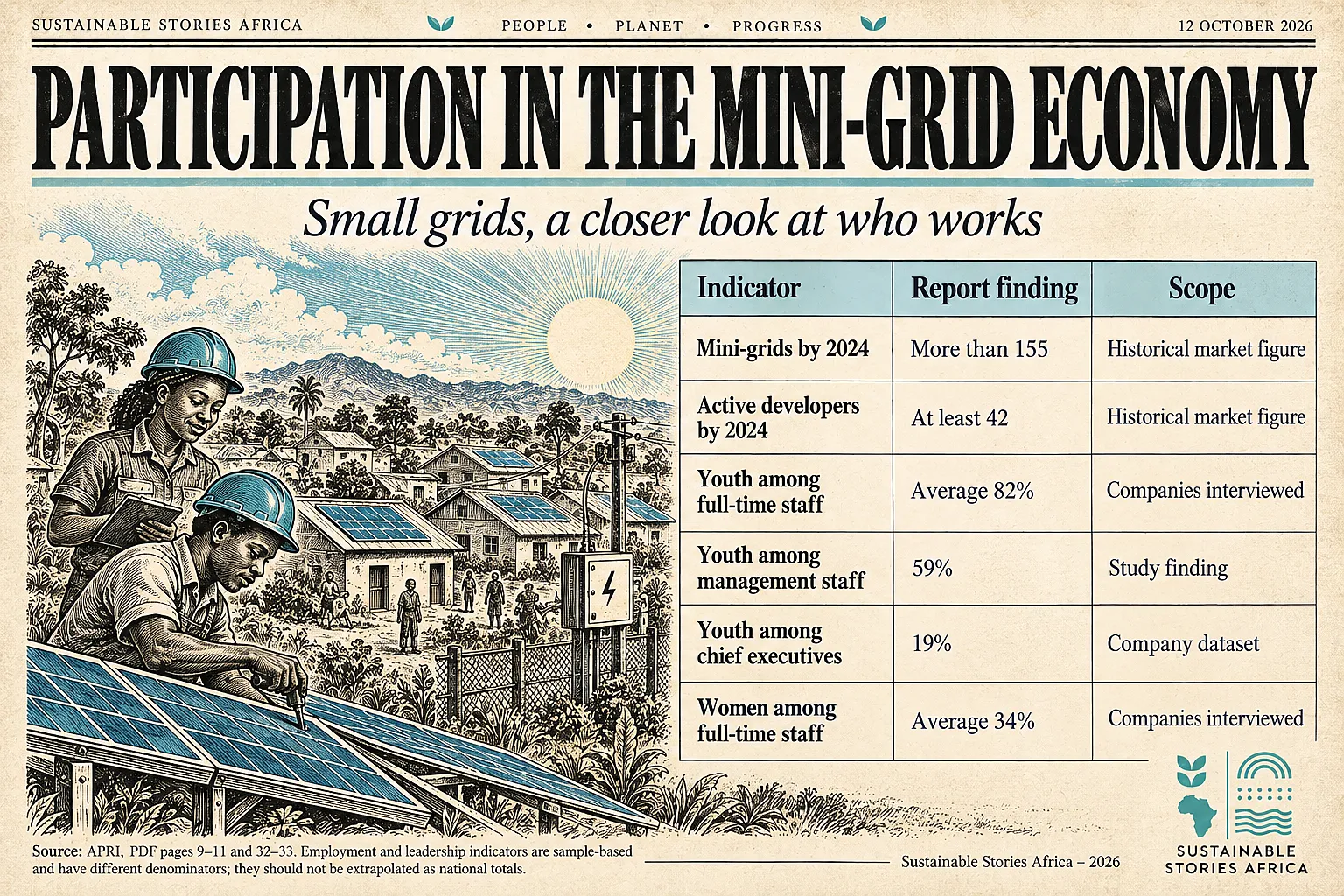
Africa Policy Research Institute’s March 2026 report finds that youth account for an average of 82% of full-time staff in interviewed companies, compared with 19% of chief executives in its company dataset.
The study examines finance, skills, innovation and policy through a dataset of 35 companies and 22 key-informant interviews.
- It argues that electrification programmes must address who participates in delivery, alongside how many communities receive power.
- The workforce figures describe the businesses examined, rather than a national labour census.
For communities seeking reliable electricity, the stakes extend to local enterprise and service quality.
An installation can enable productive activity, while local technical capacity and stable operating businesses help sustain the supply that activity depends on.
Deployment Growth Has Not Removed Entry Barriers
The report records Nigeria’s mini-grid market expanding from 11 mini-grids and five developers in 2015 to more than 155 mini-grids and at least 42 developers by 2024.
- These historical measures establish expansion within the report’s evidence period; they are not an updated October 2026 inventory.
Mini-grids generate and distribute electricity through local systems that can serve areas beyond reliable national-grid supply or operate in connection with the wider grid.
- Commercial requirements include demand assessment, system design, installation, payment collection and long-term maintenance.
- Access to engineering expertise and patient capital therefore influences who can become a developer.
The research finds that young people are strongly represented among employees and management but much less among chief executives.
- This gap is consistent with a sector in which experienced firms have advantages in capital, track record and access to public programmes.
- Employment growth alone will not remove those barriers.
Practical Skills And Patient Finance Determine Scale
The report identifies a divide between highly trained professionals and semi-skilled local technicians.
- Design engineers and project managers have broader routes to advancement, while technicians can struggle to progress without additional formal qualifications.
- Accessible professional development would help workers convert field experience into supervisory responsibility.
Skills programmes should therefore include practical installation and maintenance alongside customer engagement, financial planning and project coordination.
- Universities, vocational institutions and companies can share responsibility for applied learning.
- Training disconnected from operating projects risks producing qualifications without a route into work.
Gender differences require particular care.
- The report cites that women account for only 8% of technical staff in the broader off-grid solar sector.
- This figure is distinct from its estimate of women among mini-grid employees.
- Relatively strong overall representation can coexist with limited access to specialised technical roles.
Finance presents another constraint.
- APRI describes payback periods of seven to ten years and calls for capital suited to slow revenue maturation.
- Early-stage developers also need money for project preparation, experimentation and workforce development.
- Short repayment schedules can conflict with these requirements even where long-term project demand is credible.
The report highlights the importance of development finance channelled through the Rural Electrification Agency and recommends more balanced funding through guarantees, blended finance and co-investment.
Support access by technical assistance so younger firms can meet credible requirements for design, safety and financial management.
Electrification Can Support Several Distinct Job Categories
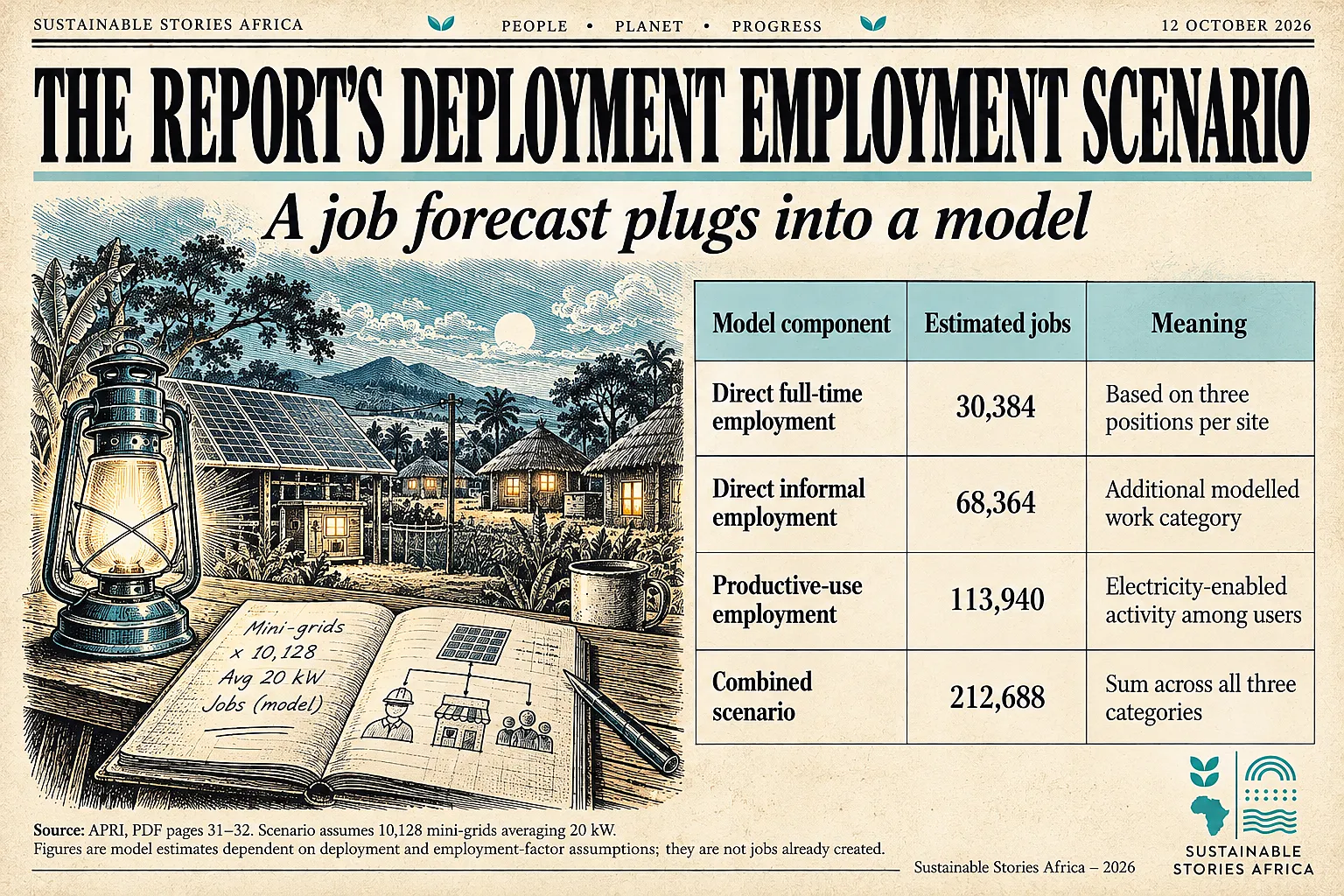
The report’s model estimates 212,688 jobs under an assumed deployment of 10,128 mini-grids averaging 20 kilowatts each.
- This total includes direct full-time work, direct informal work and productive-use jobs created through electricity-enabled activity.
- It is neither an observed employment count nor a forecast of formal salaried positions alone.
The model assumes approximately three direct full-time jobs per site and then applies employment factors to estimate other categories
- It illustrates potential pathways from electricity infrastructure to livelihoods.
- Its limits are from assumptions about deployment, system size and the response of businesses using the electricity.
These wider opportunities might involve enterprises whose activity improves with reliable power, rather than employees of the mini-grid company.
- Realising them requires equipment, customers and viable demand in addition to an electricity connection.
- Assess productive-use component separately from the developer’s own payroll.
Local innovation could improve this outcome.
- APRI estimates that up to 85% of system components are imported, leaving developers exposed to exchange-rate and supply-chain pressures.
- Technology partnerships, applied research and commercially viable local production could improve resilience, although quality and cost competitiveness must remain central.
Public Procurement Should Support Capable Emerging Developers
Electrification institutions and financiers should create entry routes that allow capable young firms to build experience.
- Smaller procurement packages, partnerships and dedicated support windows are possible approaches, provided technical evaluation and consumer protection remain credible.
- APRI advocates more flexible eligibility supported by assistance and project assessment.
Industry associations and training providers should develop progression routes for experienced technicians.
Community knowledge should also inform demand assessment, payment arrangements and operating decisions.
- The report recommends stronger residence participation and ownership, recognising that local involvement affects long-term service sustainability. [1]
Monitoring should combine electricity reliability with employment quality.
- Useful measures include retained technical staff, women entering specialised roles, young firms progressing to independent delivery and businesses using power productively.
This would reveal whether sector growth is broadening economic participation or leaving ownership concentrated among established operators.
Path Forward – Connecting Electricity With Economic Participation
Nigeria should link mini-grid expansion with practical training, patient finance and credible entry routes for young developers.
Community participation should inform project design and operation.
Measure sustained electricity service and employment separately from modelled potential.
Publishing the results would show whether deployment supports rural livelihoods and creates opportunities for young people to lead the industry.