A Global South peer-learning workshop in Abuja examined why climate finance promises can struggle to produce implementable projects.
Its findings place political authority, institutional readiness and public participation at the centre of Nigeria’s transition choices.
The April 2025 discussions offer lessons for a country platform grounded in national development.
Applying them requires a practical delivery structure, clear responsibilities and a way to assess whether investment improves livelihoods and resilience.
Transition Lessons Must Inform Nigerian Delivery
Nigeria’s climate transition requires institutions that can turn finance and policy commitments into projects with public legitimacy.
An Africa Policy Research Institute brief on a Global South peer-learning workshop argues that a Nigerian country platform should reflect domestic development priorities and political conditions rather than reproduce another country’s partnership model.
The workshop took place in Abuja on April 29 – 30, 2025, bringing together more than 150 participants from Nigeria and peer countries.
It examined experiences in South Africa, Indonesia, Vietnam and Senegal, covering financing and governance questions relevant to Nigeria.
Read for an October 2026 development discussion, the brief highlights recommendations, not proof of their subsequent implementation.
Its value lies in identifying what a credible platform would need to do and assessing delivery.
Large Pledges Still Need Credible Delivery Institutions
The workshop brief highlights a familiar financing distinction: commitments do not establish that money has reached a project.
It cites implementation difficulties, un South Africa’s $8.5 billion JETP package.
- This figure refers to the package discussed at the workshop, rather than an updated statement of the country’s financing position.
The wider lesson concerns the path between announcement and operation.
- Project preparation, institutional mandates and workable business models are necessary before finance can produce services.
- Private participants called for clearer returns and approvals, while civil society and labour representatives emphasised inclusion and protection for affected groups.
Its two-day format combined high-level comparisons with parallel government, private-sector and civil-society discussions.
That mix highlights differences in implementation requirements.
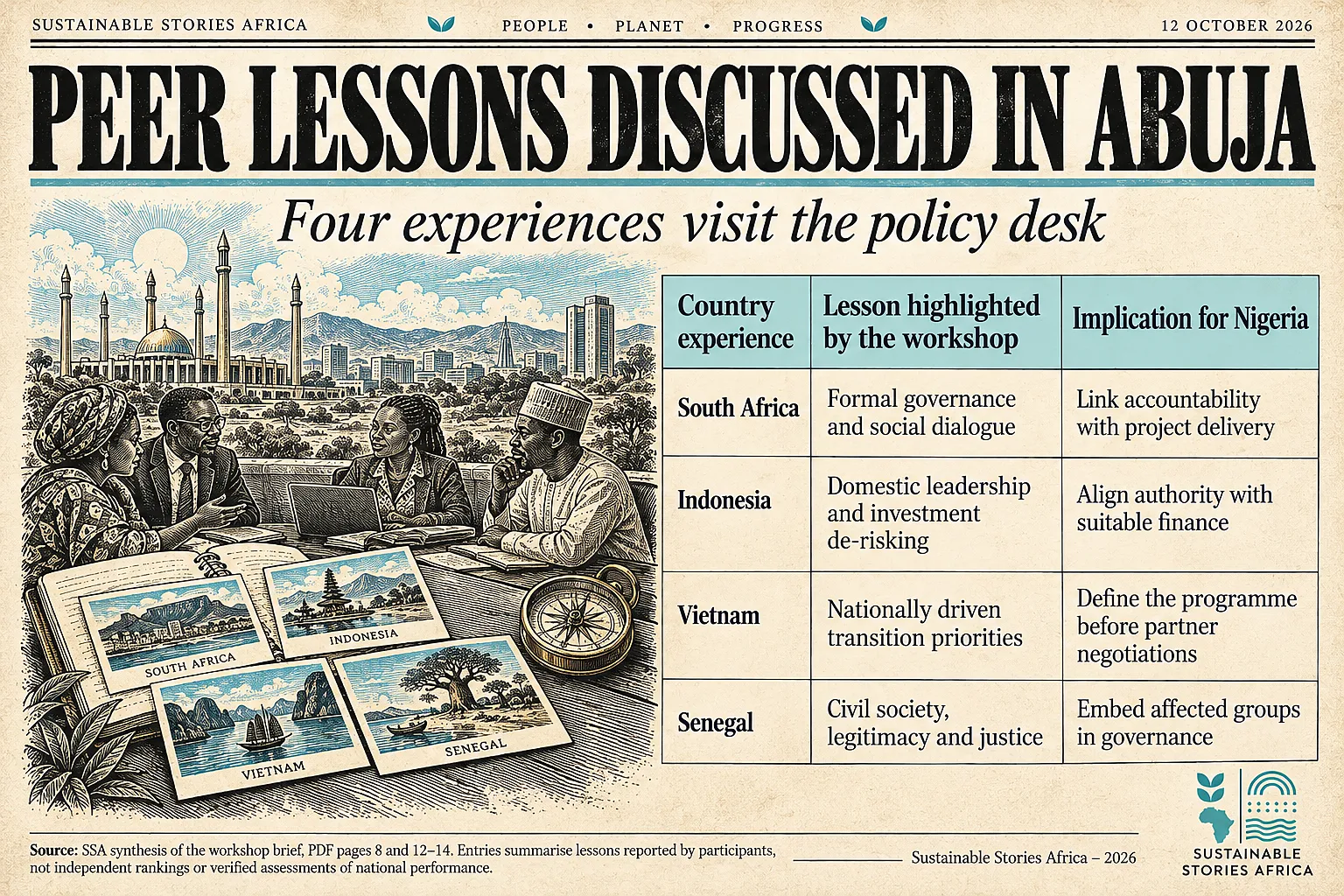
Political Authority And Participation Must Work Together
The report treats climate transition as a political process because policy choices distribute costs, opportunities and influence.
- In Nigeria, oil revenues, regional interests and employment all affect how transition proposals are developed.
- A financing plan that ignores these interests can encounter resistance even when its technical case appears persuasive.
Participants called for presidential-level support and clear mandates across ministries, departments and agencies.
- They also stressed the need to include states in a federal system.
- Central authority can convene institutions, but implementation depends on subnational capacity and incentives as well as national direction.
Oil-producing regions and labour groups need particular attention.
- Reskilling programmes and social protection should connect to realistic changes in employment and local revenues.
- Consultation is useful only when it gives affected participants a way to influence choices and see how their concerns have been addressed.
Women, young people and marginalised communities also need roles beyond occasional meetings.
- The workshop recommends representation in governance structures, grievance mechanisms and continuing social accountability.
- These arrangements can help a platform identify distributional risks before they become implementation disputes.
There is a financial reason to take legitimacy seriously.
- Projects can face delays when land, livelihoods or benefit arrangements remain unresolved.
- Early engagement cannot eliminate every conflict, but it can reveal constraints while design choices are still open.
- Treating participation as part of preparation makes the risks easier to understand.
Development Priorities Can Make Climate Cooperation Useful
The workshop argues for a platform that links climate goals with energy access, food security, employment and industrial growth.
It recommends a flexible design that links energy, agriculture, transport, industry and finance.
- This wider scope recognises that households and businesses experience development needs together rather than as isolated policy categories.
For example, an agricultural investment may depend on electricity, resilient water systems and market access.
- Coordination can identify those dependencies and help avoid projects that perform technically but fail commercially.
- The platform’s role would be to bring the relevant institutions and financing requirements into the same implementation discussion.
Domestic capital is another opportunity.
- Participants discussed pensions, commercial banks and green bonds, alongside international resources.
- Mobilisation depends on suitable terms and credible investment preparation; naming an available pool of capital does not establish that it can legally or commercially fund any proposed activity.
Diversifying partners could strengthen negotiating options.
- The brief recommends an interest-based approach to international cooperation that connects technology and financing offers with Nigerian priorities.
- A consistent programme would help compare proposals on costs, risks and local benefits, while reducing fragmented negotiations over individual projects. [1]
A Phased Platform Can Test Institutional Readiness
The workshop distinguishes an ideal platform from a practical starting point. Its ideal is legally supported, inclusive and coordinated across sectors.
- Its proposed initial route is leaner: an existing institutional home, explicit political support, technical working groups and pilots in selected sectors or states.
- This is a recommended sequence, not a record of projects launched.
Pilot activity could test whether responsible institutions can resolve approvals, prepare projects and include communities.
- It should also identify the staff, budgets and data needed for expansion
- Starting with limited scope is useful when the results inform a better programme rather than remain disconnected demonstrations.
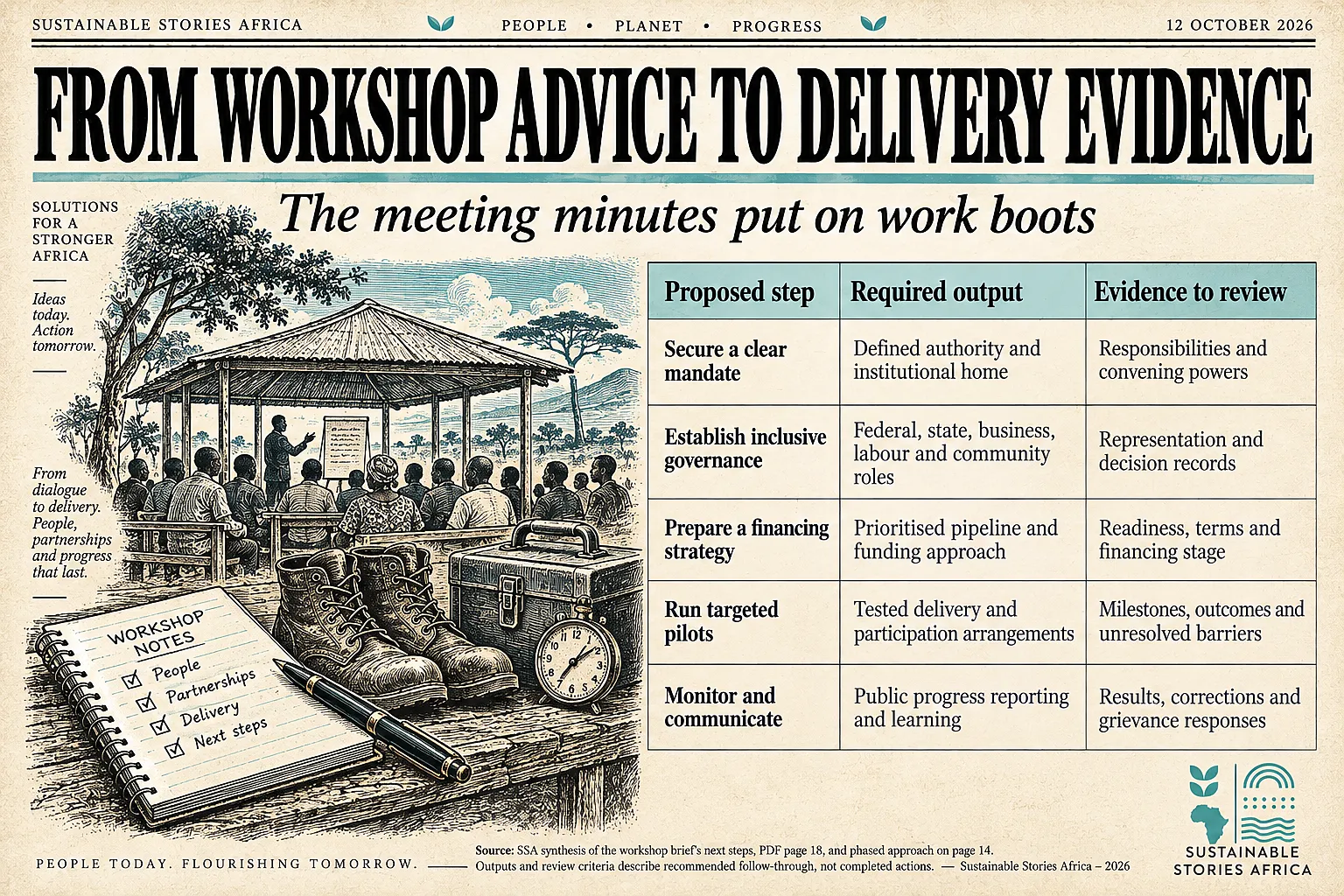
A detailed political economy assessment should accompany design, as the brief recommends.
- It can identify conflicts and incentives that an organisational chart misses.
- Partners should then commit technical assistance to the delivery requirements identified, rather than create reporting demands disconnected from institutional capacity. [1]
Public communication should make progress understandable.
- Citizens need to know which projects are planned, funded and operating.
- Explaining delays and corrective action would help establish accountability and support informed participation in decisions that affect livelihoods.
Path Forward – Testing A Nigerian Delivery Model
Nigeria should translate peer lessons into a nationally directed platform with clear authority, prepared projects and meaningful participation.
Selected pilots can test the design before expansion.
Publish what those pilots deliver and what prevents progress.
Evidence on livelihoods, resilience and operating services would make climate cooperation accountable to the development priorities that the workshop placed at its centre.