Nigeria’s critical minerals can support industrial development, but community-level extraction often happens without reliable testing, transparent prices or accessible formalisation.
A stakeholder study documents the resulting loss of bargaining power and local value.
Fieldwork across five states points towards a reform agenda centred on miners and host communities.
The priority is to link mineral demand with safer work, enforceable benefits and credible domestic processing opportunities.
Nigeria’s Mineral Opportunity Starts With Communities
Nigeria’s critical minerals strategy needs to address the conditions under which minerals are extracted and sold if growing international demand is to improve domestic livelihoods.
A 2026 Africa Policy Research Institute report by Munira Raji and Isabella Roberts finds weak coordination, costly formalisation and limited local benefit capture across selected mining communities.
Field engagement took place in Nasarawa, Kogi, Kwara, Benue and Oyo between December 2025 and April 2026.
A survey of 106 artisanal and small-scale mining practitioners provides evidence on the barriers facing operators and their expectations of justice-centred development.
The findings highlight supply-chain ambitions in contact with daily work.
Minerals may be strategically important for batteries and industry, while the people extracting them remain unable to establish their value or obtain equipment, finance and protection.
Mineral Demand Exposes Unequal Local Bargaining Power
Community participation was the most frequently identified element of justice-centred mining, cited by 45% of survey respondents. Fair benefit sharing followed at 36%.
- These results suggest that communities associate a better mining economy with influence over decisions and distribution, alongside environmental protection.
- The coded themes overlap and should not be added as if they were exclusive choices. [1]
The same principle applies to formalisation.
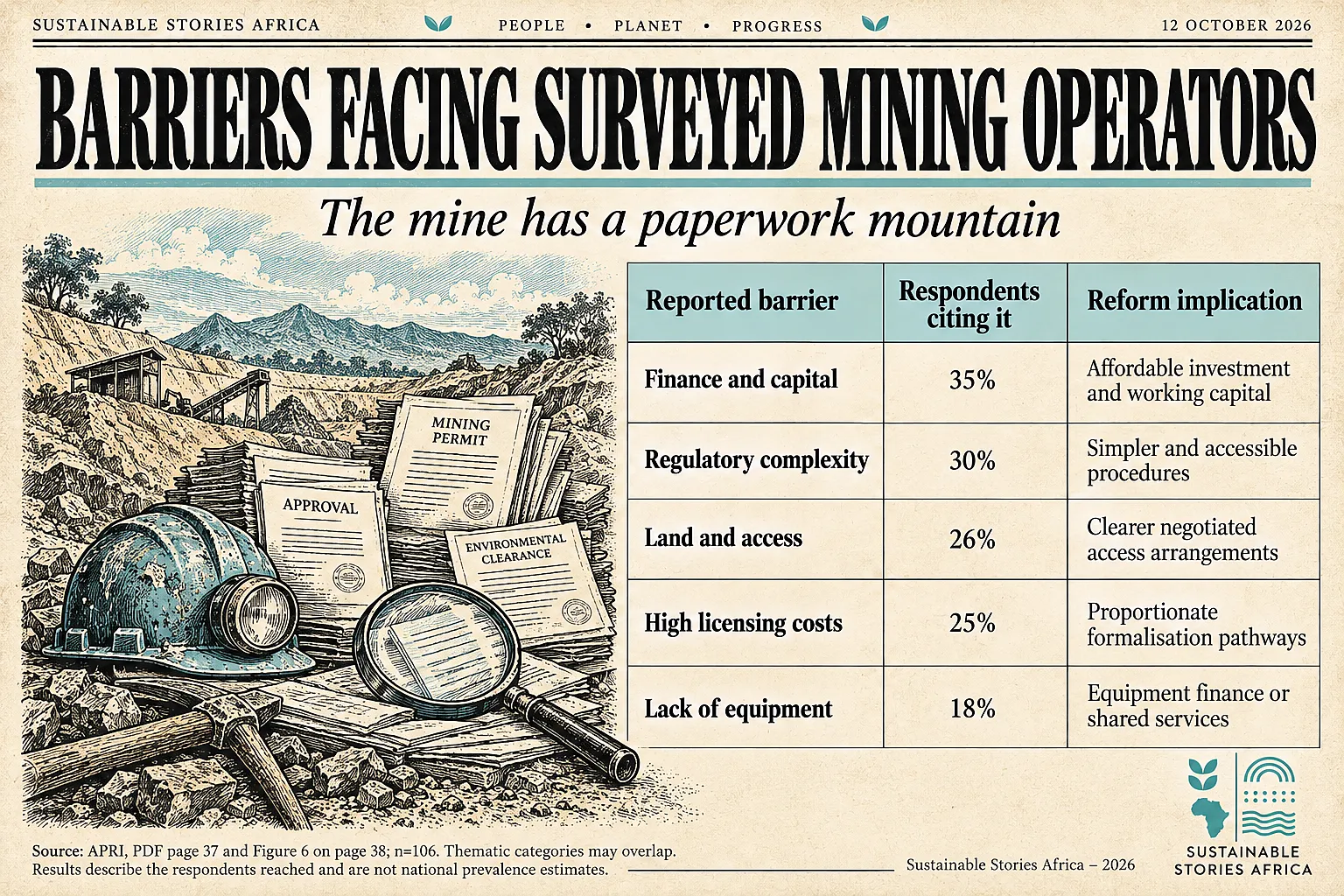
- Lack of finance was identified by 35% of respondents, regulatory complexity by 30%, land-access problems by 26% and high licensing costs by 25%.
- Operators confront several constraints at once. Reducing one administrative requirement may help, but it will not provide capital or resolve insecure access to land.
APRI reports field accounts of licensing costs ranging from N20 million to N50 million and reliance on personal connections to navigate procedures.
- These are reported barriers encountered in the research, rather than a verified nationwide statutory tariff.
- Their significance, the distance between a formal licensing system and the resources available to smaller operators.
Extraction Realities Reveal Weak Institutional Coordination
The study combines interviews, focus groups, observation and policy mapping.
- The states and sites were selected partly for mineral activity and partly for feasible access and security.
- The report explicitly presents them as illustrative case studies, rather than a statistically representative sample of Nigeria’s mining geography.
Across these sites, the authors describe largely manual extraction, limited protective equipment and inadequate testing facilities.
- Without independent assessment of mineral quality, miners rely heavily on buyers and intermediaries for valuation.
- This information imbalance weakens their negotiating position before questions of processing or export returns even arise.
Domestic processing capacity is uneven.
- The report observes activity by Chinese-affiliated processors in Nasarawa while documenting the broader predominance of raw mineral movement.
- Processing investment can retain more value, but its benefits depend on purchase terms, labour conditions and links with local suppliers.
- The presence of a processing plant alone does not establish equitable distribution.
Institutional fragmentation adds uncertainty.
- The authors find overlapping remits and largely inactive Mineral Resources and Environmental Management Committees, known as MIREMCO, across the five states visited.
- These bodies are meant to link federal oversight with state and community concerns; weak operation leaves coordination gaps close to extraction sites.
Gender exclusion is another structural issue.
- Women made up 23% of survey respondents and were observed in activities such as sorting, carrying and washing, but were less visible in ownership and decision-making.
- The sample’s composition cannot establish women’s national participation rate.
- It nevertheless reinforces the need to recognise labour contributions when designing benefits and representation.
Better Valuation Can Strengthen Local Development Returns
Accessible testing could change the terms of everyday mineral transactions.
- If miners can obtain credible quality information, they can compare offers more effectively.
- Mobile testing units and state or zonal valuation services are among APRI’s suggested responses.
- Reference information would need regular updating and safeguards against capture by dominant buyers.
Formalisation could also improve safety and access to finance if requirements meets operators’ scale.
- A tiered system allows individual miners, cooperatives and small companies to enter through differentiated procedures.
- The developmental objective is to improve practices while protecting livelihoods during the transition into formal activity.
Community Development Agreements offer an existing route to local benefits, but the report finds weak delivery of commitments.
- Enforcing agreed infrastructure, employment and livelihood provisions would give communities a clearer accountability basis.
- Document benefits with grievance channels that residents can actually use.
Regional processing and manufacturing remain longer-term opportunities.
- The report links Nigeria’s mineral strategy with energy-transition planning and continental trade integration.
- Moving to these activities requires power, transport and technical capability, alongside commercially credible demand.
- It should follow evidence on mineral quality and volumes rather than assume that every deposit supports a viable factory.
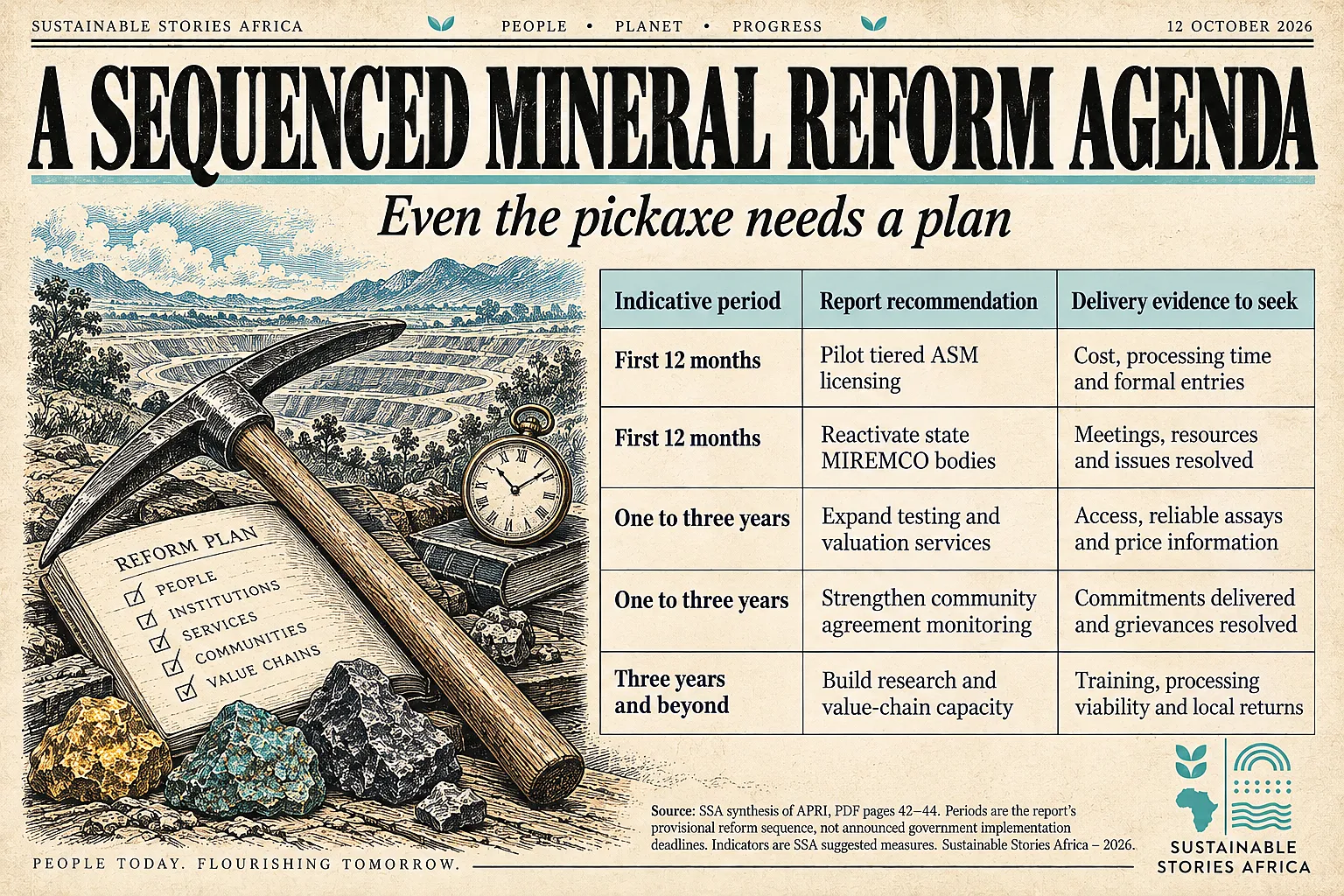
Regulators And Buyers Must Improve Accountability
The Ministry of Solid Minerals Development and relevant agencies should begin with reforms that can be tested administratively, including accessible licensing support and stronger state coordination
- APRI recommends refining feasibility through political economy analysis, recognising that authority and incentives determine whether institutional proposals can operate in practice.
Mining companies and buyers should disclose understandable transaction terms and support credible valuation.
- Community agreements should include identifiable obligations, delivery schedules and reporting mechanisms.
Development partners can provide technical support, but Nigerian institutions and communities need the capacity to scrutinise results independently.
Safety and inclusion should be integral to implementation.
- Protective equipment, child-labour prevention and recognition of women’s work are necessary parts of responsible mineral development.
- Expansion that increases extraction without improving these conditions would deepen the gap between clean energy supply-chain claims and the realities of mining communities.
Path Forward – Connecting Mineral Wealth With Fairness
Nigeria should prioritise affordable formalisation, transparent valuation and enforceable community benefits before judging success by extraction growth alone.
Pilot reforms in the studied states can establish what works and where capacity is missing.
Publishing their outcomes would help build a mineral strategy grounded in safer livelihoods, stronger local bargaining power and credible domestic value addition.