
McKinsey’s August 2026 AI survey finds widespread adoption and strong reported gains for individual workers.
Enterprise financial impact is less broadly reported, while operating costs constrain use at some organisations.
For African businesses, the evidence points to disciplined investment, workflow redesign and clear accountability for costs, quality and workforce outcomes.
AI Investment Needs Measurable Business Value
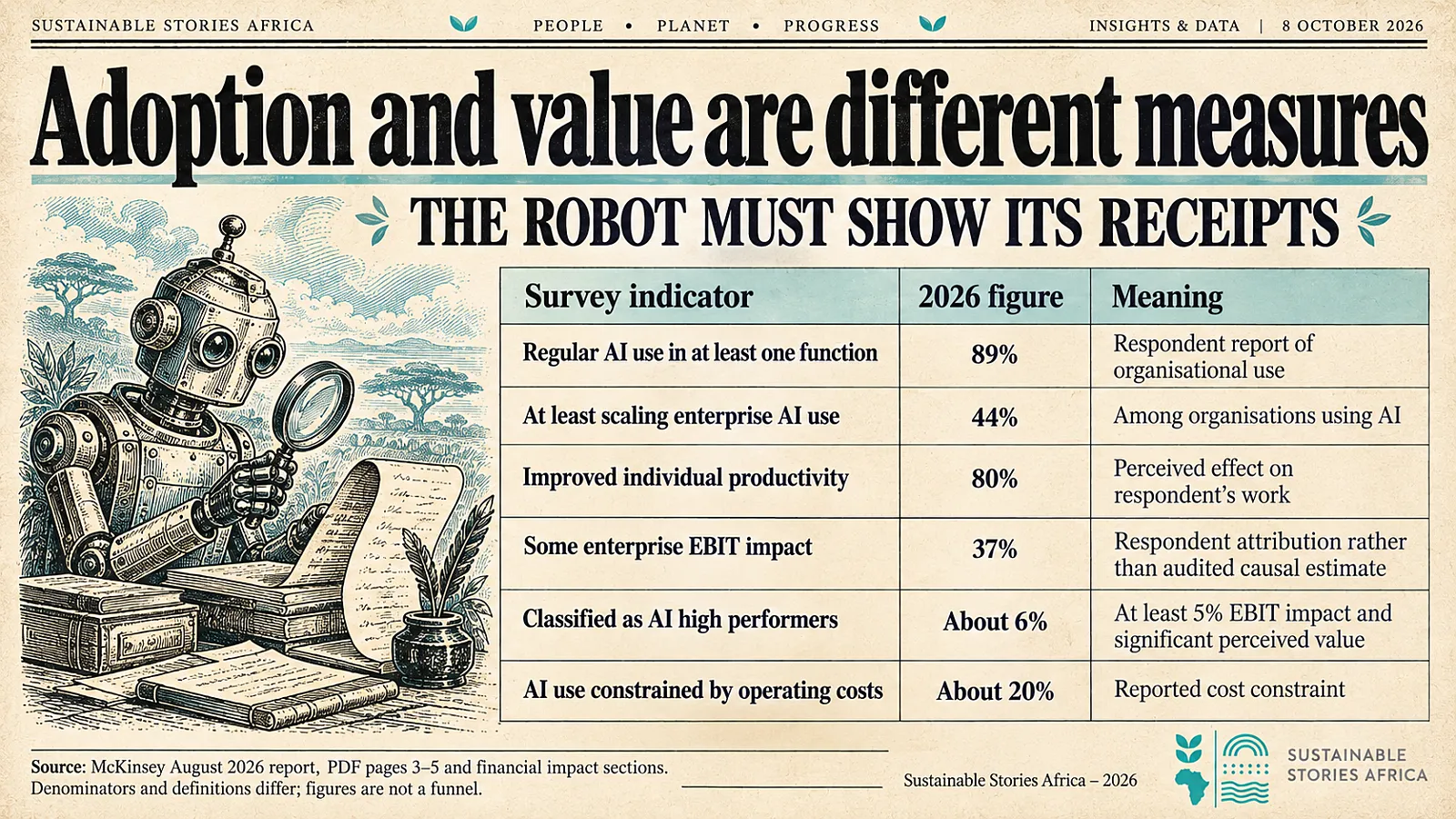
Companies are expanding artificial intelligence use without a matching increase in the share reporting enterprise financial impact. McKinsey’s August 2026 report finds that 80% of respondents say AI improves their individual productivity, while 37% attribute some contribution to earnings before interest and taxes, or EBIT, to organisational AI use.
The financial-impact share is broadly unchanged from the previous year.
- Meanwhile, about one in five respondents reports that AI operating costs have constrained use.
- The survey collected responses from 1,719 participants across 97 nations between 4 May and 8 June 2026.
For African enterprises, these findings show a practical question:
- Which applications create useful value after their full costs are included?
The survey provides a global comparison, not a forecast of African profitability or employment.
Widespread Adoption Still Leaves Financial Questions
89% of respondents report regular AI use in at least one business function.
- Among organisations using AI, the share at least scaling enterprise use reached 44%, up from 38% in 2025.
- Adoption is advancing, but activity and value remain different measures.
A worker may complete a task more quickly without changing the organisation’s revenue or costs.
- If saved time is absorbed by additional review, fragmented workflows or unrelated bottlenecks, the gain may remain personal.
- The report identifies workflow redesign and organisational execution as important features of the stronger performers.
The research is an online respondent survey, weighted by nations’ contributions to global GDP.
- It does not independently audit company financial statements or establish that AI caused the reported changes.
- Senior professionals should retain those limits when using it to support investment decisions.
Agent Scaling Favours Larger Surveyed Enterprises
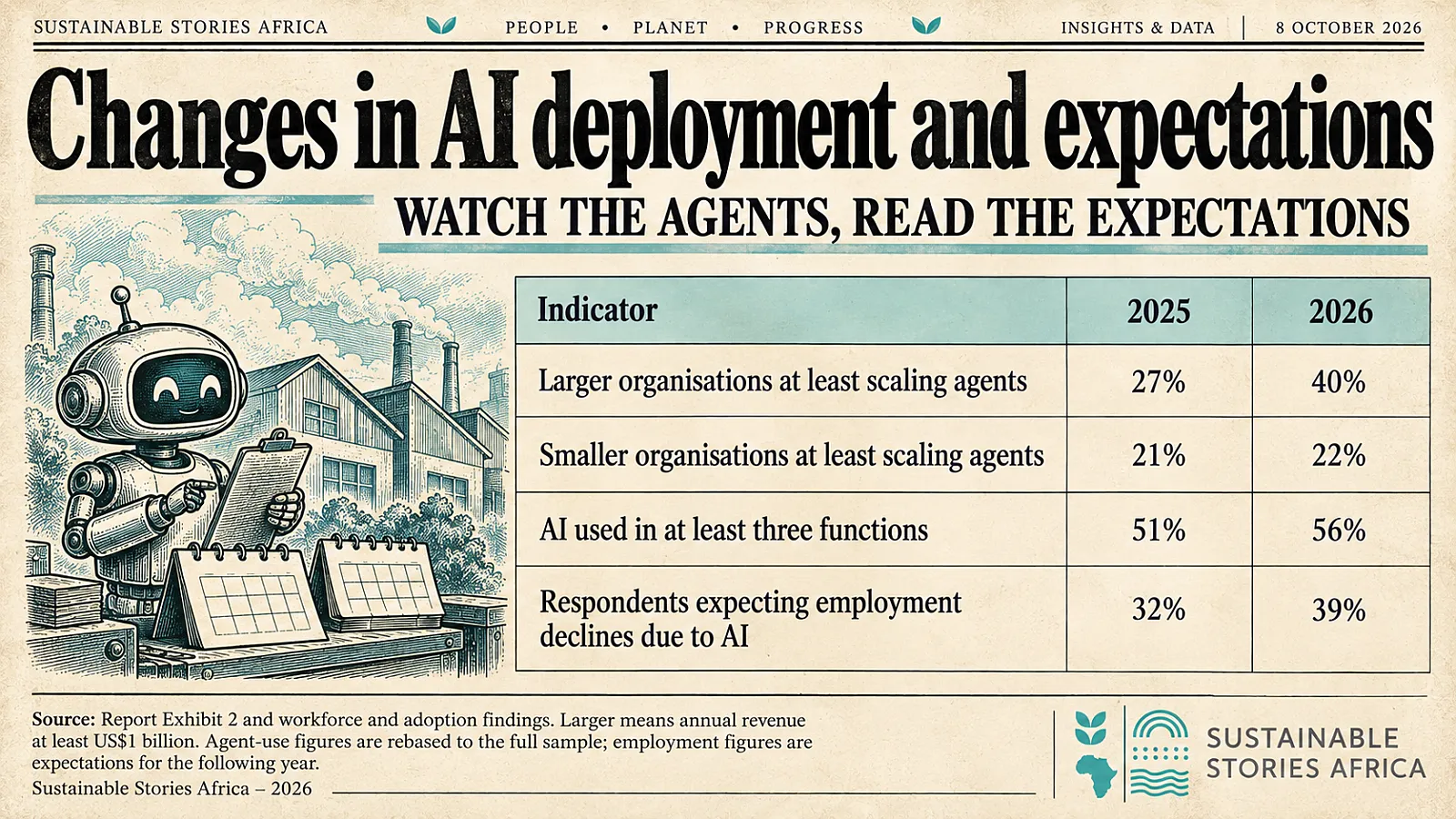
The report finds a widening difference in agent deployment by organisation size.
- Respondents at enterprises with at least $1 billion in revenue were more likely to report scaling agents than those at smaller organisations.
- This describes a revenue-based comparison, not a direct comparison between African small businesses and multinational companies.
Agents can act across tasks and workflows, creating opportunities but also increasing the importance of boundaries and supervision.
- An application that drafts a response carries different risks from one that can change a customer record or initiate an operational action.
The survey also reports that 32% of respondents say their organisations decided against buying at least one software product or feature because they could build it internally with agentic coding tools.
- This is a reported purchasing decision.
- It does not establish that the internally built alternative is cheaper over its full life or as reliable as the product it replaced.
African organisations should assess these trade-offs in their own operating context.
- Relevant costs may include integration, staff training, evaluation and maintenance, as well as subscriptions or usage charges.
- Where services are priced in foreign currency, investment appraisal should test sensitivity to exchange-rate changes rather than assume costs remain fixed.
Productivity Gains Need Organisational Follow-Through
The opportunity is to connect useful AI assistance with better service or additional productive capacity.
- An illustrative customer support team might reduce drafting time, but value would depend on response quality, resolution rates and whether customers receive answers faster.
- Generating more text would not establish improvement.
The same principle applies to ESG reporting.
- AI can help organise evidence, but an organisation still needs accountable people to check boundaries, calculations and source documents.
- A fluent narrative cannot compensate for an unsupported performance claim.
The report’s high performers pursue growth or innovation alongside efficiency, redesign workflows and support deployment with leadership commitment.
- These are associations in the survey, not proof that adopting a checklist will produce a defined financial return.
- They offer hypotheses to test in a local programme.
Workforce outcomes deserve the same care.
- The rise in expected employment declines is a change in sentiment.
- The report notes that earlier expectations exceeded subsequently reported reductions.
Boards should therefore avoid presenting survey forecasts as jobs already lost.
For employees, effective implementation requires training and a clear explanation of how responsibilities change.
- People need to know when they can rely on a tool, when review is required and how to report errors.
These operational arrangements can affect whether individual gains become dependable institutional performance.
Customers should also be included in evaluation where AI changes a service.
- Faster internal processing may have little value if a customer receives an inaccurate answer and has to repeat information to correct it.
Businesses can compare resolution time, error rates and customer understanding against the previous process.
- These measures include difficult cases rather than only successful demonstrations.
- They also give staff a way to report where automation creates additional work.
A more complete assessment can reveal whether the organisation has removed a bottleneck or moved it to another team or to the customer.
Boards Should Require Full Cost Evaluation
Businesses can begin with a specific problem, a baseline and a limited deployment.
- Before scaling, they should compare the resulting performance with the previous process and include the cost of checking and correcting outputs.
This is SSA’s implementation recommendation rather than a quantified finding of the survey.
Finance teams should distinguish time saved from reduced expenditure.
- If employee costs remain unchanged, a faster task may create additional capacity rather than an immediate cash saving.
- The business case should explain how that capacity will be used and how its value will be measured.
Technology and risk teams should define what an application can access or change.
- Where agents carry out consequential actions, review procedures and records should allow the organisation to investigate failures.
- Responsibility cannot be delegated to the tool itself.
Investment reviews should also consider vendor dependence and ongoing maintenance.
- A low-cost pilot may become more expensive when usage grows or when staff must maintain an internally developed system.
- Scaling decisions need an updated appraisal rather than assuming that pilot economics will persist.
For sustainability, firms can assess whether the chosen application improves a material activity enough to justify its resource demands.
- Broad claims that AI is environmentally beneficial require evidence of the specific change, with an appropriate boundary.
- A balanced disclosure should recognise costs and limitations alongside benefits.
Path Forward – For Accountable AI Investment
African businesses should link AI deployment to defined outcomes, full costs and accountable owners.
The global survey offers useful comparisons, but local evidence should determine scaling decisions.
Workflow redesign, employee capability and appropriate supervision can help turn personal productivity into institutional value.
Transparent reporting should distinguish measured results from expectations and make both commercial and sustainability claims reviewable.