Odiri Oginni’s seven habits of portfolio managers place judgement and behaviour alongside technical analysis.
Her central question is how investment professionals make better decisions when outcomes remain uncertain.
For African institutions managing savings and long-term capital, the governance implications extend to risk oversight, client mandates and the quality of evidence behind sustainability claims.
Investment Governance Begins With Better Judgement
Investment institutions should examine the quality of their decisions alongside the returns those decisions produce.
In a 4 October article, Odiri Oginni sets out seven habits spanning probabilistic thinking, understanding holdings, protecting capital, filtering information, recording decisions, challenging conviction and learning systematically.
- It is a practitioner framework, tailored to improve investment outperformance.
This distinction matters to pension trustees, fund boards and households whose savings depend on disciplined management.
The relevance to sustainability lies in accountability.
- Investors need to explain how they assess risk and meet client objectives, including any environmental or social requirements.
- A credible process makes those explanations easier to test.
Market Uncertainty Tests The Investment Process
Oginni’s argument provides insights into managers’ thinking, especially when new information challenges a position.
Her seven habits provide an organising framework for that question.
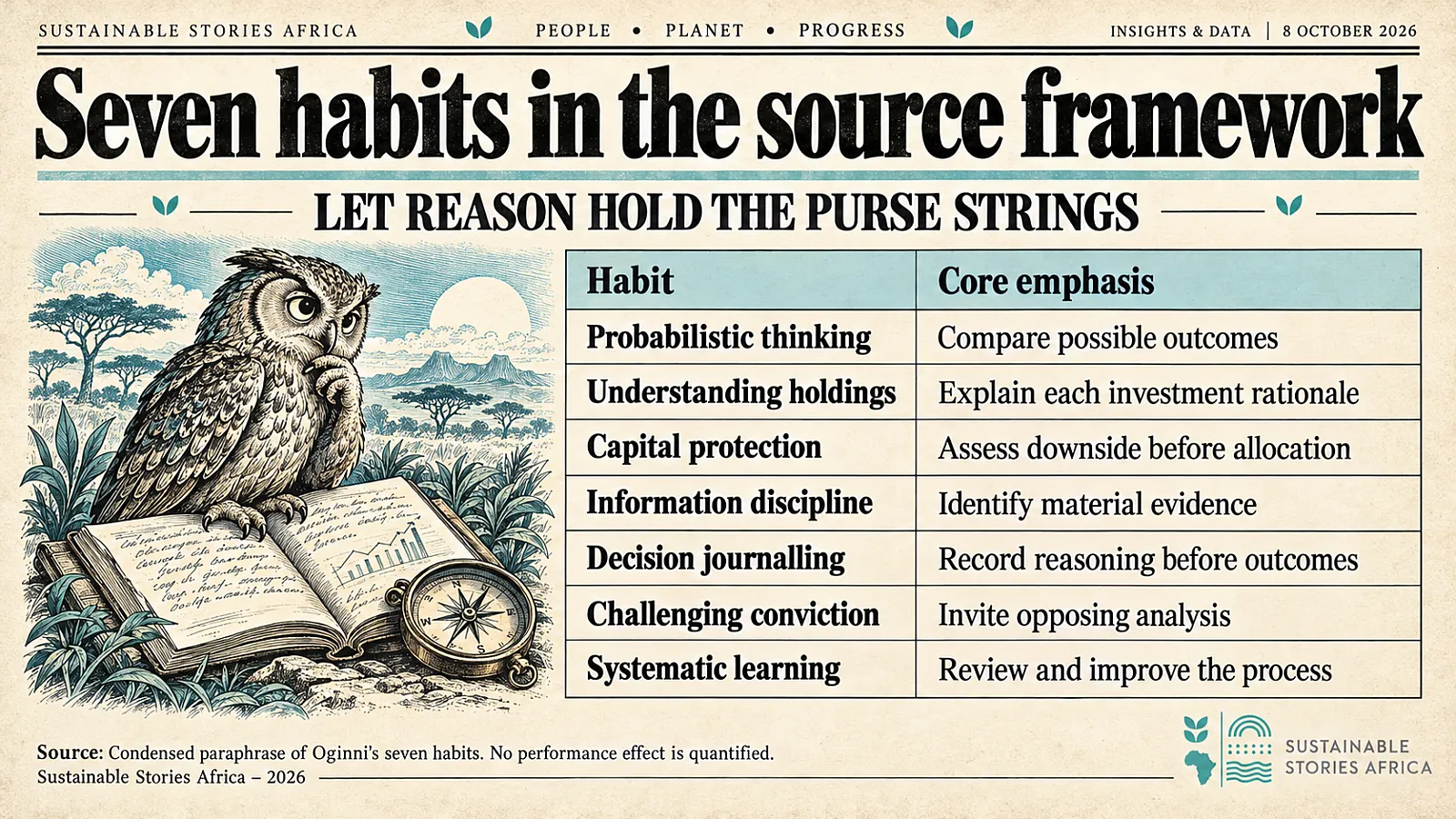
- An illustrative investment committee considering a long-dated bond can apply this approach without claiming certainty about interest rates.
- Members would examine several possible inflation and rate paths, establish how the investment behaves in each and check whether the position fits the client’s horizon.
Their eventual choice would remain exposed to uncertainty, but its reasoning would be visible.
The same discipline applies to infrastructure and climate-related investments.
- A favourable policy announcement may improve expectations without removing construction, payment or operating risks.
- A project’s development importance does not by itself establish that its financing structure is suitable for every investor.
Evidence Should Link Risk With Mandates
CFA Institute’s portfolio planning guidance identifies the investment policy statement as the starting point for management.
- It sets out return and risk objectives and the constraints within which decisions should be made.
- Its suitability standard also requires attention to the whole portfolio and the client’s circumstances.
These principles help translate a behavioural discussion into institutional practice.
- A manager needs to know when a holding is appropriate, how much capital they can commit, and what would require a review.
- A strong narrative about an asset cannot substitute for that assessment.
Consider a hypothetical portfolio with 10% allocated to one position.
- If that position falls 30%, its direct contribution to the portfolio decline would be about three percentage points, assuming other holdings and weights remain unchanged.
- That simple calculation is illustrative, not a forecast.
- In practice, related holdings may also move, and the investor may need cash at an unfavourable time.
This is why risk review must include liquidity and correlations as well as expected returns.
- A portfolio that appears diversified by the number of securities may still depend heavily on one economic driver.
- Managers should explain those shared exposures in language trustees and clients can understand.
CFA Institute’s risk management guidance emphasises integrating risk analysis into decisions and evaluating trade-offs.
- Its manager selection material separately considers investment due diligence and operational due diligence.
- The latter matters because weak controls can impair a strategy even when the underlying investment analysis is sound.
Transparent Processes Can Protect Patient Capital
For long-term investors, a documented process can support continuity when staff change, or markets become unsettled.
- A successor can examine why a position was acquired, what risks were considered and which assumptions were expected to hold.
- This reduces dependence on unwritten institutional memory.
Such documentation can also improve conversations about sustainable investment.
- If a client has specified an ESG requirement, the manager should identify how it affects selection, monitoring and ownership decisions.
- An asset labelled green still requires financial assessment and evidence supporting its environmental claim.
The benefits are conditional.
- A journal that records decisions after the result is known may rationalise the outcome.
- A challenge meeting that discourages dissent may reinforce the original view.
Useful records must be contemporaneous, and governance must give staff a reasonable opportunity to question assumptions.
There is no automatic link between these practices and higher returns.
- Their direct contribution is to make decisions more reviewable and expose weaknesses earlier.
- That is valuable to institutions responsible for other people’s money, even when a disciplined process cannot eliminate market losses.
Reviewable decisions also make client communication more precise.
- Instead of explaining every loss through market volatility, a manager can show which assumption changed and whether the portfolio remained within its agreed constraints.
- A client should be able to distinguish a temporary setback within the strategy from a breach of the mandate.
That conversation requires clear language and an appropriate benchmark.
- Sustainability objectives need the same clarity: reporting should identify what was promised, what evidence was reviewed and what the portfolio actually did.
An ESG label cannot replace these explanations, nor can it establish that client interests were protected.
Investment Committees Need Reviewable Decision Records
Attach a concise decision record to material investment proposals.
- It should link the investment rationale to the mandate, identify the relevant evidence and specify which developments would trigger reconsideration.
The following matrix offers a possible structure.
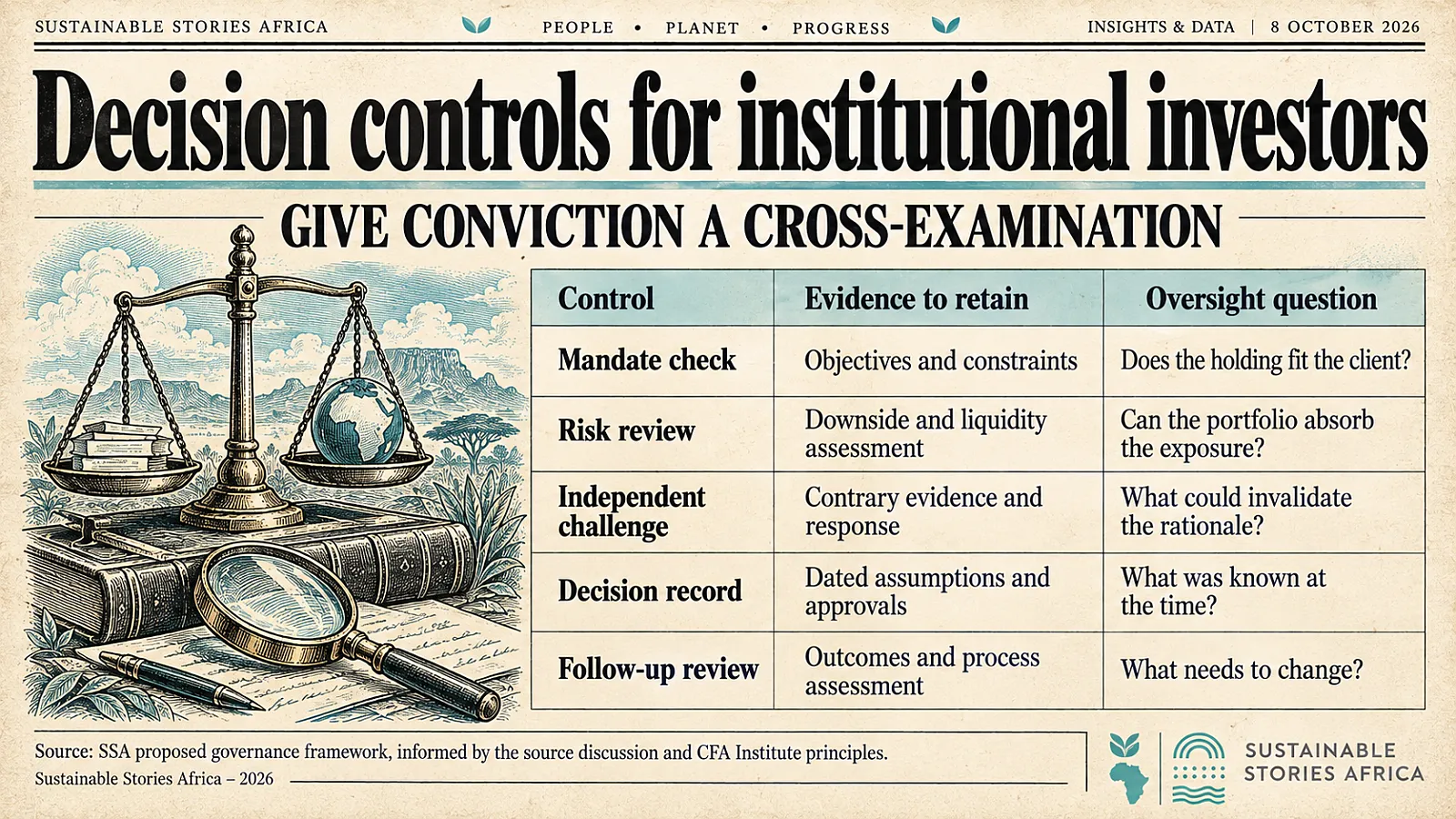
Teams should agree which decisions warrant detailed recording, so the process does not become paperwork without analytical value.
- A material allocation, significant change in risk or a new strategy deserves more scrutiny than routine implementation within an approved mandate.
Boards should also examine incentives.
- If evaluation rewards only recent returns, staff may hesitate to document uncertainty or raise concerns.
- Review criteria can recognise mandate compliance, clear analysis and appropriate escalation alongside performance.
This does not excuse poor results; it gives oversight a fuller basis for understanding them.
Learning should follow a defined cadence.
- Reviews can compare original assumptions with later developments, identify recurring errors and change procedures where evidence supports doing so.
- For African markets, that approach can help institutions adapt to local information gaps while maintaining standards of accountability.
Path Forward – For Accountable Investment Decisions
Investment institutions should make major decisions traceable to client objectives, risk assessments and the evidence available at the time.
Oginni’s habits offer a useful starting point for examining judgement.
Boards and investment teams can strengthen governance through independent challenge and regular process review.
Transparent reasoning supports stewardship of long-term savings and makes sustainability commitments easier to assess.