A Wellcome-supported synthesis of five regional dialogues calls for a global health system shaped more strongly by countries and regional institutions.
Its proposals address fragmented financing, unequal power and barriers to shared knowledge and essential products.
For Africa, the test is whether reform gives national priorities greater authority while protecting services during financially difficult transitions.
Health Reform Requires Shared Decision Power
Global health reform should shift more authority to countries and regional institutions while preserving the international functions that support standards, cooperation and equitable access.
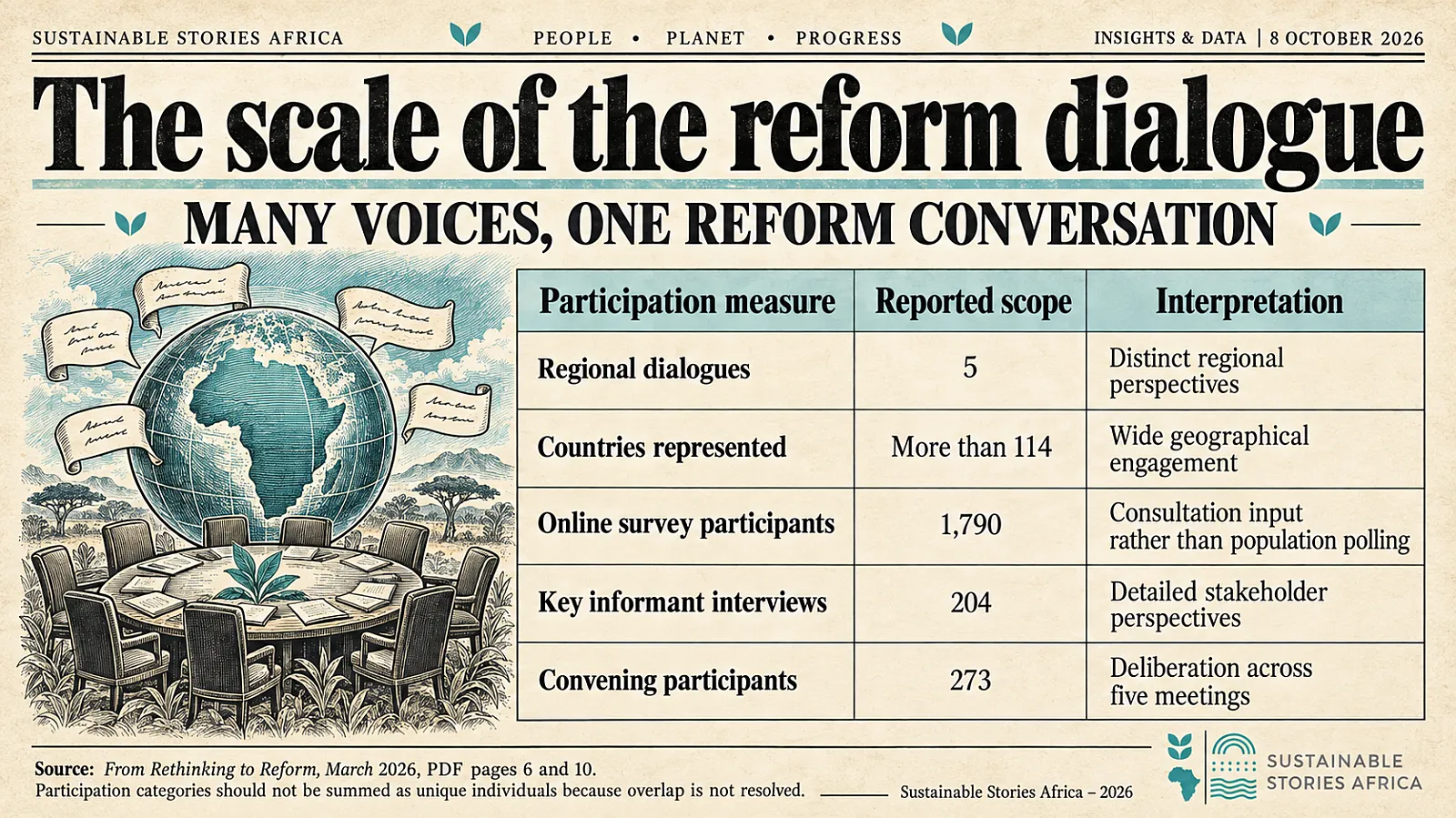
- That is the central direction of a March 2026 synthesis supported by Wellcome, drawing together five regional dialogues conducted in 2025.
The consultation involved stakeholders from more than 114 countries.
- Participants identified persistent weaknesses in governance, financing and access to data, knowledge and health products.
- They proposed a decentralised system organised around country needs, regional capabilities and a more streamlined global architecture.
For African governments and communities, the implications are immediate:
- Who sets priorities
- How funding reaches services
- Whether reform protects people during transitions.
The report presents proposals and unresolved questions. It does not establish that a new architecture had been implemented by October 2026.
A Broad Dialogue Identified Persistent Weaknesses
The process provides evidence of larger engagement, rather than a representative public opinion poll.
- It includes online surveys, key informant interviews and regional convenings.
- The Africa dialogue was led by Amref Health Africa, alongside regionally led processes elsewhere.
Across regions, participants recognised that global health cooperation has delivered substantial benefits.
- The report highlights the World Health Organisation’s normative role, technical cooperation, multilateral partnerships and humanitarian presence.
- Reform therefore needs to retain useful capabilities while addressing the arrangements that prevent them from working coherently.
The weaknesses identified include fragmented organisations and funding streams, power imbalances, accountability gaps and dependence on external finance.
- Those are institutional problems with consequences for patients.
- If parallel programmes request incompatible reports or maintain separate delivery arrangements, scarce staff time can be diverted from care.
Country Plans Need Coherent Financial Support
The report argues for international finance that fits country priorities, alongside stronger domestic and regional investment.
- This is how institutions organise support, with national plans becoming a more meaningful basis for allocation and implementation.
For an illustrative district health team, fragmentation might mean maintaining several reporting schedules, each tied to a different funding source.
- Aligning requirements could reduce duplication.
However, common reporting must still preserve information on service quality, underserved groups and use of funds.
- Simplification would fail if it reduced visibility into outcomes.
Country ownership also requires credible domestic governance.
- A national plan needs transparent priorities, realistic costing and a way for affected communities to question decisions.
- Moving power from an international institution to a ministry does not automatically give patients more influence.
The report’s emphasis on equity and accountability should apply at every level.
Financing transitions deserve particular care.
- Greater domestic responsibility is a reasonable long-term aim, but fiscal constraints vary sharply.
- Abrupt withdrawal of external support can leave services exposed before alternative financing is available.
- A transition plan should specify which services must continue, who funds them and what happens if projected resources fail to arrive.
The report recognises that macro-financial constraints affect domestic health spending.
- Policy should therefore assess the budget actually available, rather than relying on ambitious commitments that cannot be executed.
- The quality of expenditure matters alongside the amount allocated.
Regional Cooperation Can Improve Practical Access
Regional institutions could help countries address problems that exceed national capacity.
- The synthesis identifies opportunities in shared systems, technical cooperation and harmonised markets.
- For Africa, it discusses bodies including Africa CDC and the African Medicines Agency within the larger reform landscape.
The potential value lies in clearly assigned functions.
- Shared surveillance can help identify cross-border threats.
- Coordinated procurement may aggregate demand and improve supply planning.
- Regulatory cooperation can reduce duplication where participating countries establish appropriate standards and responsibilities.
These are proposed benefits, not outcomes quantified by the synthesis.
Regional cooperation must also account for differences between countries.
- A common approach can support smaller markets, but it should not erase legitimate needs or concentrate influence in a few larger economies.
- Representation, funding contributions and decision rules require explicit agreement.
Data sovereignty is part of that negotiation.
- Countries need sufficient authority and capacity to govern health data, while cooperation requires information that can be shared and interpreted across borders.
- Useful reform would combine local ownership with agreed standards, clear access rules and protection of sensitive information.
The development opportunity is a system that directs resources towards locally relevant priorities and reduces avoidable administrative burdens.
- Its credibility will depend on implementation and public scrutiny, particularly when reform affects essential services.
Community participation should have a defined place in the reform process.
- Patients and frontline staff may identify barriers that are less visible in institutional discussions, such as repeated stock shortages or referral delays.
- Their input becomes more useful when officials explain how it affects priorities and report back on decisions.
Participation should also include groups with limited access to formal consultations.
- A reform process can reproduce the same power imbalances it intends to address.
- Clear feedback arrangements would help communities evaluate whether a change in governance produces a change in the services they experience.
Reform Needs Owners, Budgets And Accountability
The report calls for governments to establish a shared direction, regional organisations to build capabilities and global organisations to streamline their roles.
- Civil society, academia and think tanks are asked to strengthen evidence and accountability.
- Translating those roles into action requires a smaller number of defined commitments.
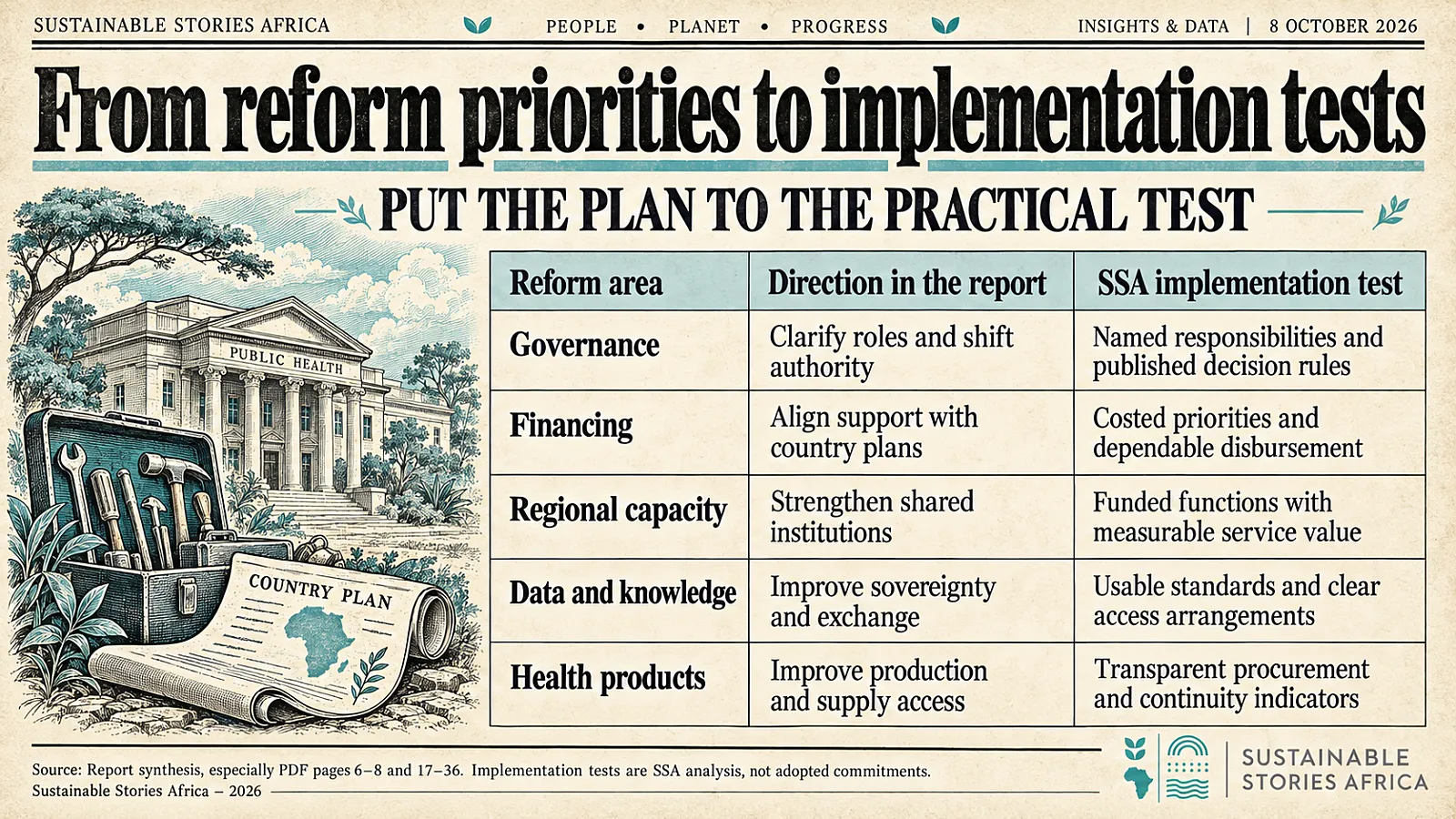
Governments and partners can begin with functions where duplication is visible, and improvement is measurable.
- A shared reporting requirement, coordinated purchasing arrangement or clearer division of responsibilities can provide a practical test before more extensive institutional changes.
Reform milestones should include the effect on services.
- Publishing a new organisational chart cannot establish that medicines arrive more reliably or that communities gain influence.
- Progress reports should explain which operational burdens changed, what resources were committed and whether service continuity was maintained.
Finally, consultations must remain open to disagreement.
- The synthesis documents convergence but also unresolved trade-offs.
- Different views about financing, authority and global responsibilities are part of the reform challenge.
Treating a dialogue as an already settled mandate would weaken the accountability the process seeks to improve.
Path Forward – For Country Led Health
Health reform should give country priorities real authority, fund useful regional functions and protect services during financing transitions.
Clear responsibilities and public progress measures can turn broad proposals into reviewable action.
African governments, regional bodies and communities need a continuing role in shaping that process. More equitable governance will matter when it improves access, continuity and trust in care.