Nigeria’s financial inclusion debate is moving beyond the number of people with accounts.
Olu Akanmu’s Afropolitan interview raises questions about identification, infrastructure and coordination, while fresh EFInA evidence shows how unreliable services weaken financial resilience.
For households and small businesses, the test is practical: can money arrive on time, remain accessible and help them survive an unexpected shock?
Banking Access Must Deliver Everyday Resilience
Nigeria’s financial sector should measure success by dependable transactions, household resilience and true account ownership.
EFInA, drawing on its 2026 Access to Financial Services survey, reports that 79% of Nigerian adults have access to financial services.
However, 52% have less than one month of financial buffer if income stops.
The figures sharpen the questions Olu Akanmu raised in an Afropolitan interview published on 30 September.
The programme’s published description highlights his argument for coordinated action among regulators, banks and fintechs to reach people who have identification but remain unbanked.
For African markets, this is a governance and development issue.
- A payment system can expand while households remain exposed to disrupted trade, emergency borrowing and income loss. Inclusion must work when customers need it most.
Accounts Mean Little When Payments Fail
The interview’s published description attributes an estimate of 40 million people with government identification but no bank account to Akanmu, alongside a proposed three-month coordinated effort to reach them.
That is an interview claim, not an independently reconciled estimate from the A2F 2026 survey.
The available description does not establish its reference year or population definition.
However, the practical issue is that identification and usable services sit at different points in customers’ journey.
- Possessing an identity document helps satisfy onboarding requirements, but it does not establish that an affordable, accessible account is available or useful.
- Providers still need to understand why a person would open an account, how they would fund it and what could make them abandon it.
Consider an illustrative trader who receives a transfer while buying stock.
- If confirmation arrives late, she must choose between releasing goods without certainty and delaying a legitimate customer.
- The costs extend beyond the failed transaction: it can interrupt replenishment, damage trust, and make cash appear safer.
This example explains the operational stakes without asserting a reported interview incident.
Survey Data Reveals Gaps Beyond Access
According to EFInA’s reports, almost four million formally included business owners still borrow outside the formal system for business needs, while nearly ten million formally included adults save informally or at home.
- These behaviours should prompt questions about product fit rather than an assumption that customers need more financial education.
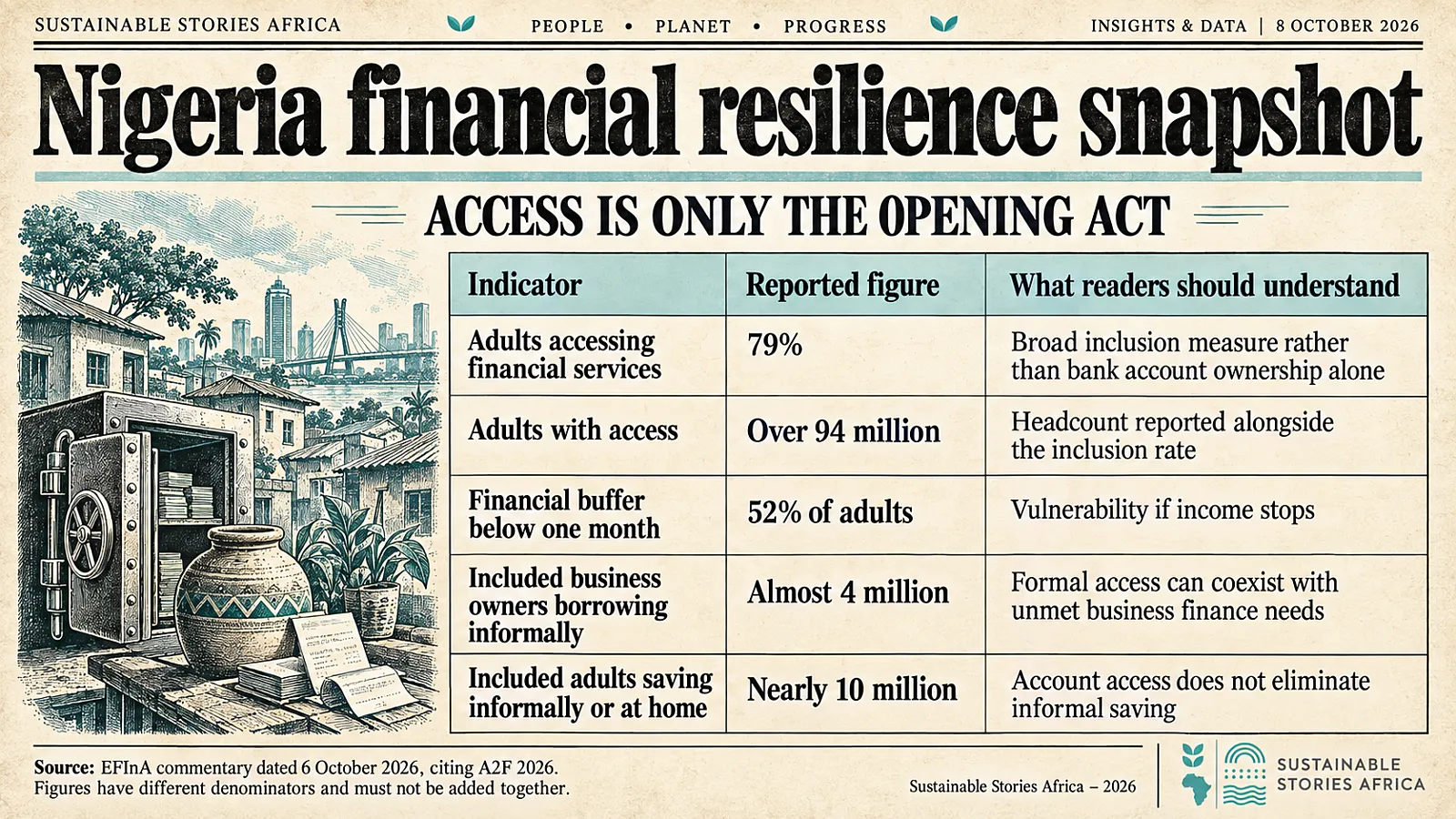
Those categories overlap.
- An adult might have a bank account, save through a community arrangement and borrow from relatives.
- Such a person should not be counted as several different people excluded from finance.
- Nor should the broad 79% inclusion rate be presented as a banked rate.
A useful evaluation asks what each channel provides.
- Informal arrangements may offer proximity, flexible contributions and social trust.
- Formal products may offer secure records, wider payment reach and regulated dispute procedures.
- Customers can rationally combine them.
The policy challenge is to improve formal services while preserving customer choice and understanding the risks of each arrangement.
The regional relevance lies in this distinction between access and resilience.
- A national average cannot show whether rural customers, women operating small enterprises or people with intermittent incomes can transact reliably.
- Providers need segmented evidence, with clearly defined populations and periods, before they claim that digital growth has closed those gaps.
Reliable Finance Can Strengthen Small Enterprises
Better, more reliable service could help businesses keep working capital available, resulting from fluctuating sales.
- Rapid resolution of failed payments can reduce the need to bridge temporary gaps with expensive borrowing.
- Savings tools with transparent withdrawal conditions can make emergency reserves easier to use.
These are plausible benefits to test, rather than outcomes demonstrated by the interview.
Akanmu’s infrastructure example, as summarised by Afropolitan, contrasts a lengthy bank server procurement process with OPay’s faster capacity expansion during the cash shortage.
- It is a practitioner account of organisational responsiveness, not a comparative audit of all Nigerian banks and fintechs.
The management implication is worth examining.
- Institutions need clear authority to respond to surging demand, backed by controls that protect customer funds.
- Speed and accountability must operate together.
- A system that scales quickly but leaves customers unable to recover a mistaken transfer would still fail the resilience test.
For sustainability reporting, banks can make their social impact claims more credible by linking access initiatives to service outcomes.
- Reporting how many accounts were opened is useful.
- Reporting whether those customers remain active, resolve disputes and obtain suitable products gives stakeholders a fuller view of what inclusion delivers.
Financial resilience also needs a time dimension.
- A customer may manage ordinary transactions successfully but struggle when income stops or an unexpected expense occurs.
- Providers can examine whether savings remain accessible and whether credit repayment terms fit variable earnings.
These assessments should be designed with customers rather than inferred from account balances alone.
- A low balance may reflect regular business turnover, while a high balance does not prove that a household has adequate reserves.
- Better evidence can help institutions direct support without turning a simplified indicator into a judgement about an individual customer.
Providers Should Publish Customer Service Outcomes
Boards should require a small set of customer outcome indicators alongside transaction volumes.
The following dashboard is SSA’s proposed accountability framework, not a set of national targets or findings from the interview.
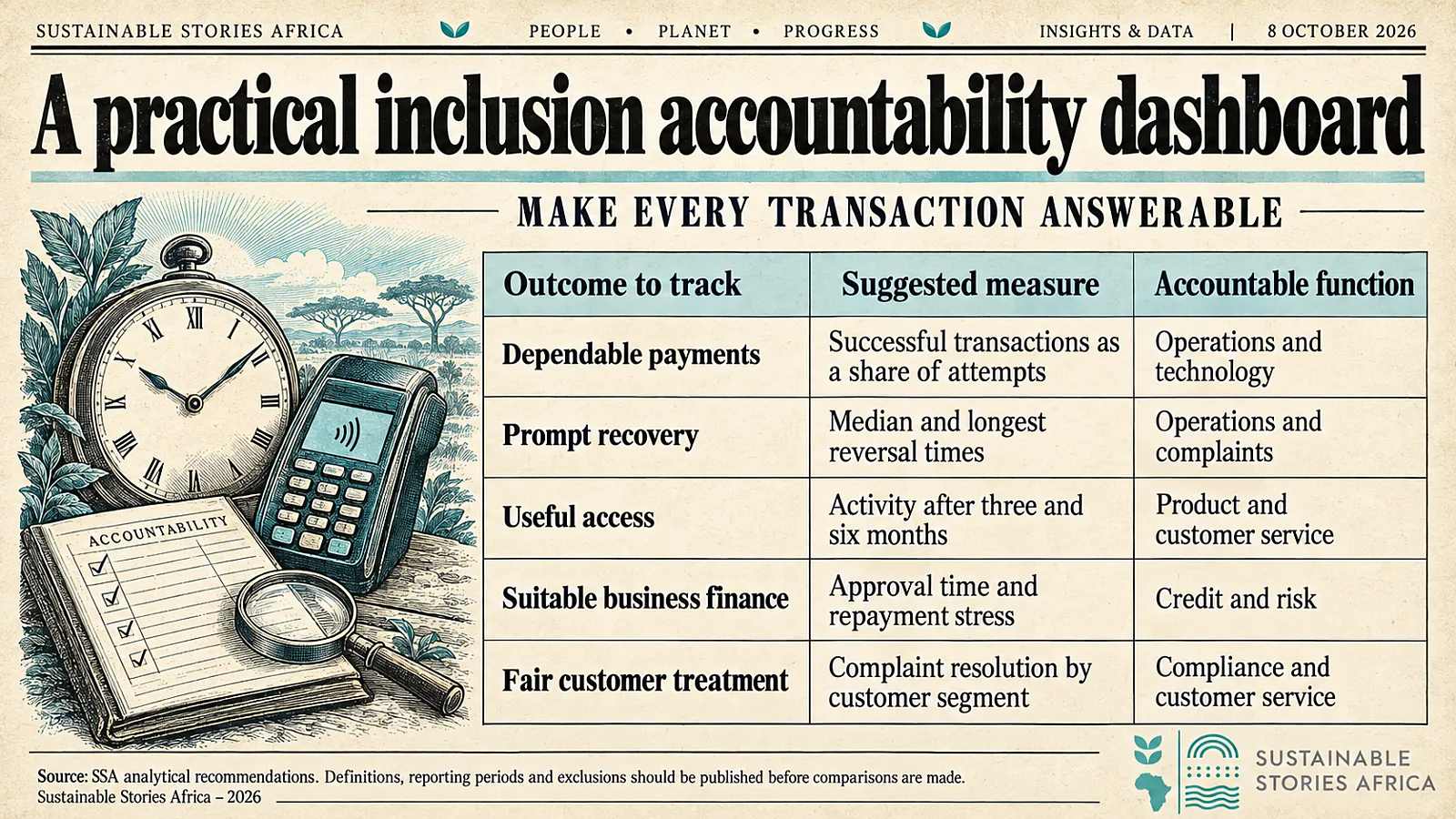
- Banks and fintechs should investigate the reasons behind repeat failures, including which customers experience them most often.
- Regulators can encourage comparable reporting definitions so that institutions cannot improve their apparent performance by changing the denominator or excluding difficult cases.
Customer research should include people who tried to register and stopped, as well as active users.
- Otherwise, product teams hear mainly from those who already navigated the system successfully.
- Low-income customers may need low-data interfaces, clear fee explanations and an accessible complaints channel. Each design should be tested with its intended users.
Coordination also needs defined responsibilities.
- A joint inclusion initiative should identify which institution resolves identity mismatches, which supports agents and who owns complaints that cross providers.
- Any sharing of personal information requires appropriate consent and controls. Accountability should follow the customer journey through to resolution.
Path Forward – For Financial Inclusion Reform
Nigeria’s next inclusion gains should combine wider reach with dependable service, useful savings and suitable finance.
Providers should publish customer outcomes and investigate where access fails to produce resilience.
Regulators, banks and fintechs can turn coordinated outreach into measurable progress by defining responsibilities and following customers beyond registration.
That would strengthen the social and governance case for financial inclusion.