McKinsey’s 2026 dairy survey finds companies under margin pressure while many expect revenue growth.
Protein demand, supply constraints and different approaches to sustainability shape the agenda in the United States and Europe.
For African dairy systems, the findings raise questions to test about nutrition, efficient processing and farmer resilience, rather than ready-made forecasts of local demand.
Dairy Growth Depends On Resilient Supply
Dairy processors are pursuing growth while managing pressure on margins, labour and milk supply.
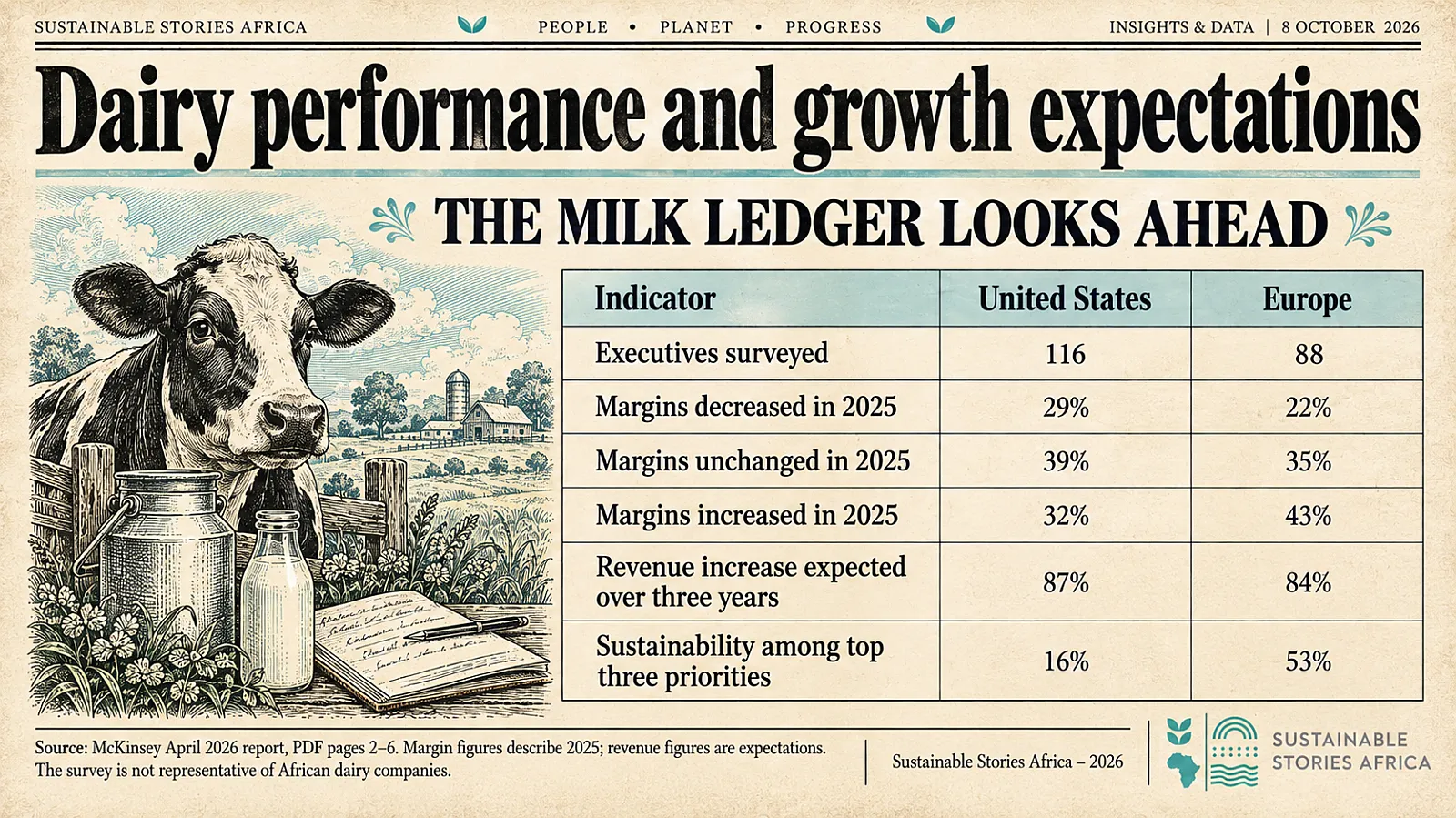
McKinsey’s April 2026 report draws on a survey of 204 executives in the United States and Europe, conducted with industry associations in the final quarter of 2025.
Nearly seven in ten US respondents and 57% of European respondents reported flat or declining margins in 2025.
- Nevertheless, 87% in the United States and 84% in Europe expected revenue increases over the following three years.
These are reported outcomes and expectations from the surveyed markets.
For Africa, the analysis offers a useful management comparison.
- The central question is how processors can maintain affordable nutrition while strengthening supply, using resources efficiently and supporting the people whose work sustains production.
Cost Pressure Shapes The Industry Agenda
The survey involved 116 executives in the United States and 88 in Europe, alongside interviews with 41 executives.
- Participants came from different parts of the dairy value chain.
- Questions were tailored to respondents’ areas of expertise, so percentages on strategy and sustainability should not be treated as answers from one identical respondent group.
Cost management and volume growth were prominent priorities.
- About 65% of US respondents placed cost management among their top three priorities, compared with roughly half of European respondents.
- Rising raw material and logistics costs help explain why growth expectations can coexist with weak margins.
Revenue growth alone cannot establish stronger profitability.
- Higher prices can increase revenue while input costs rise faster.
- Greater sales volume can also require additional working capital, transport and processing capacity.
Leaders therefore need to examine the sources of growth and the cost of delivering it.
Sustainability Priorities Differ Across Surveyed Markets
The regional comparison is particularly clear on sustainability.
- 53% of European executives ranked it among their top three priorities, compared with 16% in the United States.
- That difference describes the surveyed agenda; it does not establish that one region has better environmental performance.
Among sustainability priorities, emissions reduction was prominent in both regions.
- The report finds an increasingly practical focus on measurable initiatives such as energy efficiency, water use and logistics.
- This approach can link environmental outcomes with operating decisions, provided companies disclose the relevant boundaries and results.
The report also identifies supply concerns in Europe.
- 45% of European dairy leaders cited security of supply among their most pressing concerns
- 64% of processor executives expressed concern about farming demographics and succession gaps.
Milk supply depends on farms’ viability and the factories’ capacities.
African processors should examine comparable vulnerabilities through local evidence.
- An illustrative processor may have spare factory capacity but struggle with seasonal collection or quality variation.
- Expanding production equipment would not resolve those constraints on its own.
- Investment decisions should follow an assessment of supply, market demand and the logistics connecting them.
Environmental efficiency also needs careful measurement.
- Using less energy in a plant can be valuable, but a narrower factory boundary may omit transport or farm emissions.
- Reporting should distinguish efficiency gains per unit from changes in total environmental impact as production grows.
Protein Innovation Must Fit Local Needs
Protein demand is a major growth theme.
- 88% of US dairy executives identified it as the most influential consumer demand trend.
- The report also cites 17% compound annual growth in Western Europe’s high-protein dairy segment between 2019 and 2024.
These findings support discussions of product innovation in the surveyed markets, not a forecast for African consumers.
- Local demand depends on household budgets, preferences, product availability and nutrition needs.
- A premium high-protein product can serve one market segment without improving access for households that cannot afford it.
For African businesses, innovation could include suitable pack sizes, reliable storage and products designed around actual consumption patterns.
- A product’s nutritional value should be explained accurately, without presenting a marketing trend as a universal health requirement.
Supporting farmers can also improve resilience.
- Predictable collection, clear quality standards and transparent payment arrangements may help producers plan.
- The commercial value of those measures should be tested alongside the effect on farmer incomes and participation.
- A processor’s improved margin does not automatically mean the wider value chain is stronger.
Digital tools and AI appear in the report as emerging opportunities.
- Their relevance depends on a specific operational problem, such as demand planning or maintenance.
- Where records are weak, improving basic data quality may be a necessary first investment.
Affordability should remain visible in that assessment.
- A processor may improve efficiency without reducing the price consumers pay, depending on other costs and market conditions.
- Public claims about affordable nutrition therefore need evidence at the product and customer level.
Businesses can compare pack prices, quantities and availability over time, while explaining changes in ingredients or specifications.
- This would help stakeholders understand whether innovation widened access or mainly served a higher-income segment.
Both can be commercially legitimate, but their social contribution differs and is accurately described in sustainability reporting.
Leaders Need Integrated Operating Performance Measures
A practical dairy strategy should connect commercial growth with resource use and supply resilience.
The following table captures the report’s sustainability comparison and differences between the priorities respondents selected.
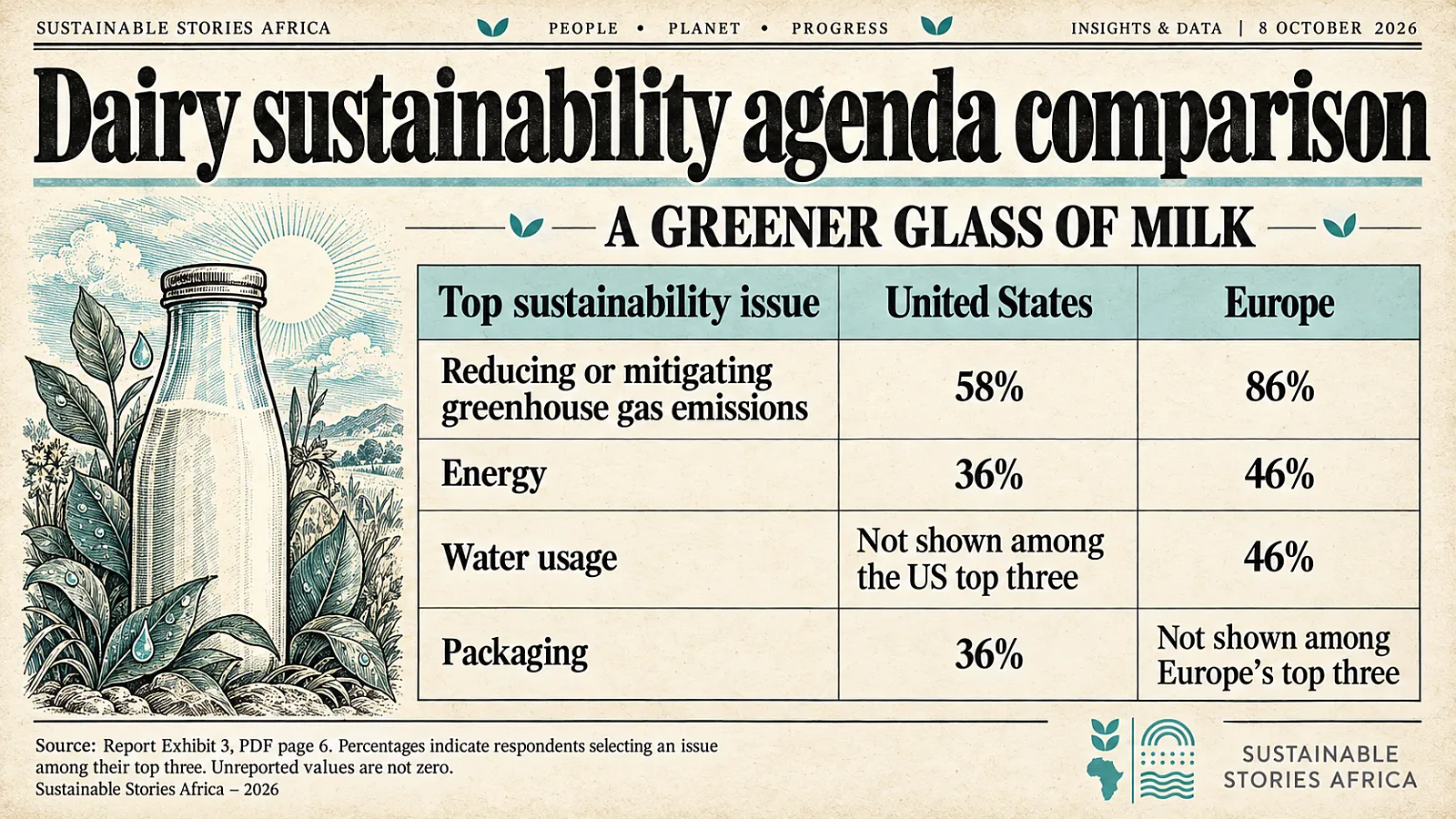
- African processors can use this comparison to formulate questions, then establish local baselines.
- Useful measures include rejected milk, collection losses, energy per unit processed and supplier payment performance.
Each should have a clear reporting period and definition.
Investment appraisal should examine trade-offs.
- A longer transport route might broaden farmer participation while raising collection costs. Improved cooling could reduce waste and require reliable power and maintenance.
- Decisions should show why a particular option delivers value under the conditions in which it will operate.
Industry associations and financiers can help by developing comparable performance definitions and supporting practical training.
Public sustainability claims should then refer to measured changes, with enough context for stakeholders to understand whether outcomes improved across the supply chain.
Path Forward – For Sustainable Dairy Growth
African dairy leaders should use the survey for comparison, then test local priorities through data on demand, supply and operating performance.
Affordable nutrition and viable farming need attention alongside factory margins.
Resource efficiency can support resilience when gains are measured, and investment fits local conditions.
Transparent reporting would help distinguish durable improvement from growth that shifts costs onto suppliers or the environment.