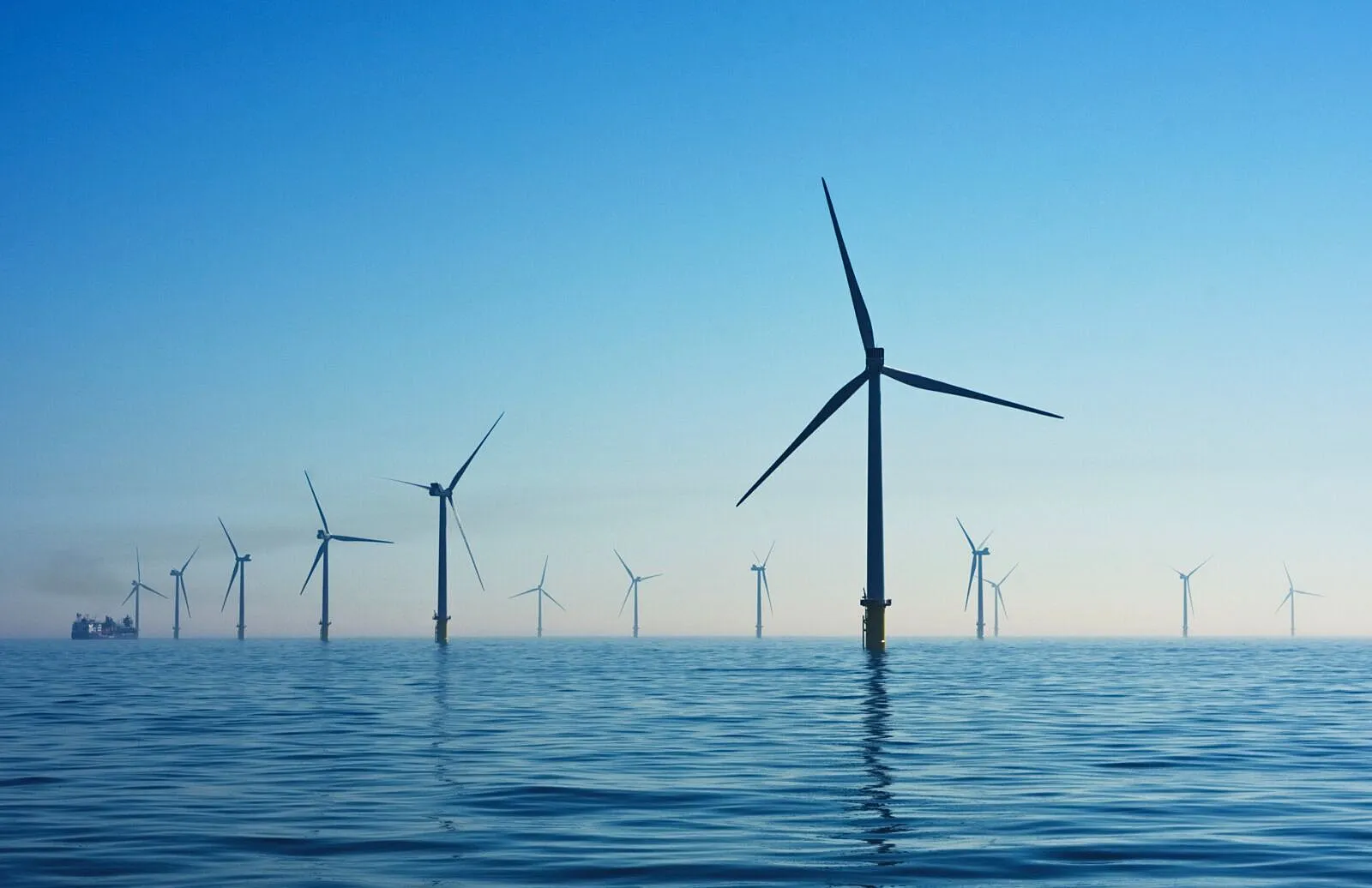
Large-eddy simulations suggest that low-level clouds help offshore wind farms recover from the wakes they create.
Researchers at the University of Twente say cloud-top cooling deepens the atmosphere above the turbines.
The findings matter because wake losses cut output. It also exposes a gap in the models used to forecast and plan wind projects.
Why Clouds Now Matter to Wind
Davide Selvatici and Richard Stevens published their study in PRX Energy on 2 September 2026.
- They found that radiatively driven cloud-top entrainment is a key mechanism linking cloud dynamics to the performance of large wind farms.
Cloud-top cooling creates a deeper, less stable boundary layer.
- That layer carries momentum and energy down toward the turbines, so wakes recover faster.
The authors argue that wind-energy models should explicitly represent interactions among wind farms, the atmosphere and clouds.
- As offshore wind scales up globally, including along African coastlines, that gap becomes a planning risk.
Offshore Wind's Overlooked Partner Hangs Overhead
Wakes from wind farms can extend up to 70 km downstream, and wakes from neighbouring farms can hurt power production.
- For large farms, farm-scale losses are typically more than twice turbine-scale losses.
Low-level cloud cover exceeds 30% in the North Sea and 35% along the eastern Chinese coast, both among the densest offshore wind regions.
However, marine clouds remain mostly unstudied in this context.
The physics starts at the cloud top.
- Net radiative cooling there, typically 50-90 W m-2, drives turbulence that pulls warm, dry air down into the boundary layer.
- Cooling rates of 5-10 K per hour dwarf the surface heating or cooling rates, which are usually below 1 K per hour.
The relationship also runs both ways.
- Wind farms can perturb the cloud layer, raising liquid water near the farm entrance and reducing it farther downstream.
What the Simulations Reveal About Wake Recovery
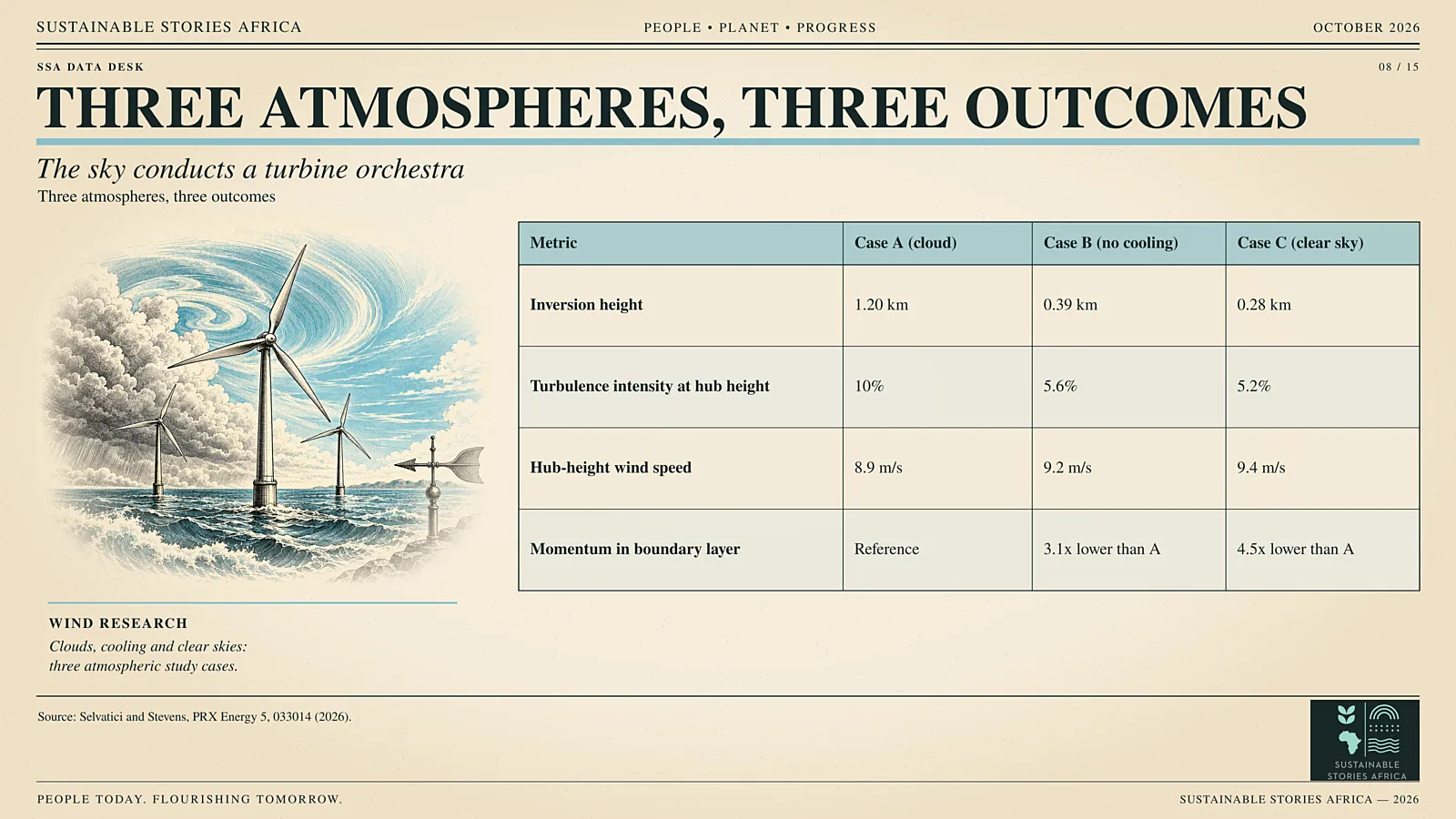
The team simulated a 9x5 array of IEA 10 MW turbines, each with a 198 m rotor, under three conditions.
- Case A was a full stratocumulus-topped boundary layer.
- Case B removed radiative cooling.
- Case C was clear sky.
The 128 ensemble simulations explored the wider parameter space.
- In Case A, wake-added turbulence reached about 0.8 km in height and extended more than 35 km downstream.
- In Cases B and C it stayed near 0.4 km, because the wake could not penetrate the shallow capping inversion.
Faster recovery in Case A appeared about 4 km beyond the farm exit.
Near the farm, the picture is more nuanced.
- Shallow cases recovered faster in the first 4 km thanks to a supergeostrophic jet above the turbines.
- Further downstream, that advantage faded, and the deeper cloudy layer, with higher turbulence and more momentum, took over.
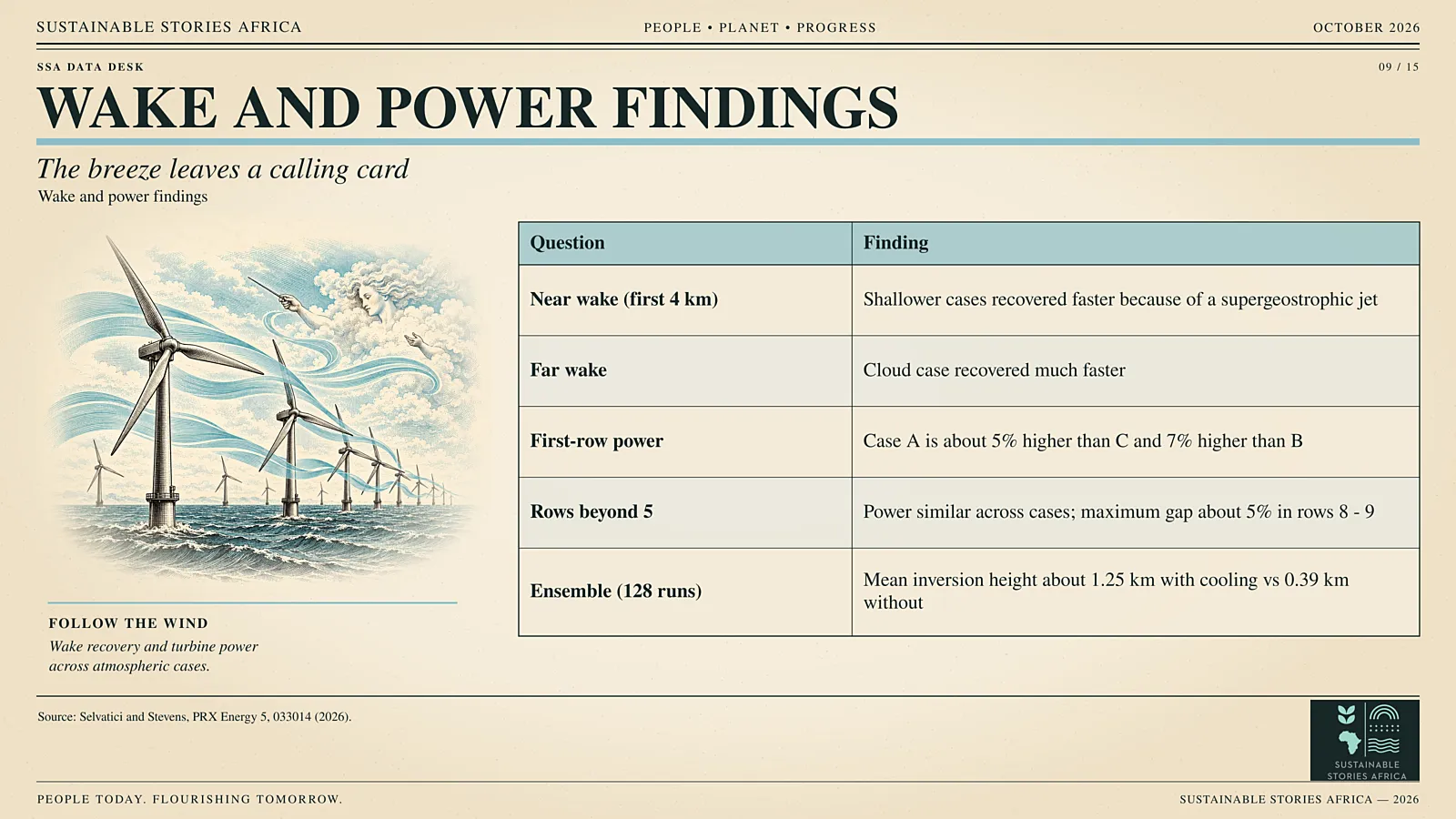
The authors caution that these power results should not be read as the overall effect of clouds on wind-farm output.
- Inversion height, turbulence and inversion strength can each shift production substantially.
- Their point is about mechanisms: far-wake recovery is controlled mainly by boundary-layer structure, not by differences in turbine thrust.
Better Models Could Unlock Smarter Wind Investment
Accounting for cloud-boundary-layer coupling is, in the authors' words, essential for better wind-energy forecasts, especially in regions with frequent low-level cloud cover
- Better wake models support better layouts, spacing and revenue forecasts, all of which feed financing decisions.
For lenders;
- Small improvements in yield prediction can change risk pricing across a portfolio.
For grid operators;
- More accurate forecasts of output from clustered farms ease balancing.
For communities;
- Better planning can mean fewer overbuilt sites and more efficient use of the sea.
The study uses idealised nocturnal conditions and lacks supporting observational data, a limitation the authors acknowledge.
It signals a research priority, not a ready-made design rule, and developers should treat it that way.
What Developers and Regulators Should Do Next
The practical next step is testing.
Wind modellers can check whether cloud-coupled effects change yield estimates in their own regions before they rely on cloud-free assumptions.
- Developers and modellers: test cloud-coupled boundary-layer effects in wake and yield models, particularly in cloudy regions.
- Regulators and grid planners: treat wake interactions between neighbouring farms as a cumulative planning issue.
- Researchers and funders: gather observational data on cloud and wind-farm effects, as the authors recommend.
- African offshore-wind planners: check local cloud and boundary-layer conditions before borrowing European yield assumptions.
Cumulative effects deserve particular attention.
- As more farms cluster in the same waters, their wakes and atmospheric footprints interact, and planning rules written for single projects may miss the combined impact.
The Path Forward for Offshore Wind
Clouds appear to shape how quickly wind farms recover from their own wakes.
Developers, regulators and researchers should build that into models and field campaigns.
For African markets entering offshore wind, better physics means more bankable projects, sounder grid planning and a more credible transition.