Interview theme - NMDPRA Role in Downstream and Pricing
Nigeria’s petrol-price debate is also a debate about evidence.
Consumers need to understand costs, operators need predictable rules and regulators need reliable information about supply and market conduct.
Jide Pratt’s TVC discussion provides the starting point for an examination of how transparent pricing and better measurement could strengthen consumer protection without confusing market oversight with routine price setting.
Fuel Prices Need A Clearer Explanation
Nigeria needs better information on fuel costs, stocks and sales to make downstream petroleum oversight more credible.
In a TVC interview with Tolulope Ogunjobi, Jide Pratt, Country Manager for TradeGrid and COO AIONA, called for transparent pricing inputs and stronger data systems across the market.
His discussion of the NMDPRA’s role addressed a question with immediate consequences for transport operators, businesses and households:
- If the regulator does not routinely set pump prices, how should consumers assess price changes and hold suppliers accountable?
The answer requires two kinds of evidence.
- Commercial information explains how fuel reaches a retail price.
- Regulatory information shows whether competition, quality, measurement and complaint systems are working.
This distinction frames SSA’s analysis for November 18, 2026.
Price Differences Need Evidence Before Conclusions
Pratt traced pump prices through product sourcing, transport, financing and margins, and explained why inventory and replacement costs can affect the timing of price changes.
- A movement in crude prices or exchange rates therefore does not explain every retail adjustment on its own.
For a consumer, however, an explanation is useful only if it can be checked.
- A price board shows what a station charges, but it does not show the age of its inventory, the cost of delivery or the basis of its commercial decisions.
- This information gap makes public debate vulnerable to claims that are difficult to test.
Neither a high price nor a difference between two stations establishes misconduct by itself.
- Equally, describing a market as deregulated does not answer concerns about false measurement, misleading information or conduct that weakens competition.
- The appropriate response is to establish what happened and compare it with the relevant evidence.
Market Pricing Still Requires Regulatory Oversight
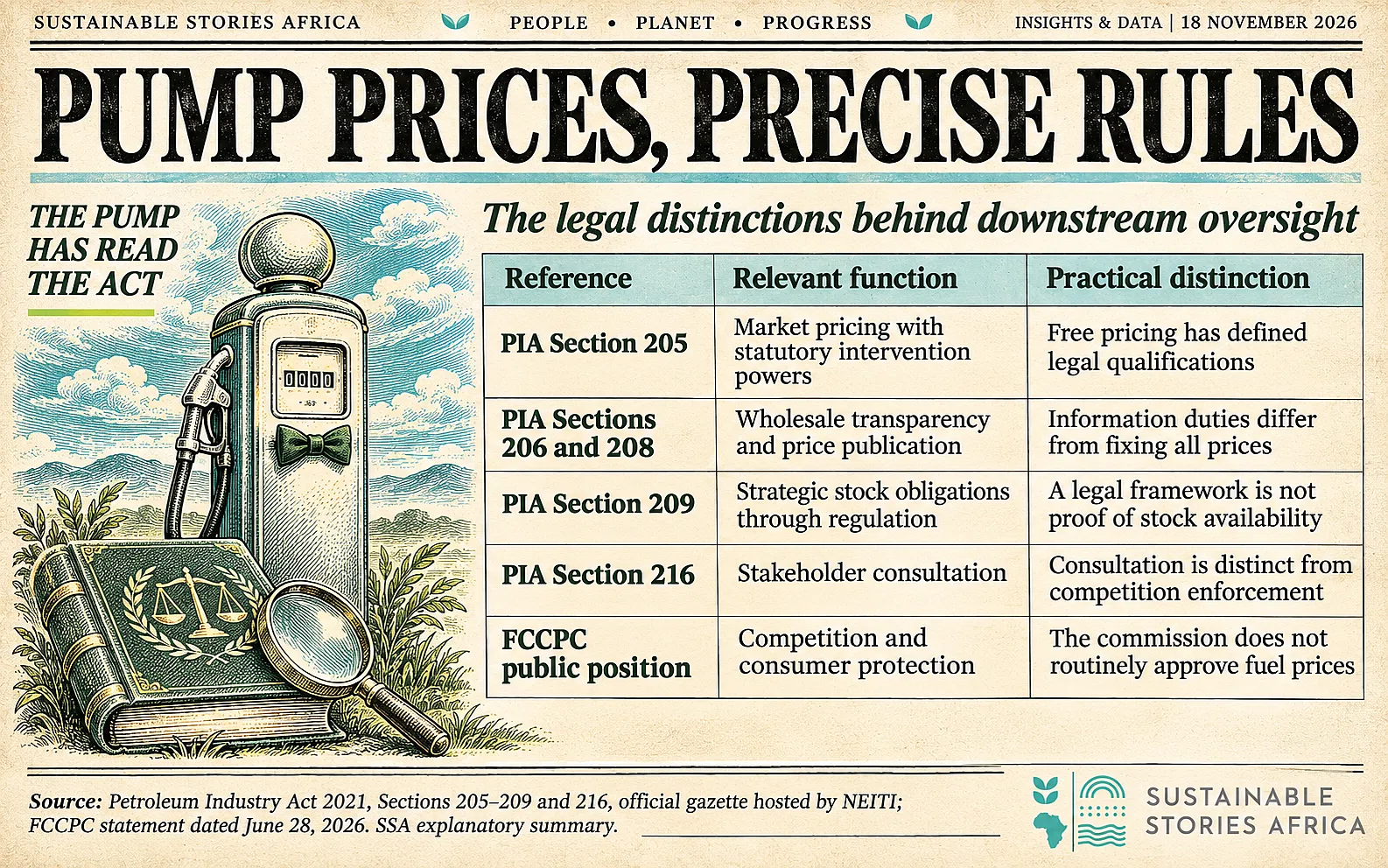
The Petroleum Industry Act provides the legal context.
- Section 205 establishes free-market petroleum-product pricing, subject to its provisions for intervention.
- Sections 206 and 208 address wholesale-price transparency and price publication, while
- Section 209 provides for strategic-stock obligations through regulation.
- Section 216 concerns consultation before regulations are finalised.
These functions should not be collapsed into a claim that the regulator sets every pump price.
The FCCPC has separately stated that it does not approve petroleum prices in the deregulated downstream market.
- Its role is to promote competition and protect consumers against unfair, deceptive or exploitative practices.
- This distinction is important when interpreting interview shorthand about consumer protection and price regulation.
NMDPRA’s published description of its work includes licensing compliance, cost benchmarking, customer protection, product quality and environmental oversight.
- These responsibilities show why market pricing and active supervision can coexist.
- A regulator can examine whether a market operates fairly without substituting a routine administrative price for every commercial transaction.
Reliable Measurements Could Improve Market Trust
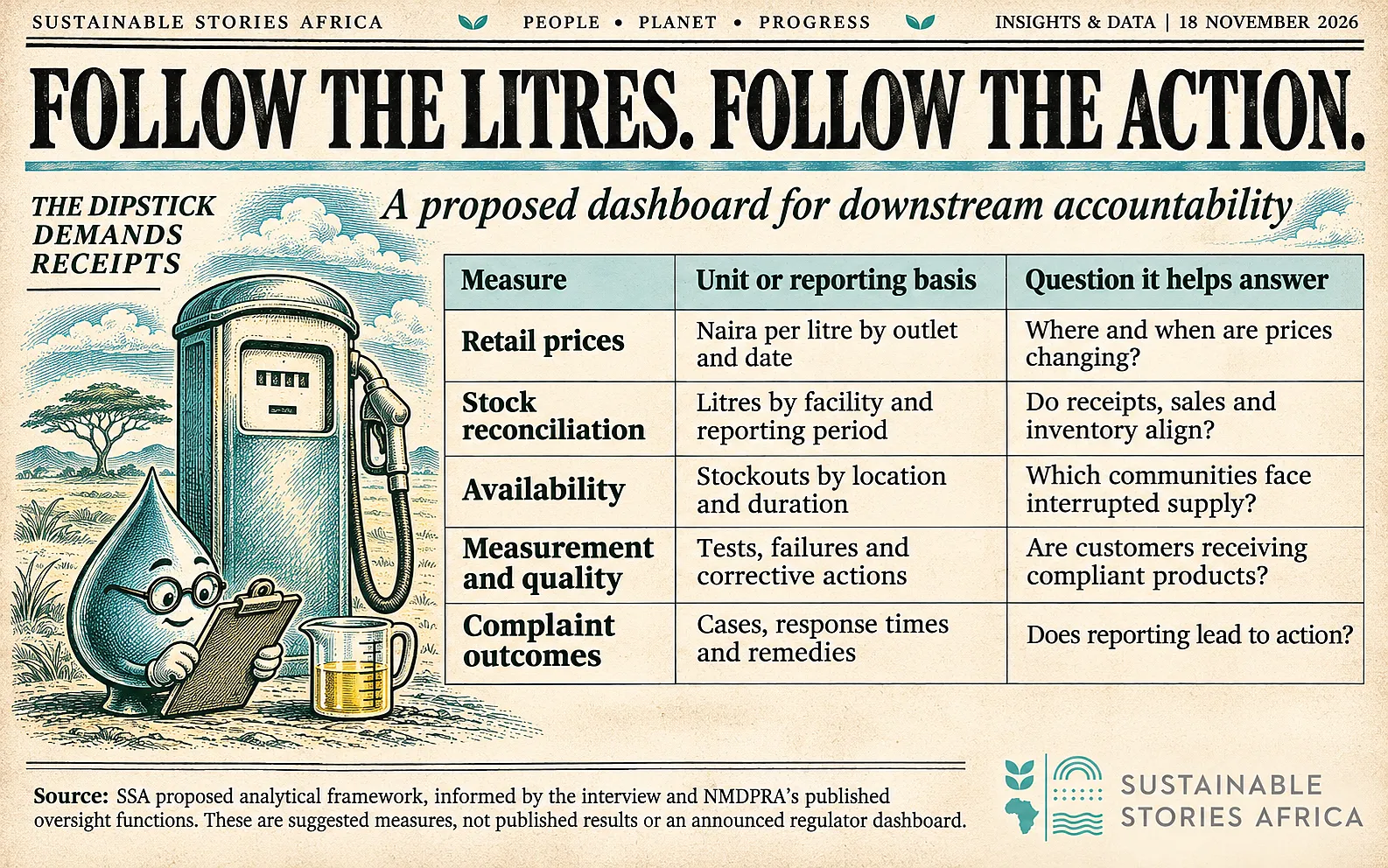
Pratt also distinguished fuel delivered to a station from fuel actually sold, advocating better stock monitoring and reconciliation.
- The distinction is fundamental to understanding supply: a delivery record establishes movement into storage, while retail sales establish movement to customers.
The starting point is a consistent stock account.
- Opening inventory plus receipts should be reconciled with recorded sales, closing inventory and documented adjustments.
- A discrepancy is a reason to investigate measurement, timing or record quality; it is not automatic evidence of diversion.
For policymakers, the value lies in locating the problem correctly.
- A national aggregate can conceal local shortages. Storage capacity can exist without usable stock.
- A reported delivery can be delayed before reaching retail customers.
Separating these measures makes it easier to assess whether an intervention should address information, transport, availability or conduct.
Better measurement can also make the consumer’s experience more visible.
- Regulators and operators should be able to compare complaints about quantity or quality with inspection findings and the action taken.
- A complaint count alone cannot show whether consumers received a remedy.
The sustainability case follows from this accountability.
- Reliable measurement supports fair treatment and resource management.
- Environmental improvement requires additional evidence, such as verified product-quality performance, spill records or transport-efficiency data; it should not be assumed from digitalisation alone.
Publish Evidence That Consumers Can Use
A useful public information system would distinguish price observations from cost indicators and enforcement decisions.
- Each series should state its date, location, unit and coverage.
- An average without a sampling method can give a false impression of precision, especially where market conditions differ across regions.
Operators can improve their own records by keeping delivery, inventory and sales measures consistent and by explaining material adjustments.
- Any data-sharing arrangement should identify who supplies each field, who verifies it and how errors are corrected.
- Clear definitions matter as much as the technology used to collect the information.
For complaints, consumers should retain receipts and note the outlet, transaction date, product, displayed price and disputed quantity.
- Photographs taken safely can support a complaint, but an apparent quantity discrepancy requires appropriate testing.
- Complaint processes should provide a reference number and a route for escalation through the operator and the relevant authority.
Pratt advocated clearer pricing information, stronger monitoring and accessible complaint channels.
SSA’s assessment is that these proposals become more useful when performance is published:
- How complete the records are, how quickly cases are acknowledged and what inspections or remedies follow.
- No unverified service deadline should be presented as a universal regulatory guarantee.
The aim should be a market in which consumers can understand the evidence and operators can plan against clear requirements.
That calls for consistent reporting, justified enforcement and visible follow-through rather than an assumption that one data platform can resolve every supply constraint.
Make Market Accountability Visible To Consumers
Nigeria’s downstream market needs information that connects price explanations with verifiable supply, measurement and complaint outcomes.
Regulatory credibility will depend on the quality of that evidence and the response when problems are established.
Transparent reporting can support fair competition and consumer trust.
Its development value should be assessed through reliable access, accurate transactions and accountable remedies, alongside separately measured safety and environmental performance.