The Gambia aims to cut net greenhouse gas emissions 7.2% below its 2035 projection through domestic measures.
The reduction could reach 31.9% with the full package of domestic and internationally supported measures.
The submission also sets out distinct plans for coastal protection, adaptation and recovery from climate-related loss and damage.
The Gambia Quantifies Its Domestic Pledge
The Gambia filed its third nationally determined contribution (NDC 3.0) on 31 August 2026.
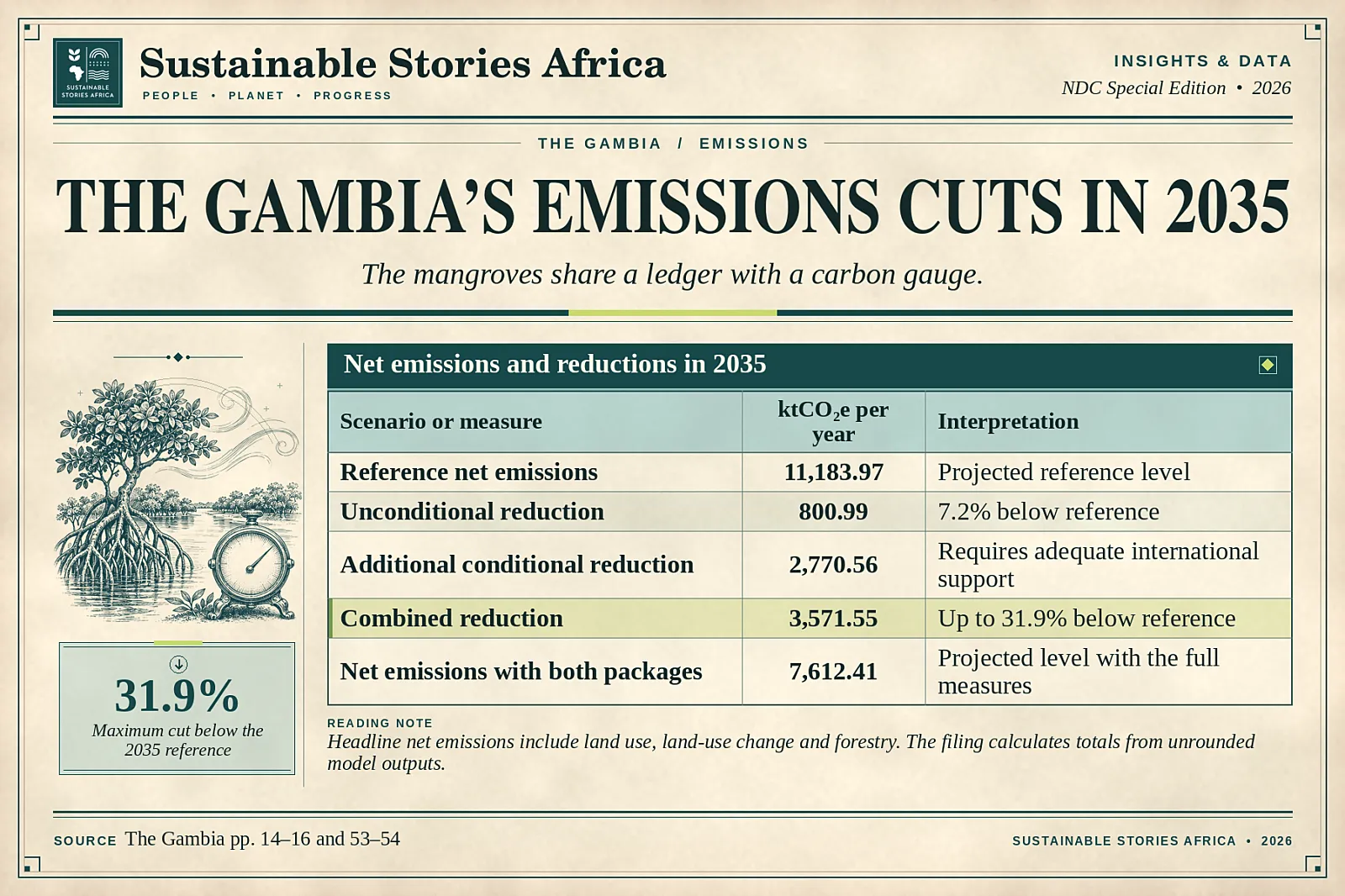
- Under its reference scenario, the active filing projects net greenhouse gas emissions of 11.184 million tonnes of carbon dioxide equivalent (MtCO₂e) in 2035.
- Its full mitigation package would bring that figure to about 7.612 MtCO₂e.
The plan distinguishes between the measures The Gambia intends to undertake domestically and the additional measures that need support.
- The filing quantifies 39 mitigation measures, including 10 unconditional and 29 conditional measures.
- This split lets readers track how international cooperation affects the outcome.
A nationally determined contribution is the climate plan a country communicates under the Paris Agreement.
- The Gambia’s latest plan pairs its 2035 target with measures to reduce vulnerability and respond to climate impacts.
- For communities exposed to floods and saltwater intrusion, delivery means reliable water supplies and coastal protection.
What The Two Mitigation Packages Deliver
The domestic package would avoid about 801 kilotonnes of carbon dioxide equivalent in 2035, equal to approximately 7.2% of projected net emissions.
- The additional conditional contribution would avoid about 2,771 kilotonnes.
- Together they would deliver a reduction of roughly 3,572 kilotonnes, or up to 31.9% below the 2035 reference.
The headline target counts land use, land-use change and forestry.
- The Gambia also reports results excluding that category, which gives readers a way to understand the role of land-sector emissions and removals.
- Its quantified portfolio covers energy, agriculture, land use and waste, among other sectors.
- The filing includes a further refrigerant-related action whose emissions effect has yet to be quantified.
The previous plan communicated a 49.7% reduction from a 2030 reference.
- The Gambia’s latest filing explains that the target year, underlying data and model have changed.
- Its new domestic figure and list of measures provide a clearer basis for implementation, while the percentages alone give a limited view of how ambition changed.
The Gambia reports its pathways in kilotonnes of carbon dioxide equivalent per year.
- One thousand kilotonnes equals one million tonnes.
- Publishing tonnes and percentages together helps readers distinguish each package's contribution from the reference size.
- The additional contribution is one part of the combined outcome.
How The Measures Can Reduce Emissions
The submission groups some work as enabling measures.
- Stronger data collection and coordination can support the projects that reduce emissions directly.
- These activities have their own costs and responsibilities.
- A funding record can account for them while emissions reports attribute quantified reductions to the measures that produce them.
The filing includes renewable electricity, energy efficiency, cleaner cooking and more sustainable transport.
- It also identifies waste recovery, composting and wastewater measures.
- Estimating their emissions effect depends on local data, such as fuel use, electricity delivered and the amount of waste diverted or treated.
Reforestation and agroforestry have a role in the land sector.
- Their impact depends on tree conditions and land over time, as well as on what would have happened under the reference scenario.
- Land-sector data can help readers distinguish restoration progress from cuts in sources such as fuel use.
The Gambia’s earlier stocktake found that incomplete or inconsistent data limited its ability to assess emissions reductions under its previous plan.
- The new submission proposes stronger monitoring and specifies measures of individual contribution.
- This can make it easier to see which projects are delivering results and where the evidence still needs improvement.
Where Coastal Protection And Recovery Meet
Saltwater can affect farms and freshwater supplies before a single event that triggers emergency assistance.
- Local reporting can capture the persistence of those effects and how people respond.
- It can also help identify which communities need protection or changes in water management and where recovery support should cover losses that have already occurred.
The plan identifies coastal erosion, saltwater intrusion, flooding and heat as threats to communities and services.
- Adaptation measures include coastal protection, stronger water and sanitation systems and improved irrigation.
- Communities can track whether these measures improve drinking water reliability or reduce flooding in exposed areas.
The loss and damage section addresses impacts that communities still experience.
- Priorities include early action, emergency response, rehabilitation and reconstruction.
- The filing also recognises displacement and losses that are difficult to price, including damage to ecosystems and culturally significant places.
The plan assigns an initial estimate of $250 million for programme planning to loss and damage.
- Adaptation has its own indicative estimate of $590 million.
- Keeping these categories visible helps readers follow spending on measures that reduce exposure and on assistance for people already dealing with losses.
The submission describes regional consultations held between May and July 2026, involving 294 participants.
- It says those consultations helped shape priorities.
- Continued participation can help agencies see how choices about water, coastal works and emergency support affect households.
- Reporting the outcomes of local programmes would give communities a way to judge how the priorities identified in consultation were carried through.
What The Financing Estimate Can Show
The filing calls for predictable support for national priorities, including grants, concessional financing and help preparing projects.
- A coastal intervention may need design, assessment and consultation before construction can begin.
- Budget documents can show how those preparatory steps are funded and which conditions still need to be met.
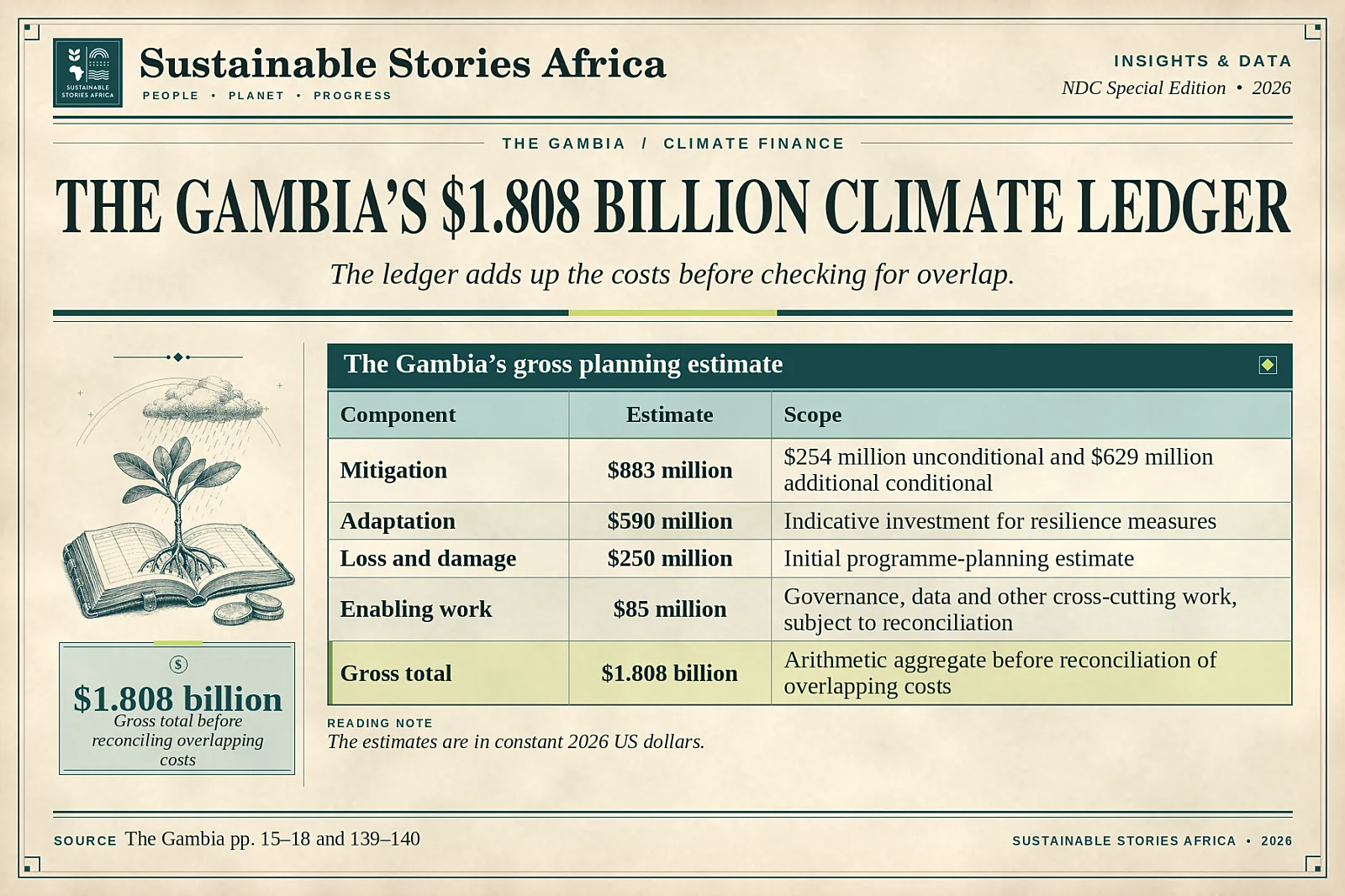
The Gambia reports a gross planning aggregate of $1.808 billion in constant 2026 dollars.
- The sum includes $883 million for mitigation, $590 million for adaptation, $250 million for loss and damage and $85 million for enabling work.
- The filing says the total must be reconciled against overlap between programme costs.
Within mitigation, the government estimates $254 million for the unconditional package and $629 million for the additional conditional package.
- Its outside support plan includes climate finance, technical assistance and capacity building.
- Project records can distinguish those forms of support and show when a conditional measure has sufficient resources to begin.
The Gambia plans a national transparency system to connect emissions inventories with mitigation, adaptation, loss and damage and finance reporting.
- Local agencies can help test whether those systems capture what happens on the ground.
- Coastal works, water supplies and recovery programmes need evidence on the places and households they reach.
Under the Paris Agreement, national transparency reporting can show records of how the contribution is being implemented.
- The Gambia proposes common definitions, reporting periods and quality standards across agencies.
- This would help connect emissions, finance and local outcomes and give officials a way to revise costs or change projects when evidence shows a programme is falling behind.
The proposed investment pipeline is intended to link each measure with its estimated cost, financing source and implementing institution.
- For a coastal project, this can make it possible to follow spending from assessment and design through construction and operation.
- A shared set of records can also identify where a financing estimate overlaps with another programme before the totals are updated.
Path Forward – What To Track In The Gambia
Follow the domestic and conditional packages separately, alongside updates to the gross financing estimate as overlapping costs are reconciled.
Track coastal protection, water quality and recovery support by location.
The national transparency system can show how those results relate to financing and the wider Paris Agreement pledge.