Botswana’s new Paris Agreement pledge could hold its 2035 greenhouse gas emissions 31.5% below the projected level with international support.
The domestic pathway delivers a smaller cut.
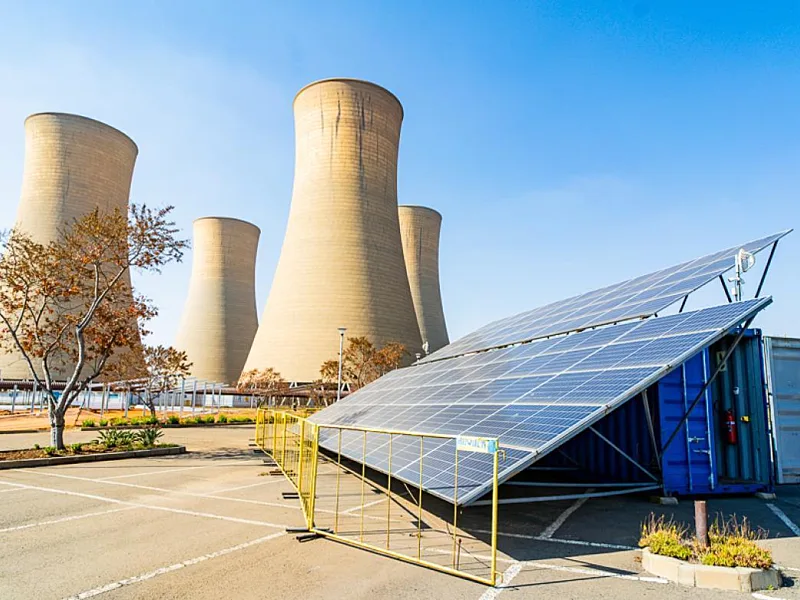
Solar power is central to the mitigation plan.
Drought, livestock losses and pressure on water supplies explain why adaptation is first for Botswana.
Botswana Sets Out Its Two Pathways
Botswana filed its third nationally determined contribution (NDC 3.0) on 8 November 2026, a day before the start of COP31 in Antalya, Türkiye.
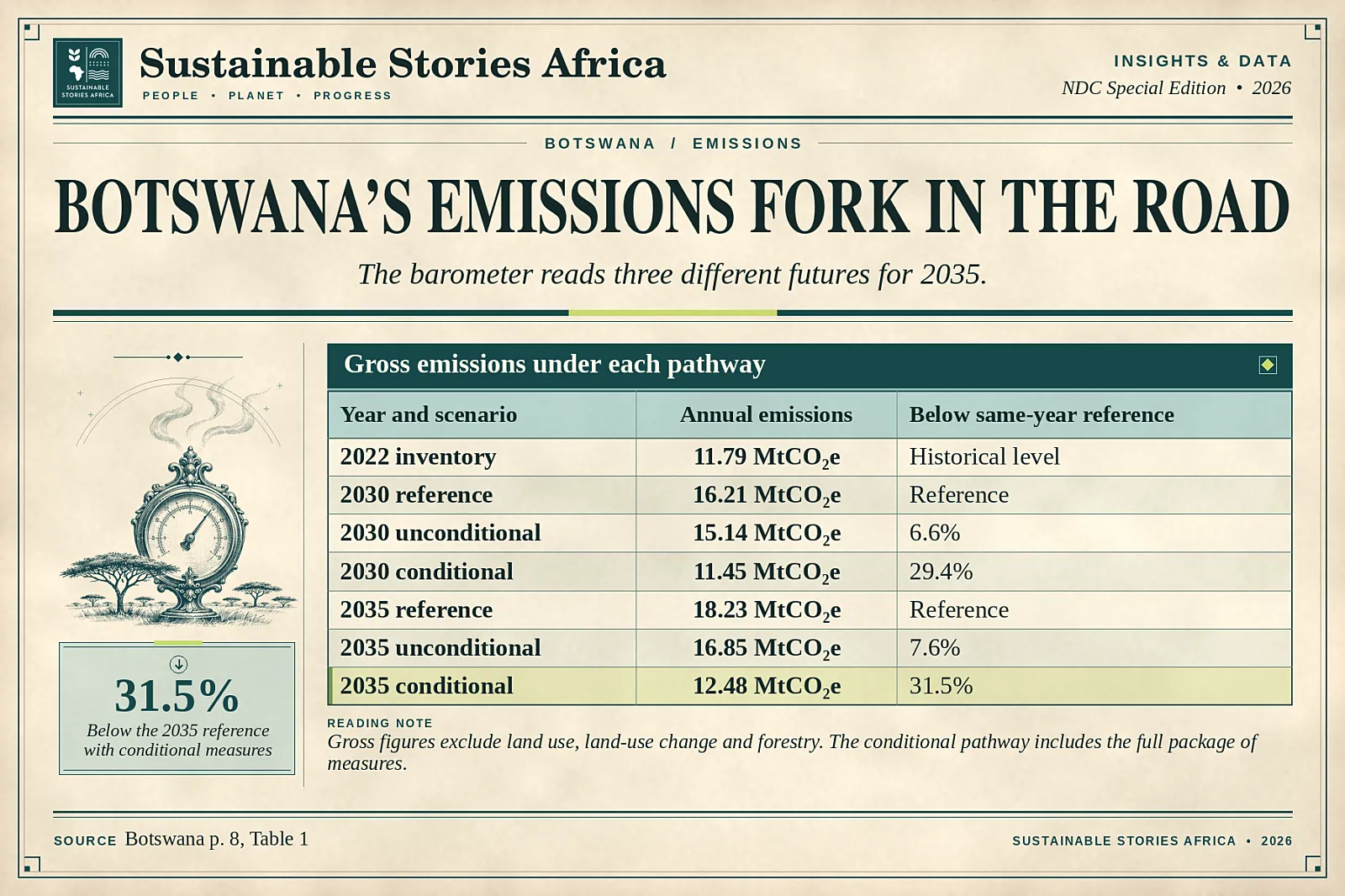
- The active submission projects gross greenhouse gas emissions of 18.23 million tonnes of carbon dioxide equivalent (MtCO₂e) in 2035 under business as usual.
- With international support, Botswana expects to hold emissions to 12.48 MtCO₂e.
The 31.5% reduction is measured against that 2035 projection.
- Compared with the 2022 inventory of 11.79 MtCO₂e on the same basis, the full-support pathway would still leave 2035 emissions around 6% higher.
- Electricity demand and the timing of new renewable capacity help explain how both comparisons can be true.
Under the Paris Agreement, an NDC is a national climate plan.
- Article 4 requires successive submissions every five years and calls for progressively greater ambition.
Botswana’s new filing uses its 2022 inventory to quantify the potential of individual measures, while presenting forest and land-use accounting separately from the headline target.
What The New Emissions Targets Measure
The plan gives Botswana two sets of milestones.
- For 2030, the domestic scenario would hold gross emissions to 15.14 MtCO₂e against a projected 16.21 MtCO₂e. With the full set of measures, the figure would fall to 11.45 MtCO₂e.
- This supports 2030 level is about 2.8% below the 2022 inventory, before rising again by 2035 in the model.
The power plan underpinning those projections schedules renewable additions through 2030.
- The submission models increasing power demand after that point without further scheduled additions in the version of the electricity plan it uses.
- The actual trajectory will depend on when additional generation comes into service and what it displaces.
This makes the next electricity planning cycle relevant to the climate pledge.
The domestic and supported pathways are alternative national scenarios.
- Their percentage reductions share a reference case, and the supported percentage already reflects the full portfolio.
- Readers can follow the gap in tonnes to see the value of additional measures, while keeping the 2022 inventory in view to understand the direction of national emissions.
Botswana’s 2024 submission used a 15% reduction below its 2030 reference.
- The new filing uses a different model and reports 6.6% below its 2030 reference domestically and 29.4% below it with support.
- The revised inventory and assumptions matter when comparing the old and new percentages.
The new scenario table helps by publishing the annual emissions levels alongside the cuts.
Why Solar Power Leads The Plan
The NDC identifies utility-scale solar as its highest-ranked mitigation measure and follows it with coal phase-down and integrated fire management.
- Prioritisation helps show how the government expects to achieve the aggregate reduction.
- It can also guide lenders and agencies toward projects that need decisions on land, grid connection or finance before capacity can be built.
Energy accounted for 7.80 MtCO₂e, or 66.2% of Botswana’s gross 2022 inventory.
- The filing includes a 188 MW domestically financed solar programme and places the Mmadinare and Jwaneng independent power projects in the supported pathway.
- It records their reported investment separately from the new conditional funding sought, so the same project investment is counted once in the costing.
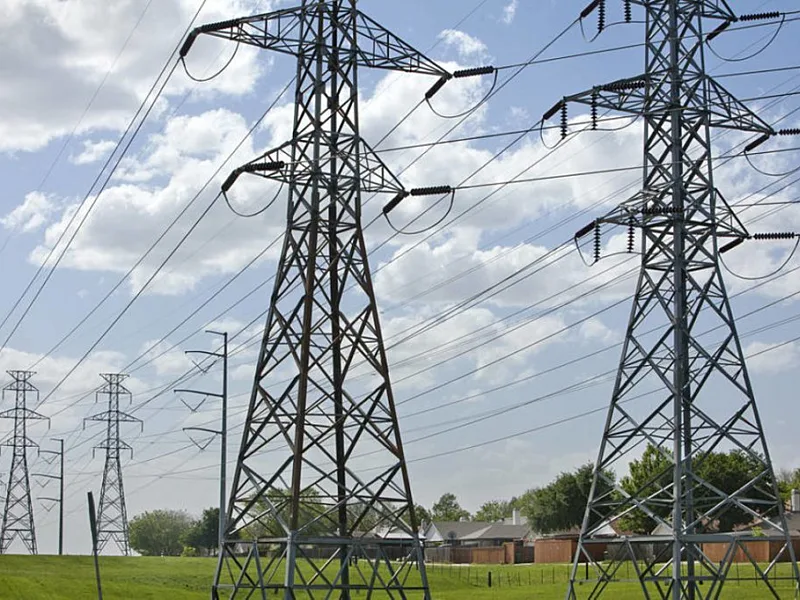
Grid connections determine how much of the planned capacity can produce electricity.
- The emissions savings then depend on when solar generates and which coal-fired output it displaces.
- The plan already assumes the retirement of Morupule A in its reference case.
Assessing progress requires tracking the power system against those assumptions, including coal generation and changes in demand.
Other measures include vehicle efficiency standards, improved livestock feeding and waste treatment.
- Integrated fire management appears in the plan, with the land-use contribution reported separately in the headline accounting.
- Improved rangeland management can help pastoral communities withstand dry periods and support healthier ecosystems.
These benefits deserve their own indicators alongside the emissions inventory.
How Adaptation Could Protect Rural Livelihoods
Drought exposure varies across the country.
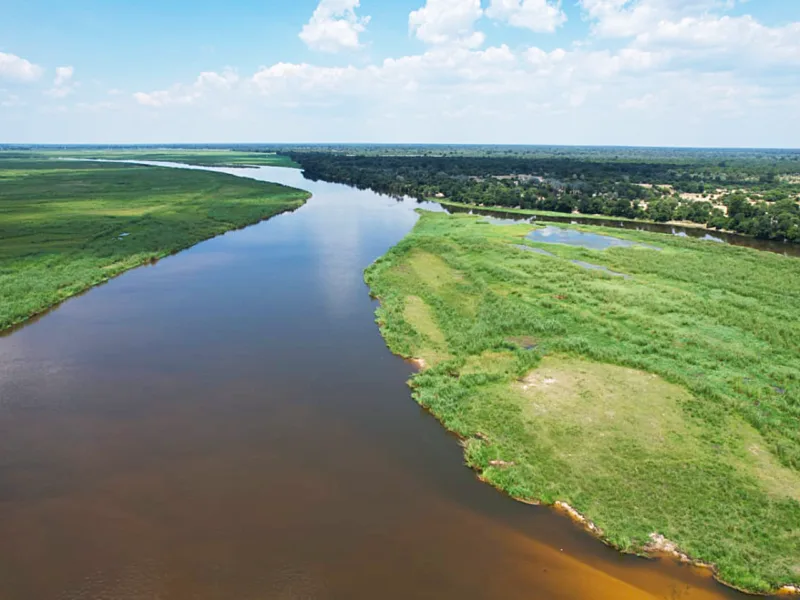
- The filing describes the aridity of Kgalagadi and the importance of variable flood pulses in the Okavango Delta.
The difference has implications for adaptation spending.
- A rangeland intervention can be judged through grazing conditions and livestock access to water.
- Work in a wetland can be assessed through water conditions and the livelihoods that depend on it.
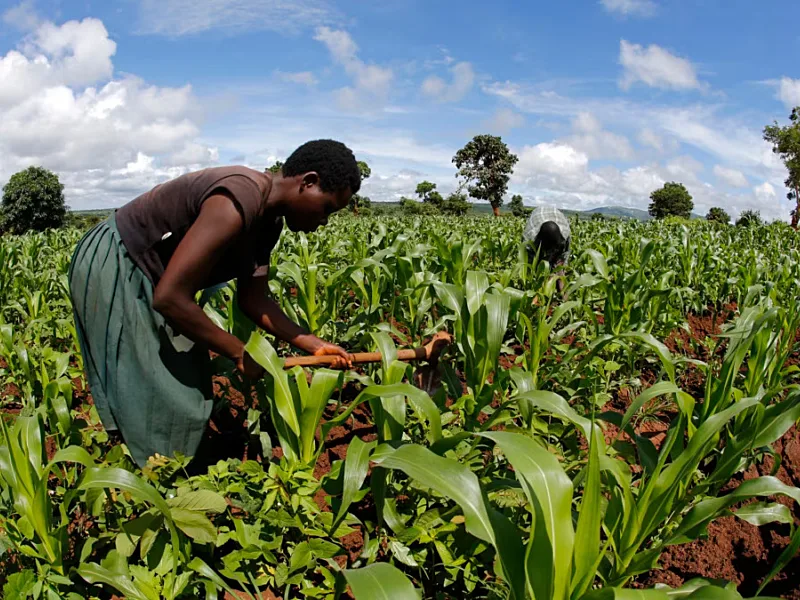
The submission identifies hotter conditions and increasingly erratic rainfall as threats to water security, rain-fed crops and cattle.
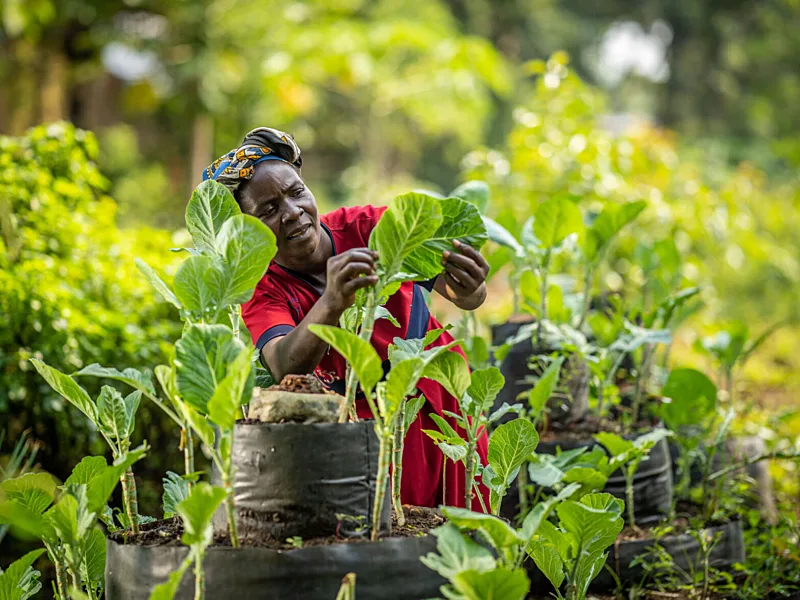
- It proposes drought-tolerant seed, agricultural risk insurance and work on water resources, including rainwater harvesting and managed aquifer recharge.
- For a cattle owner, the difference can show up in access to water and grazing during the months when both are most scarce.
The plan draws on the Green Climate Fund project for ecosystem-based adaptation in communal rangelands, including in Ngamiland, Kgalagadi and Bobirwa.
- Community-level measures can be monitored through the condition of grazing land, access to water and the extent to which households can maintain their livelihoods during drought.
- These measures give local officials more to work with than a national expenditure total.
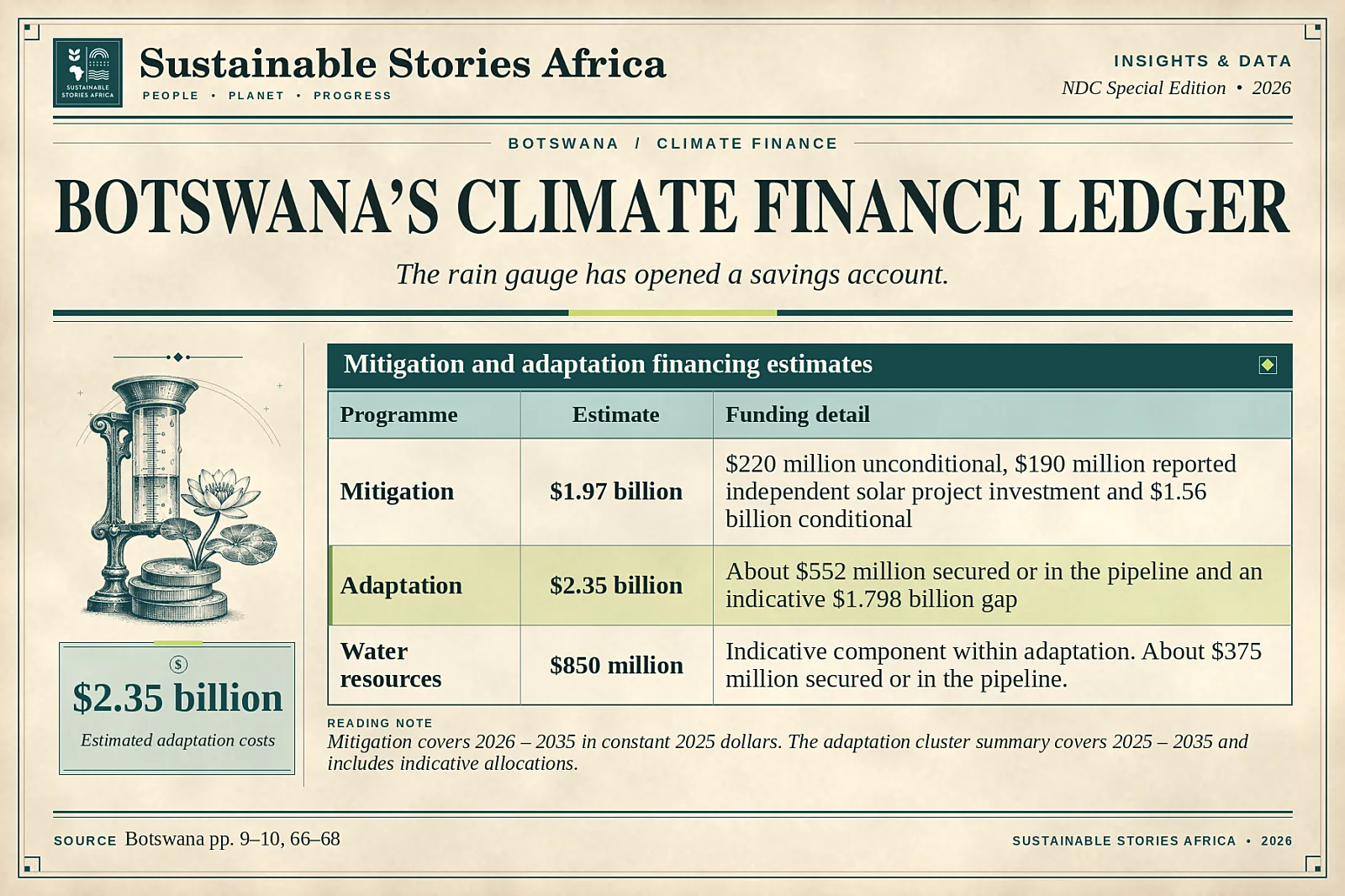
Botswana’s adaptation costing is an indicative estimate across six broad clusters.
- The water resources cluster alone is estimated at about $850 million.
The plan combines secured and pipeline amounts in its adaptation summary, so a project-by-project funding record is needed to see which works are ready to proceed.
What Utilities And Ministries Can Track
The financing figures also have different levels of detail.
- The $2.35 billion estimate groups water, agriculture, health and other adaptation needs into broad clusters.
- The plan describes a separate process for costing individual interventions and identifying which share of a development project addresses climate risk.
This distinction matters when a water or road project would go ahead anyway and only part of its design responds to a changing climate.
The $1.97 billion mitigation estimate uses constant 2025 dollars.
- The $1.56 billion conditional component calls for international finance, technology and capacity building.
- About $220 million is classified as unconditional and roughly $190 million is reported investment in the two independent solar projects.
The plan’s broader figures from the previous NDC refer to a different scope and should stay labelled by submission and programme.
Power agencies can report contracted capacity, grid connections and annual generation alongside coal output.
Finance and environment authorities can distinguish expected funding, commitments and disbursements.
- A national record that links each payment to a project and its progress would clarify where the financing gap is delaying work.
Botswana’s future greenhouse gas inventories and Biennial Transparency Reports can show whether the modelled decline through 2030 is occurring.
- The same reporting cycle offers a way to explain recalculations and report land-sector outcomes separately.
- On adaptation, water agencies and district authorities can report where water supplies remained usable through drought and where the work still requires funding.
Under the Paris Agreement’s transparency framework, finance and project data can accompany the emissions record.
- Botswana can preserve the distinction between the cost of a project and the amount that qualifies as adaptation expenditure.
- It can also report whether a facility reached the communities it was intended to serve and how well the facility works during the conditions it was built to withstand.
Path Forward – Where To Look For Delivery Evidence
Track the 188 MW domestic solar programme through connection and generation, then check how supported projects change coal dispatch and the 2035 trajectory.
For drought resilience, follow water and rangeland projects by district.
Published records of operational facilities and secured funding can show which communities are gaining protection.