Nigeria’s headline inflation slowed to 14.63% in September, according to Financial Derivatives Company.
However, some of the food and fuel prices tracked in its November briefing rose sharply over the preceding year.
A firmer naira can ease import costs.
The household test is whether lower pressure on importers reaches shops and transport fares while wages catch up with the cost of living.
Why Slower Inflation Still Feels Expensive
Nigeria entered November with a stronger currency and slower pace of inflation, according to economist Bismarck Rewane’s presentation for Financial Derivatives Company (FDC) at the Lagos Business School breakfast session on 4 November.
- The briefing put headline inflation at 14.63% in September, down from 15.39% in August.
- It cited an October official exchange rate of about N1,332 to the US dollar and external reserves above $55 billion.
These readings describe different parts of the economy.
- The exchange rate tells importers how many naira they need to pay a dollar invoice.
- The inflation rate tells households how fast the price of a representative basket has risen.
A worker on the N70,000 monthly minimum wage still has to pay earlier increases from price accumulation.
The gap matters in Nigeria and in other African economies exposed to imported fuel, machinery and food inputs.
- If the currency steadies while distribution remains expensive and wages lag, businesses get the first gains.
- A household may see the benefit much later, and some costs may keep rising in the meantime.
The Costs Behind Nigeria’s Inflation Numbers
In September 2026, the headline rate was 3.39 percentage points below the 18.02% FDC cited for September 2025.
- The positive September reading still means the national price index was 14.63% higher than a year earlier.
FDC projected a further slowdown to 14.35% in October.
- The October figure was a forecast in the 4 November briefing.
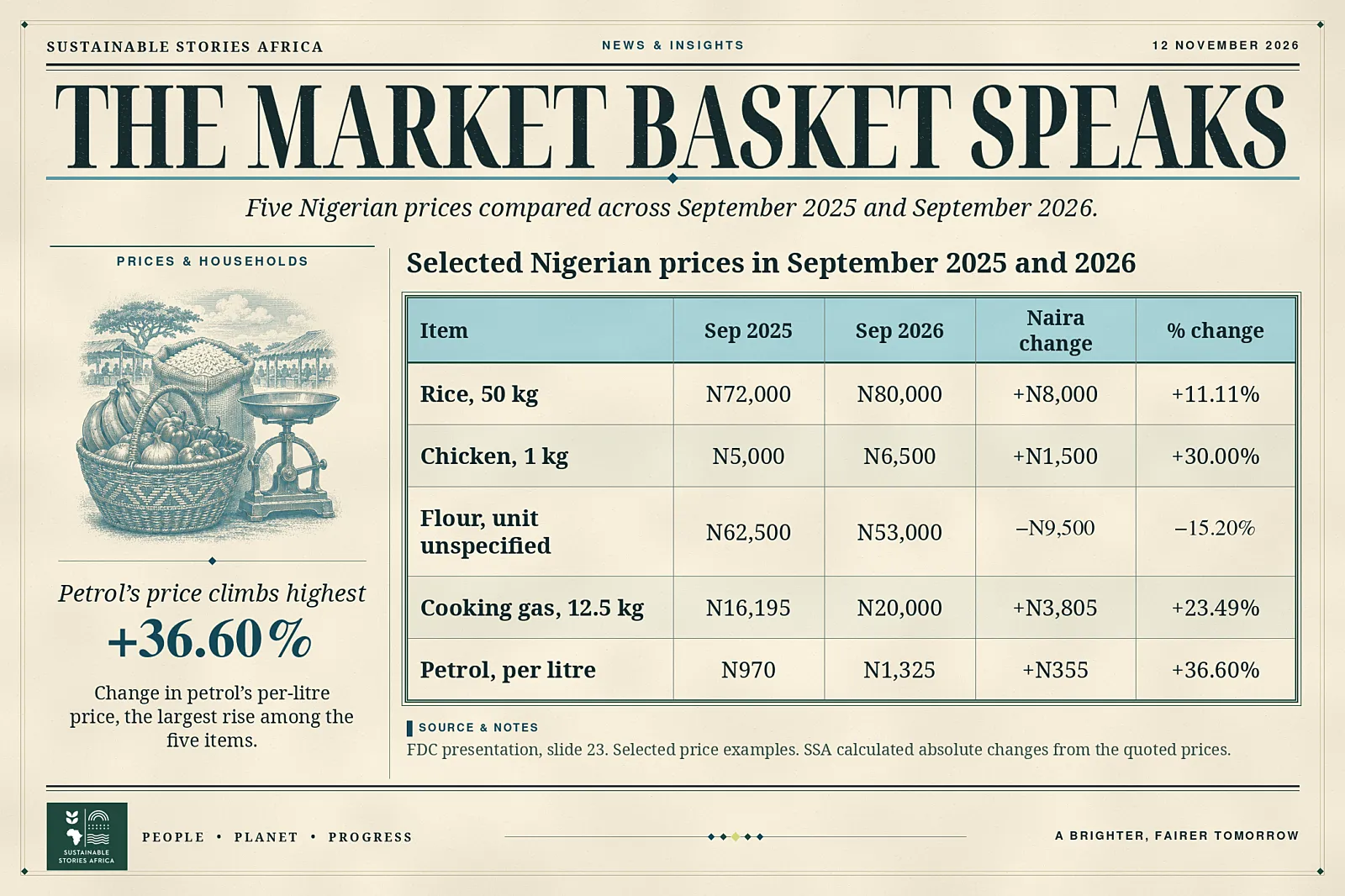
FDC’s selected prices illustrate how uneven the experience can be.
- Over the same year, a 50 kg bag of rice rose by N8,000, and a 12.5 kg cooking gas refill rose by N3,805, while the flour item in the briefing became cheaper.
- A household’s experience depends on how much of its budget goes to each item.
Petrol costs also reach shoppers indirectly through what a trader pays to move food to market.
The N80,000 rice price was N10,000 more than the monthly minimum wage cited in the briefing.
- Families that buy in smaller quantities still face a budget decision when staples absorb more of each pay packet.
- A slower inflation rate can ease pressure on the next pay packet while leaving the cost of earlier increases in place.
What Could Keep the Naira Stable
The briefing compares an official rate of about N1,332 per dollar in October 2026 with a late-2024 low of N1,669.15.
- FDC attributes the improvement to tight monetary policy, foreign exchange inflows and the central bank’s ability to smooth demand with stronger reserves.
- High yields can attract portfolio investors to naira assets.
These flows can also reverse if yields fall or investors become more cautious.
Foreign exchange relief can take time to reach the till.
- An importer may still be selling stock bought when dollars cost more.
- The next shipment may drop in naira, but freight, financing and local distribution still affect the selling price.
Exporters face a different calculation.
- Each dollar of sales converts into fewer naira when the currency strengthens, which can squeeze a producer whose wages and other bills are in naira.
There is a measurement issue too.
- Nigeria’s National Bureau of Statistics updated the consumer basket and rebased the consumer price index to 2024.
Its January 2025 release put inflation at 24.48% under the rebased series.
- For a household, the relevant question remains what today’s income can buy.
- For anyone tracking the trend, comparisons within the rebased series offer a clearer basis for interpreting the slowdown.
FDC put the premium between the official and parallel exchange rates at 28%, down from above 60% earlier.
- The gap matters for firms that struggle to source dollars through official channels.
- A company that plans its orders using the published rate still has to account for the rate it can obtain and the time it takes to complete a payment.
Where Lower Costs Could Reach Households
A steadier currency gives food processors and other import-dependent businesses a better basis for costing their next order.
- For example, a mill buying wheat can estimate the naira cost of a shipment with greater confidence.
- If the benefit survives the cost of power, borrowing and transport, the firm has more room to hold prices, buy more inputs or keep production running.
Households gain when shops can hold prices for frequently purchased goods or when reliable transport reduces the cost of reaching jobs and markets.
- Real incomes improve when earnings rise faster than the prices households face.
- The World Bank’s Nigeria Development Update identifies higher productivity in farm and non-farm household enterprises as one route to improved incomes while better-paying jobs take time to materialise.
Access to credit is another part of that recovery.
FDC flagged the weak link between policy-rate cuts and better living standards when private firms still struggle to borrow, and high prices restrain sales.
- For a small food processor, financing a better storage system can reduce waste and make output more predictable.
The investment makes sense if the firm can cover repayments from the business it expects to do.
How Businesses and Policymakers Can Respond
Retailers and manufacturers can start with the next order.
- Track the landed cost of each shipment, then record how much of the change reaches the shelf price.
- If smaller packs are needed to keep purchases affordable, display the price per unit so buyers can see the trade-off.
- Tracking sales volumes alongside revenue can show whether customers are buying more or simply paying more for less.
For the Central Bank of Nigeria, reserves, oil receipts and the gap between official and parallel exchange rates are useful alongside the headline rate.
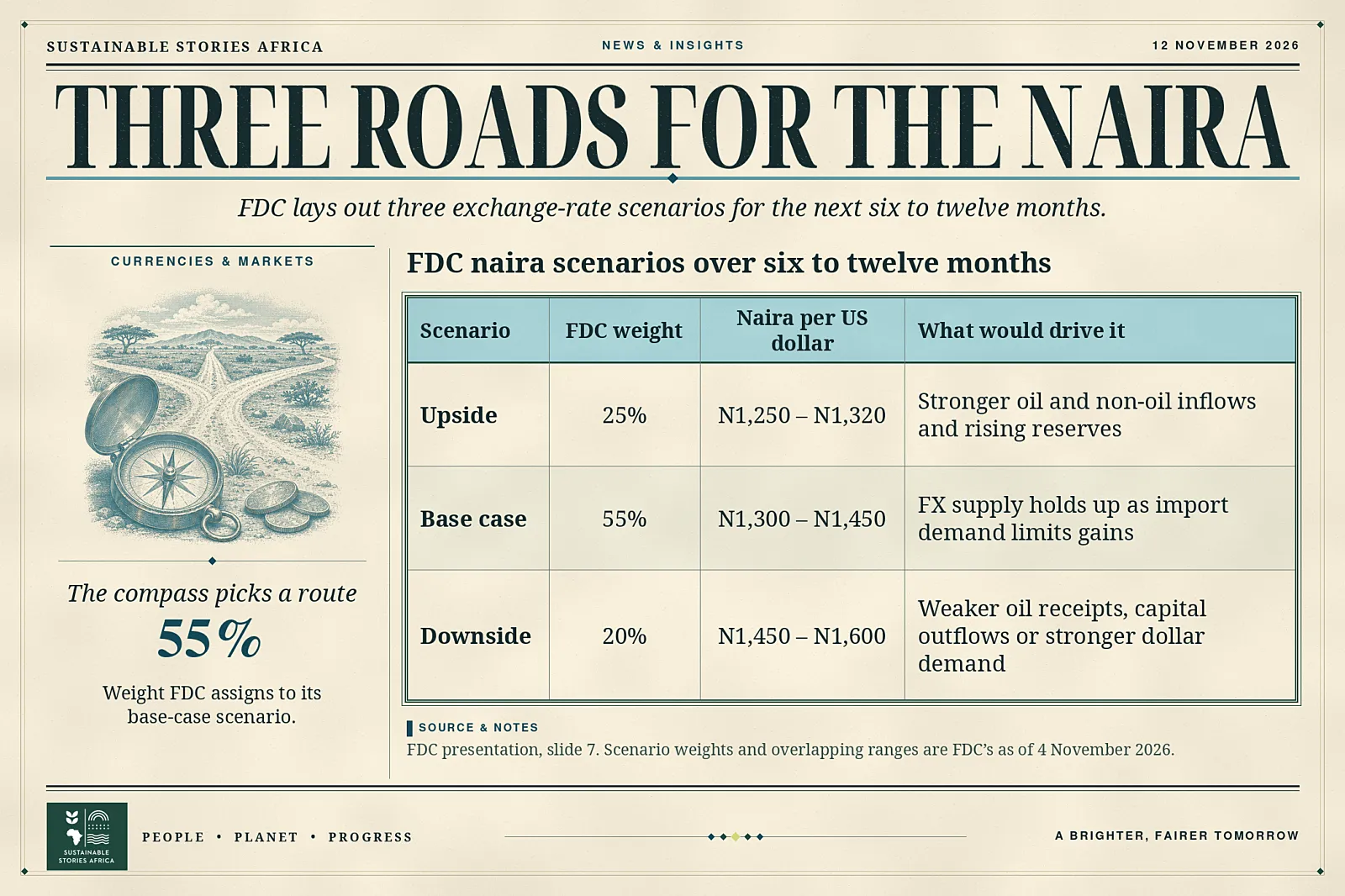
- FDC assigns a 20% weight to renewed depreciation over six to twelve months.
- For businesses with regular dollar invoices, running budgets across the three scenarios can help set reorder points, plan working capital and decide how much of an exchange-rate shock they could absorb before raising prices.
Federal and state governments can focus on costs that firms and households face even when the naira steadies.
- In farming areas, that means safer routes to market and storage that reduces spoilage.
- Employers reviewing pay can benchmark transport and food costs alongside headline inflation, then check whether wages change or allowances improve purchasing power.
- The distinction matters for informal and low-paid workers whose take-home pay may adjust slowly.
Officials can also make gains easier to assess by publishing regular price and wage indicators with their coverage and methodology.
- A national headline remains useful for monetary policy.
- Price series for essentials, measured consistently across locations, give states a better basis for targeting investments that reduce transport and distribution costs.
Path Forward – For Nigerian Household Relief
The next test is whether a steadier naira and slower inflation improve what wages can buy.
Track essential prices, earnings and the exchange-rate gap together as festive demand and oil receipts test the outlook.
Businesses can measure how much of any import saving reaches customers.
Governments can reduce the cost of moving and storing food, then use local price data to see where those gains reach households.