Egypt’s Paris Agreement submission projects its largest quantified emissions cut in electricity.
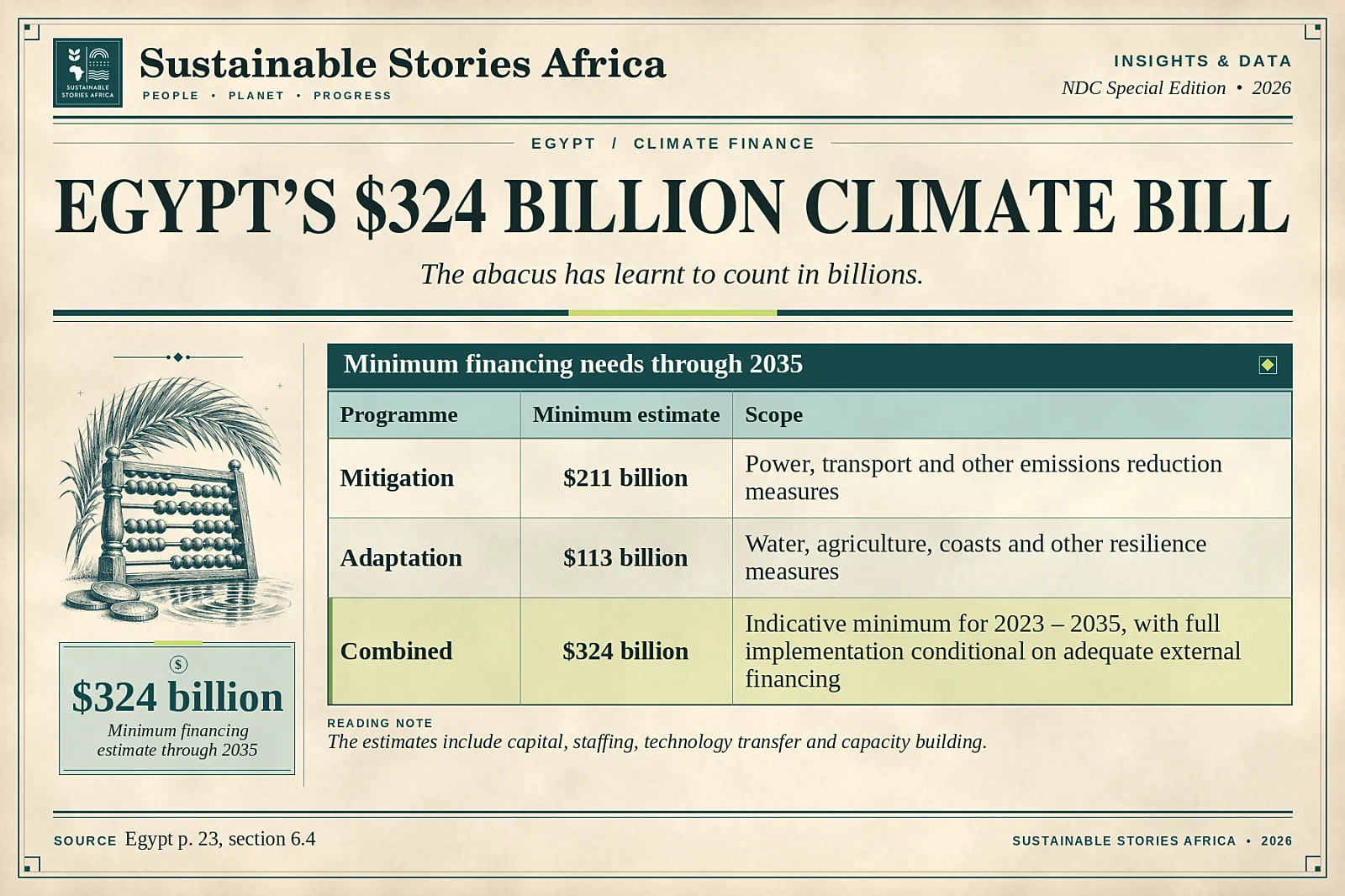
The country also estimates it needs at least $324 billion for mitigation and adaptation through 2035.
Along the Nile Delta, the stakes include protection from coastal flooding and continued access to water for farms and communities.
Egypt Sets Sector Targets For 2035
Egypt filed its NDC 3.0 on 8 November 2026, ahead of COP31 in Antalya, Türkiye.
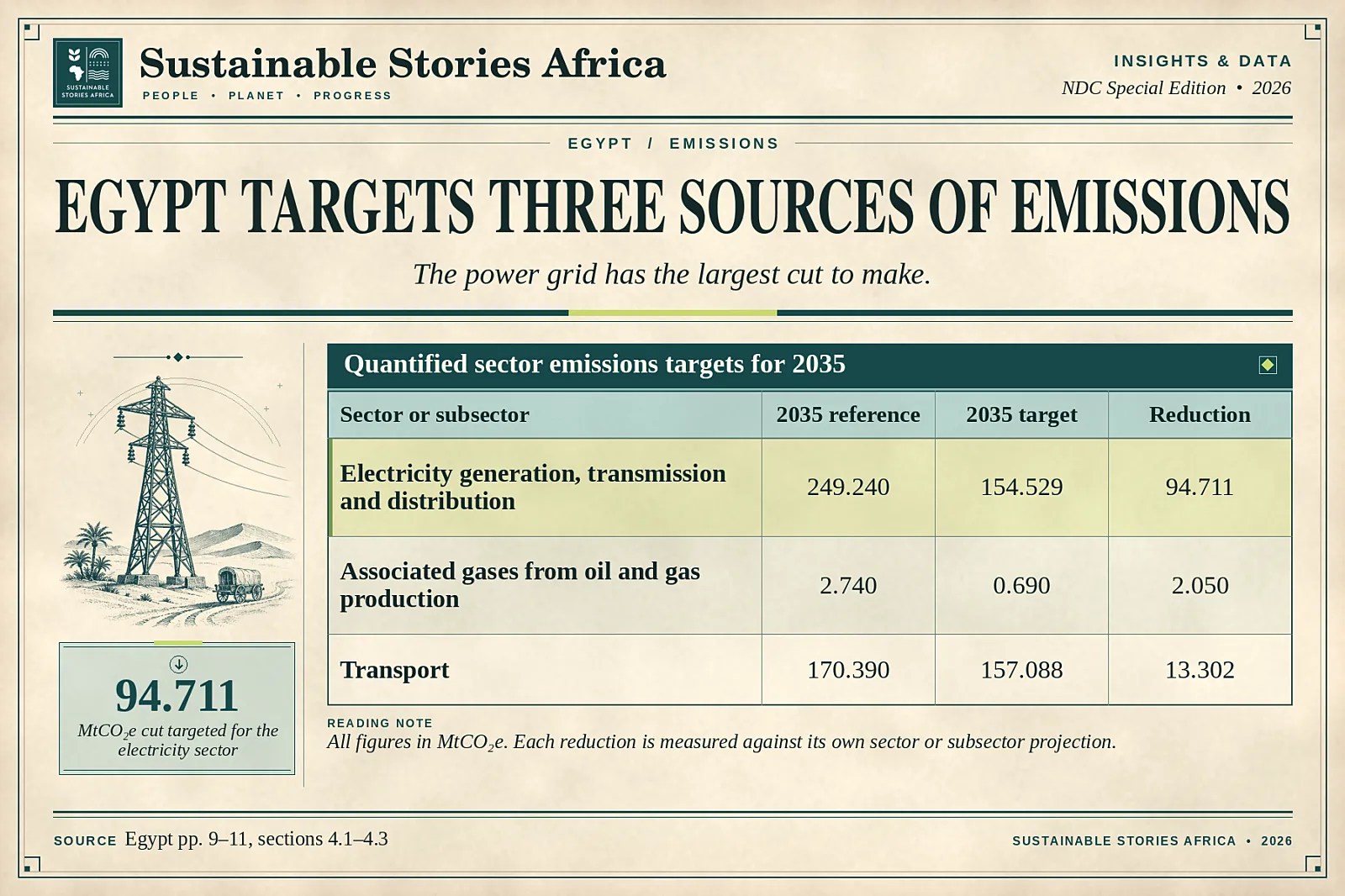
- Its active submission projects that electricity generation, transmission and distribution could avoid 94.711 million tonnes of carbon dioxide equivalent (MtCO₂e) in 2035.
- Transport and associated gases from oil and gas production have separate targets.
A nationally determined contribution (NDC) is the climate plan a country communicates under the Paris Agreement. Article 4 requires successive submissions every five years.
- Egypt’s filing carries forward its 2030 commitments and extends the quantified sector targets to 2035, while identifying additional measures in industry and other areas.
The financing requirement spans power, transport and measures such as protecting the Northern Delta and improving agricultural water supplies.
- Egypt says full implementation depends on adequate external support.
The practical question for utilities and local agencies is which programmes can attract financing and when they can start building.
How To Read Egypt’s Sector Targets
Egypt’s electricity baseline projects 249.240 MtCO₂e in 2035.
- With the mitigation measures in its new plan, the submission projects 154.529 MtCO₂e, a difference of 94.711 MtCO₂e.
- The reduction is about 38% of the projected electricity emissions, calculated from the filing.
For comparison within the sector, its 2030 pledge is to avoid 80.520 MtCO₂e against that year’s projected level.
Transport has a 2035 reference of 170.390 MtCO₂e and a target level of 157.088 MtCO₂e.
- The plan gives associated gases from oil and gas production their own reference and target.
- The 2.050 MtCO₂e cut applies to the associated-gas subsector.
- Changes in emissions elsewhere in the oil and gas value chain would need their own assessment.
Business as usual is a projection built on assumptions about demand, economic activity and policies.
- Egypt’s electricity target can be met through a combination of changes in generation and lower losses across the system.
- Assessing progress requires both the power-sector inventory and a clear account of which assumptions the government used to construct the reference case.
In its 2024 Biennial Transparency Report, as summarised in the new filing, Egypt estimated electricity emissions in 2022 were 34.34% below the reference projection for that year.
- This is a historical assessment against a model, with its own period and reference level.
- Future updates can show how that comparison changes as new generation enters service and electricity demand grows.
Where Electricity And Transport Can Change
The industry chapter describes energy efficiency, renewable heat and a lower proportion of clinker in cement.
- Some proposals involve technology and standards, which means deployment also depends on manufacturers’ investment decisions.
- Reporting adoption by plant or industry could help clarify which measures are operating and whether they are changing fuel use or production emissions.
Egypt seeks a 42% clean-energy share in its electricity mix by 2030, with additional capacity by 2035.
- The filing discusses wind, solar, hydropower, biomass and nuclear power within its transition.
- The generation mix depends on what plants actually produce over the year.
- A capacity announcement shows the scale of an investment, while grid connection and generation records show its contribution to the system.
Transmission upgrades, storage and planning for variable generation feature in the plan.
- These can help make more renewable electricity available when consumers need it.
- Egypt also plans to continue adjusting electricity tariffs and identifies targeted social support for vulnerable consumers.
- The way tariffs and support are designed will influence whether households and firms can afford new equipment or take advantage of more efficient services.
Transport measures include expanding mass transit and improving vehicle efficiency.
- The benefit of a new rail or bus service will depend in part on whether it attracts trips previously made by private vehicles or road freight.
- The oil and gas measures include 19 associated petroleum gas projects adopted or planned through 2035.
- Operating records can show how much gas is captured and used in place of flaring.
Why Water And Coastlines Need Investment
Egypt plans to raise daily reuse of treated wastewater and agricultural drainage from the 6.6 million cubic metres cited in the filing to 14.1 million cubic metres by 2035.
- It also describes canal rehabilitation, more efficient irrigation and heat- and drought-tolerant crop varieties.
- The combination matters because improving water supply and helping farmers use water more efficiently address different parts of the same problem.
For the Northern Delta, the plan describes measures intended to safeguard 20 kilometres of coastline and four square kilometres of land by 2035.
- It also sets out programmes for Mediterranean cities and high-risk stretches near Alexandria.
- Measures range from hard coastal structures to nature-based protection.
- The design and upkeep of each intervention will determine how it affects flooding, erosion and the people who live nearby.
Those programmes have different beneficiary estimates, some of which may cover the same people.
- Local reporting can give more meaning to the national figures by showing the places covered and the services or assets protected.
- This approach would also make it easier to see whether a completed work is providing the protection expected.
The water and coastal measures can also serve the same communities.
- Maintaining water quality in irrigation systems matters where drainage and treated wastewater are reused.
- Protecting vulnerable stretches of coast addresses a different source of disruption.
- Locating investments and reporting the condition of the services would help readers understand where the combined programme is improving resilience.
How To Follow Funding And Implementation
The plan’s financing categories matter for public budgeting.
- Industrial efficiency or electricity projects can have revenues or savings that support investment.
- Some coastal and water measures protect public services or communities and may depend on different sources of funding.
- Publishing the terms, expected beneficiaries and long-term maintenance responsibilities would help readers understand how financing supports each type of work.
Egypt’s cost estimates cover the period 2023 – 2035 and include upfront capital, technology transfer, capacity building and the staff required to deliver measures.
- The government reports domestic public and private investment and links full implementation to adequate external financing, including highly concessional finance and grants where appropriate.
- The table presents the minimum cost estimate as the filing reports it.
The National Council for Climate Change supervises the monitoring framework, and the Climate Change Central Department coordinates it with other agencies.
- A central database is intended to bring together information on emissions, progress and support.
- For an electricity project, the most useful chain of records runs from approved finance through procurement and grid connection to measured output.
Coastal works and irrigation projects need a different set of measures.
- Authorities can report treated water volumes, water quality and irrigation areas served.
- For coastal works, they can publish locations and the extent of completed protection.
- Biennial Transparency Reports under the Paris Agreement can connect that project evidence to the country’s national climate reporting.
Egypt’s filing also links monitoring to accounting for internationally transferred mitigation outcomes under Article 6.
- If a project generates an outcome that is transferred, the accounting should show how it is reflected in national progress.
- This matters to the public record of emissions as well as to buyers who rely on the integrity of the transaction.
Path Forward – What To Watch In Egypt’s Reporting
Compare annual electricity emissions with the sector’s projected pathway and track how new capacity, grid upgrades and generation change the power mix.
For adaptation, follow verified water reuse volumes and completed coastal works.
Funding approvals and disbursements will help explain which parts of the plan can proceed.