Financial control failures and under-resourced compliance teams tied as the most cited causes of significant integrity incidents in EY’s 2024 global survey.
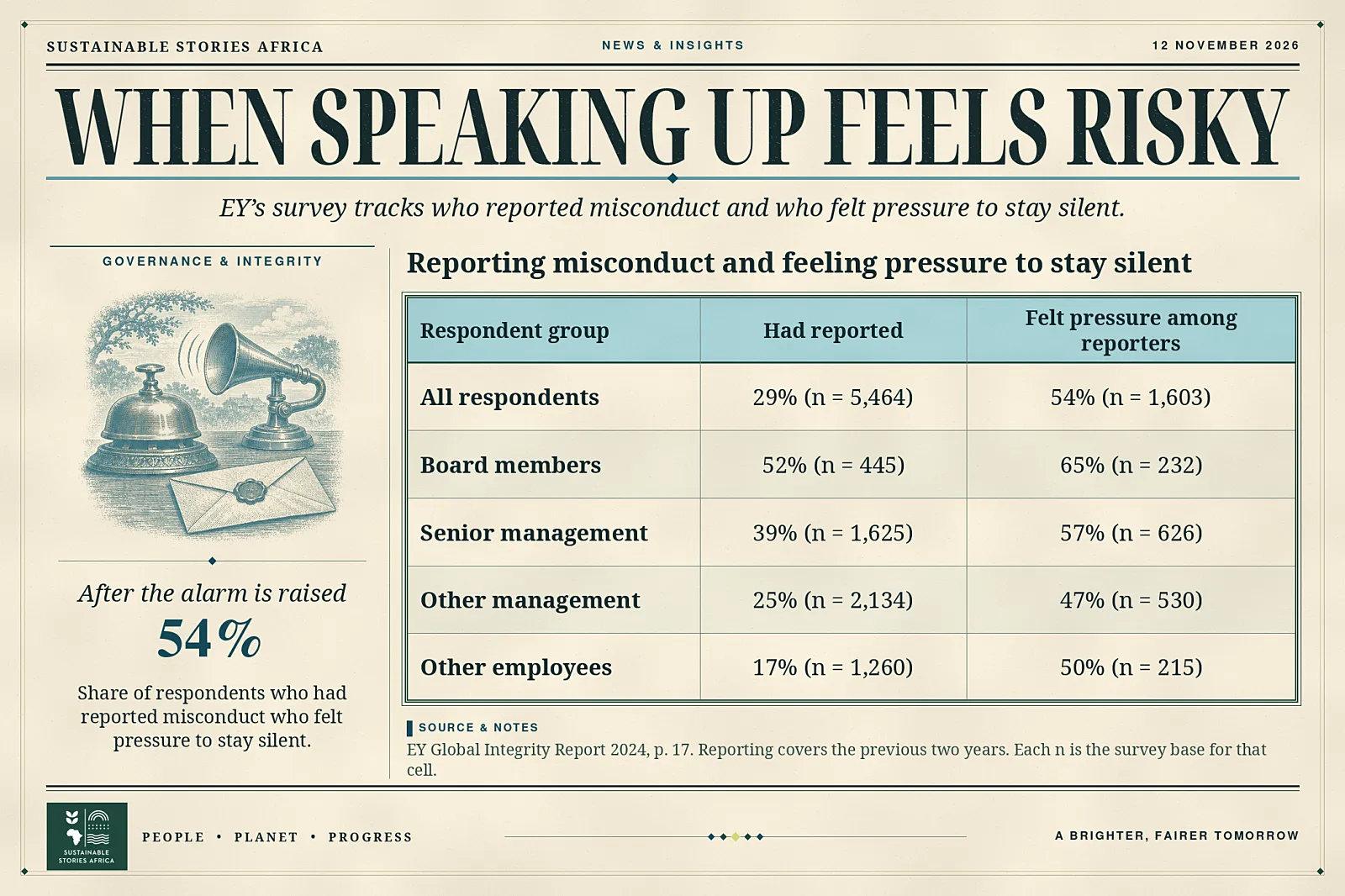
Among people who had reported misconduct, 54% said they had felt pressure to stay silent.
For African businesses adapting global sustainability standards, the survey raises a practical question.
Can employees question a payment, a supplier record or a disclosure and trust the company to act?
Where Corporate Integrity Systems Break Down
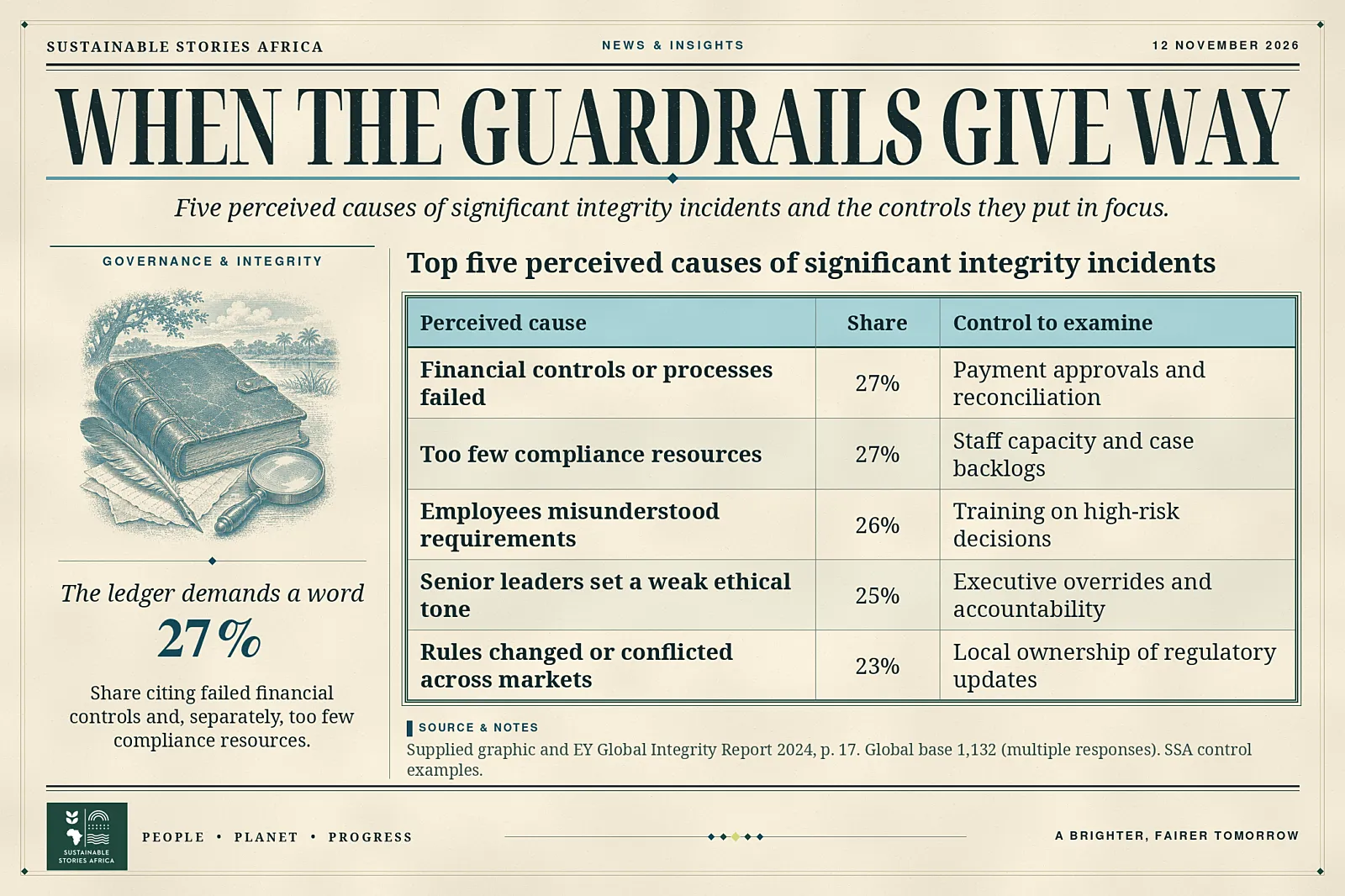
About 27% of respondents whose organisations had experienced a significant integrity incident cited weak financial controls and a shortage of compliance resources, according to EY’s Global Integrity Report 2024.
The survey asked respondents what they believed had led to the incident.
- It offers a starting point for boards reviewing how their controls work when deadlines, revenue targets and powerful managers put them under pressure.
Applying global environmental, social and governance (ESG) rules in African markets was the first panel topic at Udo Udoma & Belo-Osagie’s Investigations, Compliance & Ethics Summit in Lagos on 11 September 2025.
- The agenda listed Uade Ahimie as moderator and Olumide Lala, Ibrahim Shelleng, Tinuade Awe and Oludamilare Adesola as speakers. The programme drew on expertise in climate finance, government, governance and risk advisory.
The issue has a practical focus in Nigeria in 2026.
In February, the Financial Reporting Council released an amended roadmap and implementation guidance for adopting IFRS S1 and IFRS S2.
As companies prepare sustainability and climate disclosures, the quality of the underlying records matters to investors, lenders, workers and communities.
Five Weaknesses Reported After Integrity Incidents
EY interviewed 5,464 board members, managers and employees in large organisations and public bodies across 53 countries and territories between October 2023 and January 2024.
The question on perceived causes covered 1,132 respondents.
The accompanying infographic highlights how closely the leading answers cluster.
One percentage point separates the two top categories from policy misunderstanding.
- Consider a procurement officer asked to approve an urgent supplier payment.
- A financial control can flag a change in bank details.
- Training tells the officer who can approve an exception.
- A staffed compliance function gives that employee somewhere to take the question before the money leaves.
Who Reports Misconduct and Faces Pressure
EY’s reporting questions show how unevenly concerns reach decision-makers.
- Some 52% of board respondents said they had personally reported misconduct in the previous two years, compared with 17% of other employees.
- Access to a reporting channel, the incidents people encounter and their position in the organisation can all affect what incidents are reported.
Among respondents who had spoken up, pressure was widespread across roles.
- Half of employees who reported outside management said they had felt pressure to stay silent.
- EY also found that 46% of other employees with concerns who did not report them said they felt their concerns would go unaddressed.
An audit committee reviewing a quiet hotline should examine who can use it, how cases are handled and what employees hear after raising a concern.
The relevance to African markets is practical.
- A group with several subsidiaries may need a common escalation policy and a different way for each workforce to reach it.
- On a site where staff share devices or where contractors lack company email, a web form alone leaves gaps.
- An independent phone line with local language support can widen access, provided employees know how the company will protect confidentiality.
Suppliers need a route to raise concerns.
- EY found that 68% of respondents whose organisations had experienced a significant integrity incident said a third party was involved.
- A local supplier that depends on one large customer may hesitate to complain about a request from that customer’s purchasing team.
Giving vendors a contact outside procurement makes it possible for an investigator to hear both sides.
What Better Controls Make Possible Locally
Better controls can change who bears the cost of a mistake.
- If a buyer checks that an invoice matches goods received, a supplier can resolve a genuine discrepancy before payment is delayed.
- If the business also records every override, internal audit can see when the same manager repeatedly bypasses a check or when a control routinely obstructs legitimate orders.
The same discipline applies to an ESG disclosure.
- A company reporting fuel use can link the published number to depot records and invoices and assign an employee to reconcile them.
- An investor can then ask how the company handles gaps and whether any estimates changed from one period to the next.
For local suppliers, simple shared templates and a named contact can make it easier to provide credible data.
The same approach can help when subsidiaries face different disclosure requirements.
- A group can document common data quality checks and let local teams identify what their regulator or market requires.
If a local team cannot collect reliable data from every supplier, it can record the gap, explain how it estimated the missing information and set a timetable to improve coverage.
What Boards Can Test This Quarter
Boards and audit committees can begin by sampling decisions where the incentive to bypass a check is greatest.
- Review urgent vendor onboarding, payment overrides and adjustments to sustainability data.
- For each exception, establish who approved it, what evidence they saw and whether someone outside the business unit reviewed it.
- Repeated exceptions may signal a control that needs redesign or a manager who needs closer oversight.
Management can then budget for the work the tests reveal.
- A smaller business may use shared investigation support and focus training on staff who authorise payments, buy from suppliers or collect disclosure data.
- A larger group can give investigators a direct route to the audit committee for cases involving senior executives.
- Both can track how long cases stay open, which corrective actions are overdue and whether people report retaliation after speaking up.
Regulators and industry bodies can reinforce this work by giving companies examples of the evidence expected for common disclosures and by coordinating guidance where requirements overlap.
Lenders and investors can ask for a sample of underlying records and evidence that a finding was closed.
- This gives a board something concrete to examine when a company’s sustainability statement and workers or suppliers experiences diverge.
A confirmed incident can expose several weaknesses at once
- In a diverted payment, investigators can trace how the supplier record changed, what the approver was told and whether the same employee could edit the record and release the payment.
- The audit committee can then check that the company corrected each weakness the case exposed.
How the board interprets the numbers matters too.
- An increase in reports after a confidential channel opens may reflect greater trust in the channel.
- Reviewing case outcomes and repeat incidents over several quarters can help directors decide whether the response is resolving the underlying problems.
Path Forward – For Stronger Corporate Integrity
Boards can start with the next payment exception, misconduct report or ESG data correction.
Each should have a named owner, a record of the evidence reviewed and a way to escalate unresolved issues.
Companies can review whether workers and suppliers trust those channels, then publish what they can about how issues are resolved.
This gives investors and affected communities a clearer basis for judging the company’s commitments.