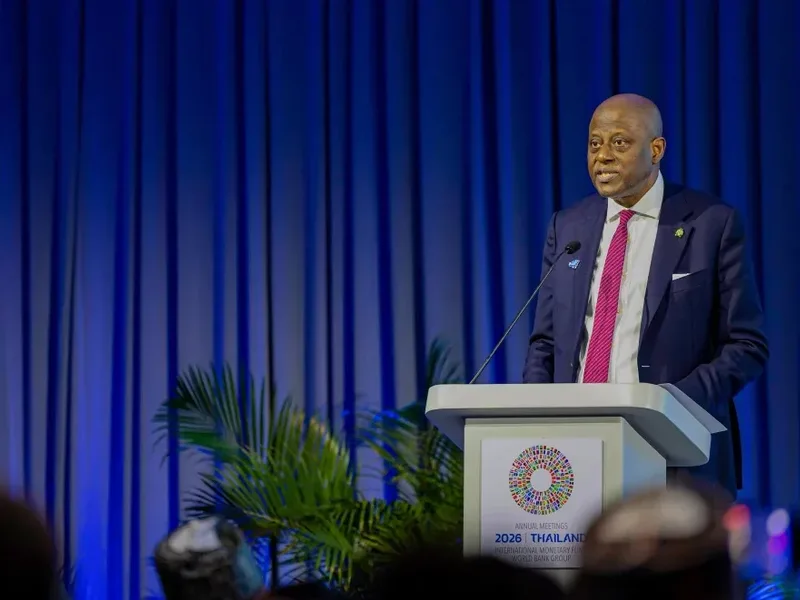
Session theme - Building Africa’s Next Generation of Institutions
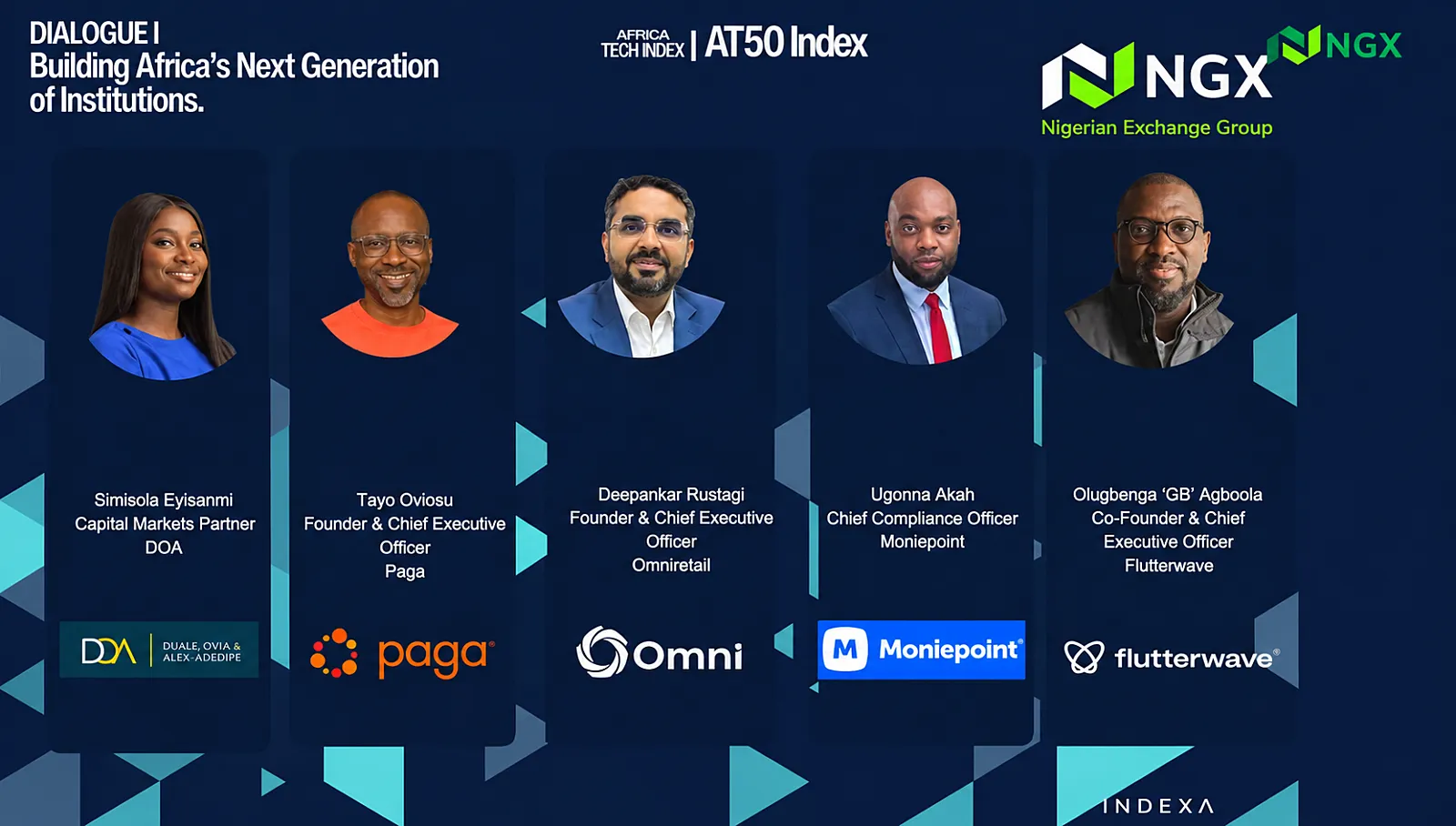
Moderator: Simi Sola Eyisomi, Capital Markets Partner, Duale Ovia and Alex Adedipe.
Panellists: Tayo Oviosu, Founder and Group CEO, Paga; Ugonna Aka, Chief Compliance Officer, Moniepoint; Morenike Olufemi, Group CFO, Flutterwave, representing Co-founder and CEO Olugbenga Agboola; and Mayowa Ali, COO, OmniRetail, representing Founder and CEO Deepankar Rustagi.
Africa’s technology companies are being asked to prove their growth can survive leadership changes, funding conditions and public scrutiny.
At the AT50 Lagos Market Open, operators described the systems that turn a successful business into an enduring institution.
The discussion linked financial discipline and independent oversight with a practical development question: can the businesses supporting everyday commerce remain reliable when their founders step back?
Africa Tests What Makes Companies Endure
African technology companies seeking long-term capital must show that their operations, finances and governance can function beyond their founders, executives told the AT50 Lagos Market Open at the Nigerian Exchange on November 18, 2026.
- Their central message was that institutional credibility has to be built into everyday decisions.
The session, Building Africa’s Next Generation of Institutions, brought together Paga, Moniepoint, Flutterwave and OmniRetail.
- Moderated by Simi Sola Eyisomi, it examined the transition from entrepreneurial control to businesses with accountable teams, dependable records and the capacity to withstand disruption.
For consumers and small businesses, this transition has consequences beyond fundraising.
- A payment provider’s continuity or a distributor’s financial stability can determine whether a trader gets paid, a pharmacy serves customers, or a manufacturer reaches retailers.
Governance therefore becomes part of the infrastructure on which livelihoods depend.
Large Payment Volumes Raise Accountability Stakes
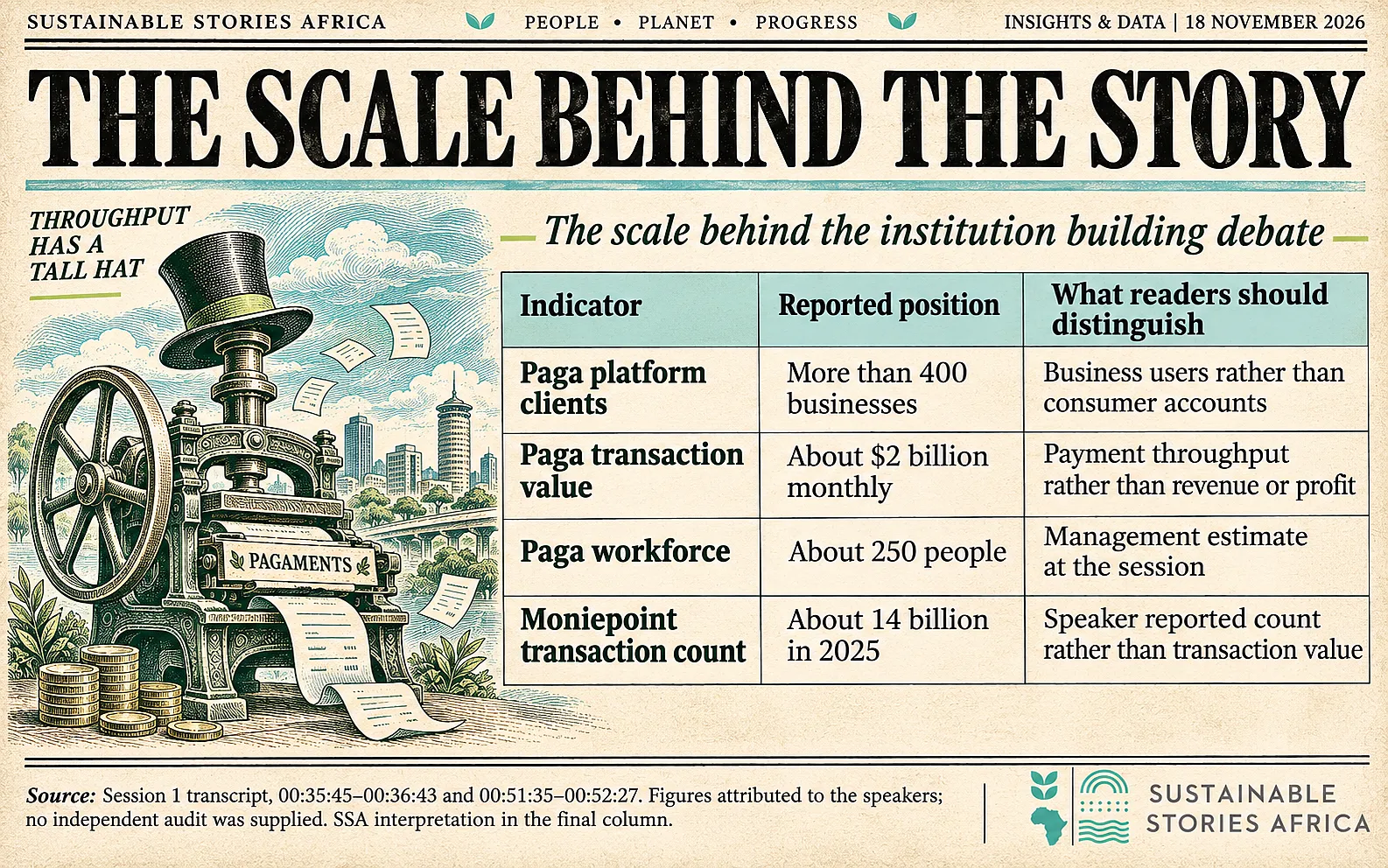
Paga’s Tayo Oviosu said the business served more than 400 companies through its platforms and processed approximately $2 billion in monthly transaction value.
- He described a workforce of about 250 people and an ambition to build a company that would still exist in 200 years.
- These were management disclosures at the event, rather than audited figures presented with supporting accounts.
That scale makes dependence on one person a business risk.
- Oviosu described stepping back from daily management of Paga’s Nigerian business earlier in the year to focus on new markets and technologies.
- His practical test was to withdraw for two weeks, observe what failed and strengthen the processes responsible.
The test is less about a founder’s absence than the quality of decisions made without them.
- Documented responsibilities, accessible records and capable managers allow an organisation to retain knowledge when individuals move on.
Financial Records Determine Whether Capital Arrives
Flutterwave’s Morenike Olufemi placed basic accounting systems at the centre of investment readiness.
- A chart of accounts, a reliable financial close and visibility over cash runway may be routine; however, they determine whether a business can explain its performance when an investor asks difficult questions.
She recalled a transaction from an earlier professional role that failed because the company could not supply sufficiently detailed customer-acquisition information.
- The lesson was specific: historical data that was never collected cannot simply be reconstructed when a funding opportunity arrives.
Unit economics connect this accounting discipline to strategy.
- A company needs to understand what it spends to acquire and serve customers, what those customers generate and how long its cash can sustain operations.
- Rapid activity growth cannot answer these questions on its own.
The distinction between transaction value and company income is especially important in payments.
- Large sums moving through a platform can show operational relevance, but do not reveal the fee retained, the cost of providing the service or the cash available to meet obligations.
Investors need those connections explained rather than treating throughput as a substitute for business performance.
Profitable Growth Can Protect Everyday Commerce
OmniRetail’s Mayowa Ali described reviewing product and business lines, restructuring some and closing others that could not be operated profitably or competitively over time.
- He presented this as a shift towards sustainable, profitable growth, even where customers were already using the services.
Ali also described devolving decisions to business heads within clear organisational principles.
- This gives managers room to respond while preserving accountability.
A company becomes more resilient when the organisation's strategy and operating authority are understood across, and deliberately separated.
Ugonna Aka framed Moniepoint’s compliance responsibilities through merchants' trust, as merchants who expect the service to be available the following day.
- He argued that boards should own the risk culture, compliance should enter product design early, and growth should be assessed alongside the risks it creates.
The potential social benefit is continuity.
- Stronger controls can help protect merchant balances, preserve service reliability and reduce avoidable disruption.
- These outcomes require measurement; company growth does not establish that customers are safer or better served.
Also, the cost of making changes.
- Closing an activity can affect customers and staff, while decentralising authority requires managers to develop new capabilities.
The panel did not quantify those effects.
- A fuller assessment of institutional progress would examine how companies manage transitions, communicate decisions and maintain service for the people affected.
Make Governance Visible In Daily Decisions
The discussion points towards a practical change in management priorities.
- Boards should receive risk information with the same consistency as growth reports.
- Finance teams need complete operating records and a predictable reporting calendar.
- Business heads need decision rights that remain usable when the founder is unavailable.
Investors also have work to do.
- Oviosu favoured investors who contribute expertise and help solve operating problems.
- Olufemi stressed timely disclosure, including difficult news.
- A productive financing relationship depends on investors understanding the business and management making that understanding possible.
The governance dimension of sustainability is evident here:
- Credible oversight protects the people who rely on a company
- Financial discipline helps preserve its capacity to serve them.
- Assess environmental performance separately using relevant operating evidence rather than inferred from good governance.
An effective board should be able to see whether these practices are improving over time.
- Persistent reporting delays, repeated exceptions or decisions that continue to return to the founder can indicate that formal structures have not become operating habits.
Management can use those signals to direct attention and resources before the weaknesses become a financing or service crisis.
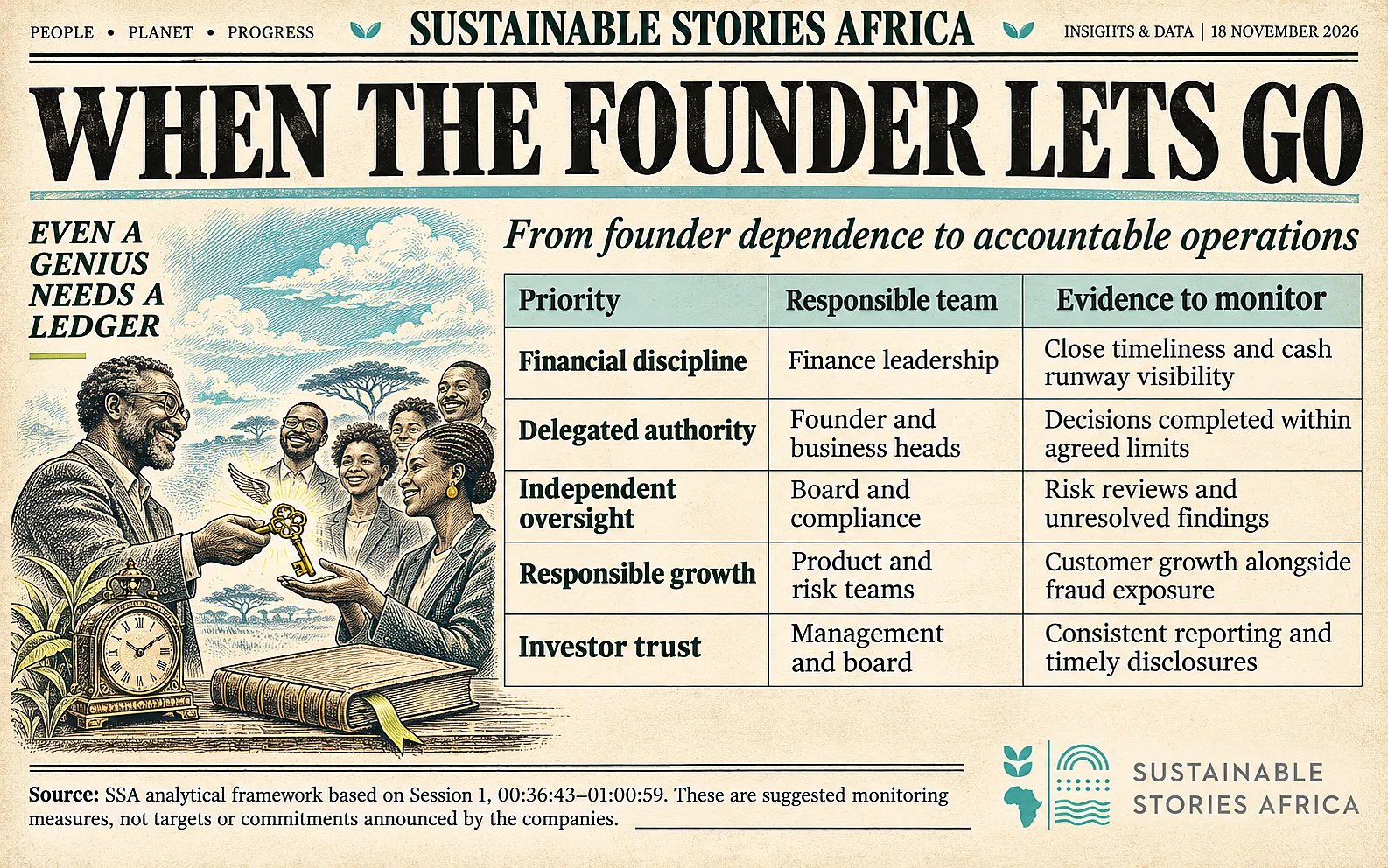
Path Forward – Build Institutions Through Measurable Daily Discipline
The next step is to turn governance principles into operating evidence: dependable financial records, empowered managers, independent challenge and risk controls that work before a crisis.
For Africa’s technology businesses, institutional maturity comes from continuity and accountability.
Capital can support that transition, but the foundations must be visible in how companies serve customers, manage resources and disclose their performance.