Nigeria’s new framework gives stablecoin issuers and payment providers defined routes into regulated operations, with minimum paid-up capital ranging from N1 billion to M15 billion.
The immediate test is whether firms can meet the transition requirements while protecting customers.
For African digital finance, the wider question is how stronger oversight can support reliable payments without making compliant services unaffordable.
Nigeria Sets Rules for Digital Money
Nigeria’s stablecoin issuers and virtual asset payment providers face new capital and licensing requirements under Central Bank of Nigeria regulations effective from 5 November 2026.
Existing operators have 180 days from commencement to submit applications, but earlier registration and reporting obligations make the transition an immediate business priority.[1][2]
The Regulations for the Operations of Non-Security Virtual Assets in Nigeria cover stablecoins, Deposit Money Tokens and related services within the CBN’s mandate.
- Securities remain under the Securities and Exchange Commission, while payment, settlement and foreign exchange activities can require CBN oversight even when connected to a securities transaction.
For a merchant accepting a digital payment or a household receiving a transfer, the practical issue is whether value remains accessible when needed.
- The framework’s development significance rests on enforceable customer protections and accountable providers.
Its capital requirements also raise a question for smaller firms: how much will compliance cost, and who ultimately pays?
Capital Requirements Raise Stakes for Fintech Firms
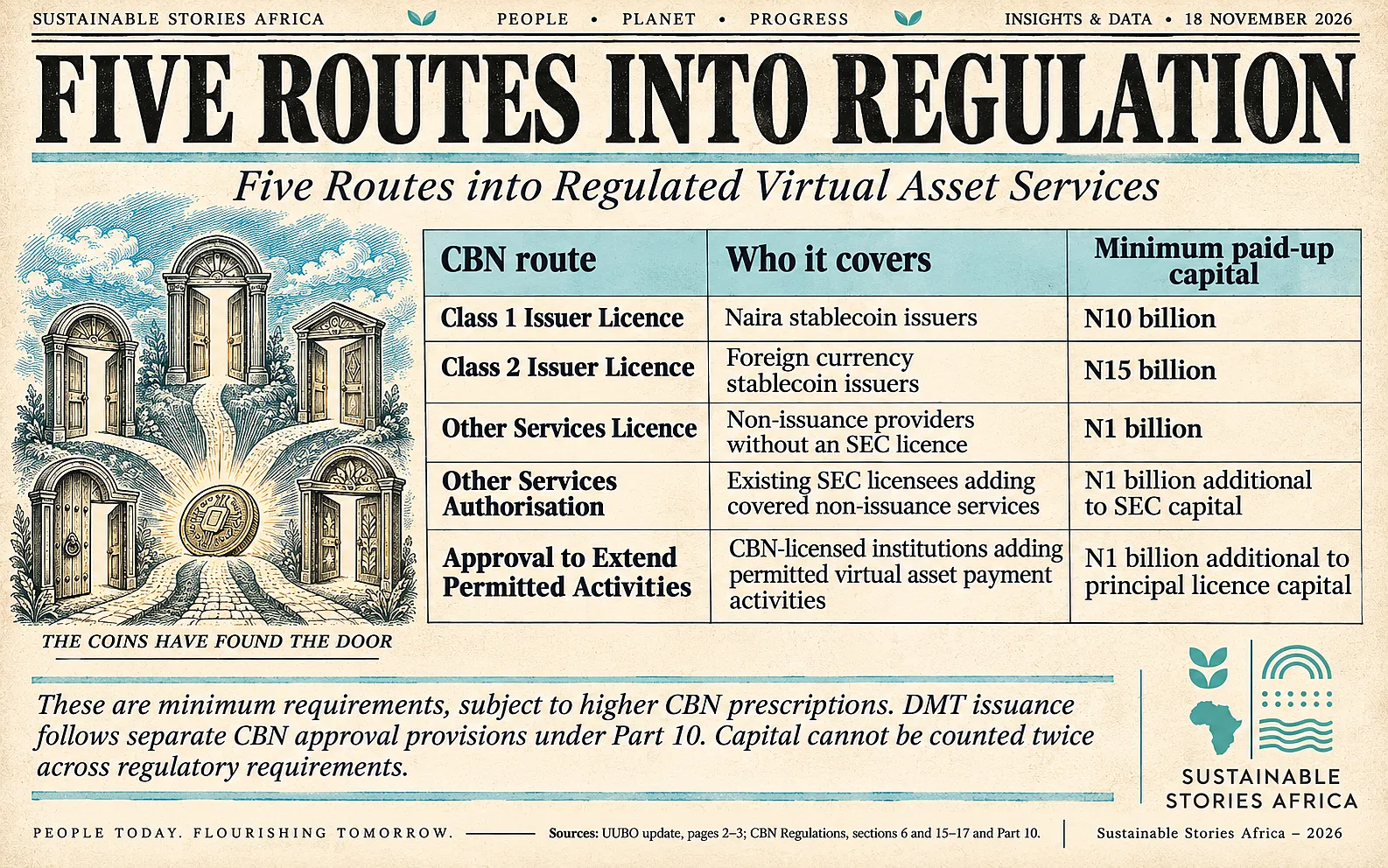
A foreign currency stablecoin issuer must maintain at least N15 billion in paid-up capital, compared with N10 billion for a naira stablecoin issuer and N1 billion for other non-security virtual asset service providers.
- These are capital floors, and the CBN can prescribe higher amounts.
The Class 2 threshold is 50% above Class 1, an SSA calculation from the stated requirements.
- This difference matters for fundraising and business planning.
- Paid-up capital is separate from customer backing: meeting the entry threshold does not establish that an issuer can honour every redemption.
Udo Udoma & Belo-Osagie’s regulatory update, authored by Joseph Eimunjeze, Pamela Onah and Ayomide Soretire, identifies five main licensing and authorisation routes.
Existing SEC licensees and CBN-regulated financial institutions have distinct approval pathways; their current status does not automatically permit the additional activities.
For a smaller operator, the financing decision begins with its actual business model.
- Providing a covered service and issuing a stablecoin involve different requirements. Management should assess the activities it intends to conduct before approaching investors.
- A funding plan also needs to sustain compliance staff and technology.
Raising the stated minimum would leave the business exposed if it then lacked resources to supervise transactions, maintain systems or support customers.
Regulatory Boundaries Follow Products and Their Functions
A stablecoin seeks to maintain value against a reference currency.
- A Deposit Money Token represents an existing naira deposit claim on its issuing bank.
- Under the CBN rulebook, DMT issuance requires prior CBN approval and follows a separate regime.
- Treating every token as the same product would obscure who owes the customer money.
The new framework reaches regulated activities conducted in or from Nigeria and those directed at Nigerian customers.
- Foreign currency stablecoins must be issued through a Nigerian-incorporated Class 2 licensee, with prior CBN Token Approval.
- For overseas providers, serving Nigerian users therefore creates obligations that a foreign licence alone cannot satisfy.
Some products sit outside this framework.
- Central bank digital currencies are excluded.
- Already regulated electronic money and stored-value products remain under their applicable payment rules unless changed functionality triggers CBN authorisation.
- Limited-network rewards that cannot be exchanged for money or transferred to third parties are also excluded.
These boundaries make product classification essential before a firm chooses its application route.
The same analysis should follow a product as it develops.
- A firm expanding from a limited service into payment processing may change the permissions it needs.
For business partners, an authorisation check should therefore examine the service being supplied, rather than relying on a provider’s broad claim to be regulated.
Customer Protection Depends on Accessible Reserve Backing
The opportunity is a market in which customers can identify the responsible provider and understand how to recover their funds.
- The CBN rulebook requires full stablecoin reserve backing plus a buffer of at least 2 per cent of circulating par value.
- Valid redemption requests ordinarily must be met at par by the end of the following business day, with specified exceptions, including a CBN-approved stress extension capped at five business days.
These safeguards could make digital payment services more dependable for businesses and households.
- Their value depends on implementation: reserve management, customer asset protection and operational resilience must work when systems fail or withdrawals rise.
- A minimum capital figure alone cannot demonstrate that performance.
Consider a merchant who receives tokens for a sale but needs conventional money to replenish stock.
- A transfer can appear successful while the merchant still waits for usable funds.
- Clear redemption arrangements would help that business understand when payment becomes available.
This illustration also explains why customer disclosures matter: users need accessible information about the responsible issuer, the process for withdrawing value and the route for resolving a problem.
Higher compliance costs could favour larger firms, encourage partnerships or feed into fees.
- These are possible market responses, not measured outcomes.
- For African and emerging-market policymakers, the social and governance test is whether stronger supervision improves customer protection while preserving affordable access.
Whether fees fall, adoption grows or more people gain access will require evidence from implementation.
Operators Must Meet Earlier Transition Requirements First
The 180-day application window is conditional.
- Existing operators may continue only at their existing scale and subject to interim CBN conditions.
- They must register within 30 days, implement financial crime controls from commencement and begin supervisory reporting within 60 days, or earlier if prescribed.
- Missing the application window requires cessation until the necessary licence or authorisation is obtained.
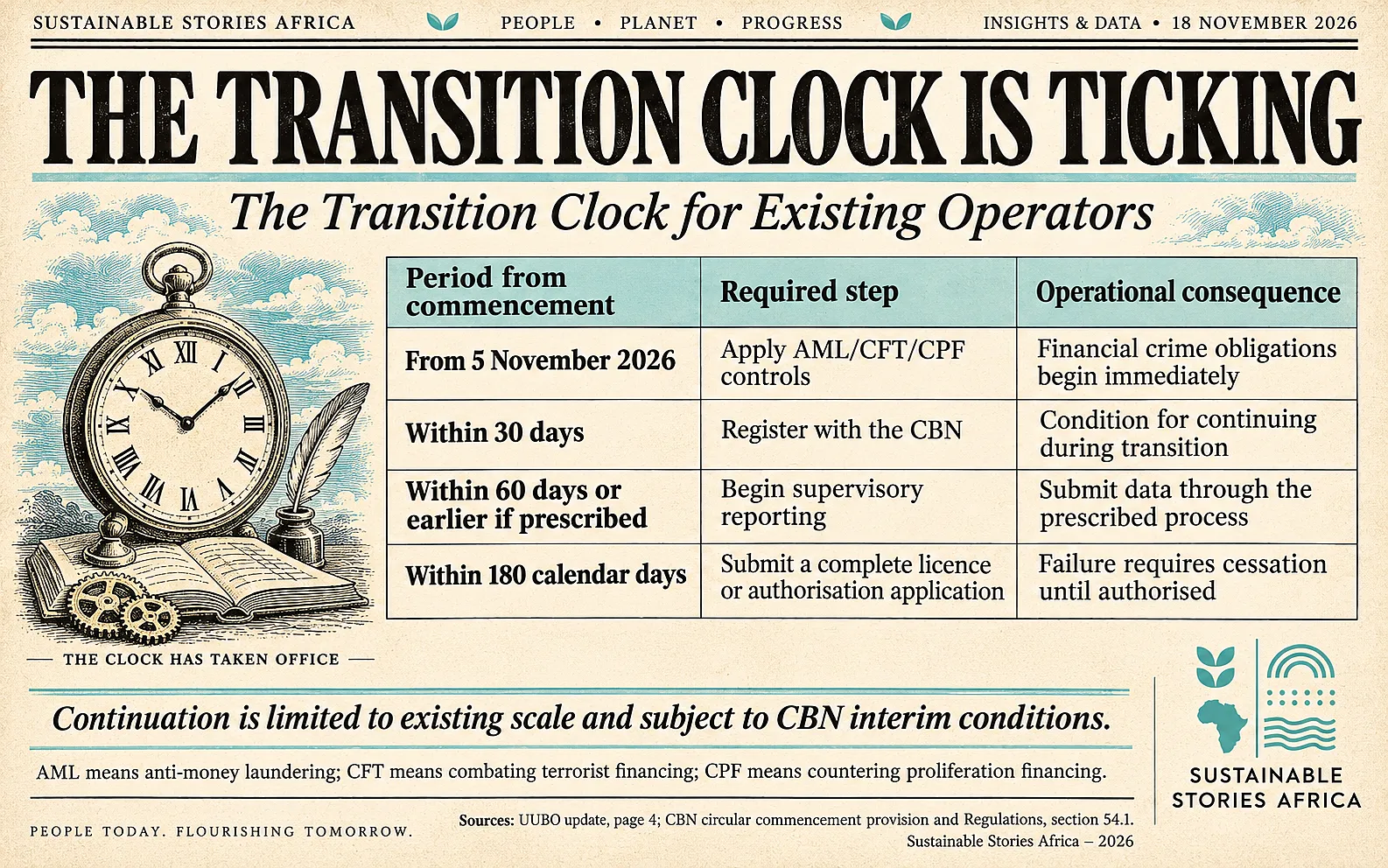
Continuation is limited to existing scale and subject to CBN interim conditions.
Boards should first map each service to the correct regulator and approval route, then compare available capital with the applicable floor.
- Application preparation should examine ownership, governance, reserve arrangements, customer disclosures and operational resilience.
- Know-your-customer checks and customer due diligence need to support ongoing monitoring, including
- Travel Rule obligations governing information accompanying virtual asset transfers.
Management should assign responsibility for registration and reporting, with a separate review of application completeness.
- A board can use the transition timetable to track unresolved ownership questions, funding gaps and weaknesses in customer protection.
- Firms anticipating difficulty should engage the regulator and advisers early.
- The useful evidence is a documented control that operates in practice, supported by reliable records and a named person responsible for correcting failures.
Investors should assess funding needs beyond the headline capital requirement.
Regulators should explain overlapping responsibilities clearly and make approval scopes understandable to customers.
Customers should check what a provider is authorised to do and how redemption works.
- Unlicensed regulated activity attracts a fine of at least N100 million, with continuing daily penalties, according to the update.
Path Forward – for Accountable Digital Payment Services
Nigeria’s next test is execution.
Operators need complete applications and functioning customer safeguards; regulators need consistent supervision across institutional boundaries.
Measures of progress are redemption performance, complaint resolution, service continuity and customer costs.
Tracking those outcomes would show whether the framework advances financial inclusion and accountable governance.
Licence numbers and capital raised will describe compliance activity; customers’ ability to use and recover their money will help establish its development value.