
Session theme - The AT50 Index Making Africa’s Private Technology Economy Visible
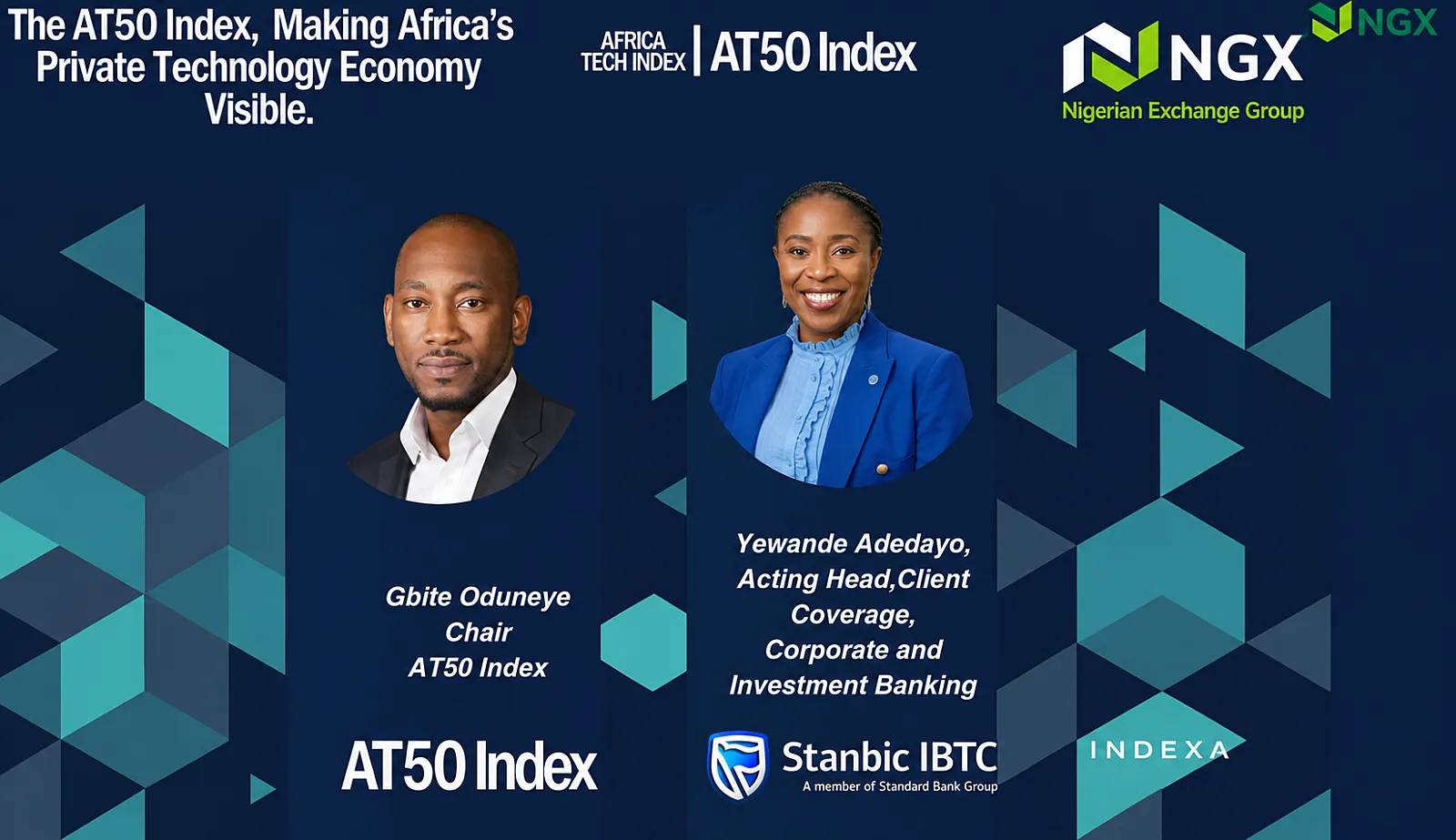
Speakers: Gbite Oduneye, Chair, AT50 Index; and Yewande Adeayo, Acting Head, Client Coverage, Corporate and Investment Banking, Stanbic IBTC. Adeayo led the fireside conversation.
Africa’s private technology companies have grown faster than the information systems connecting them to many institutional investors.
The AT50 Index is attempting to close that visibility gap through benchmarking and stronger disclosure.
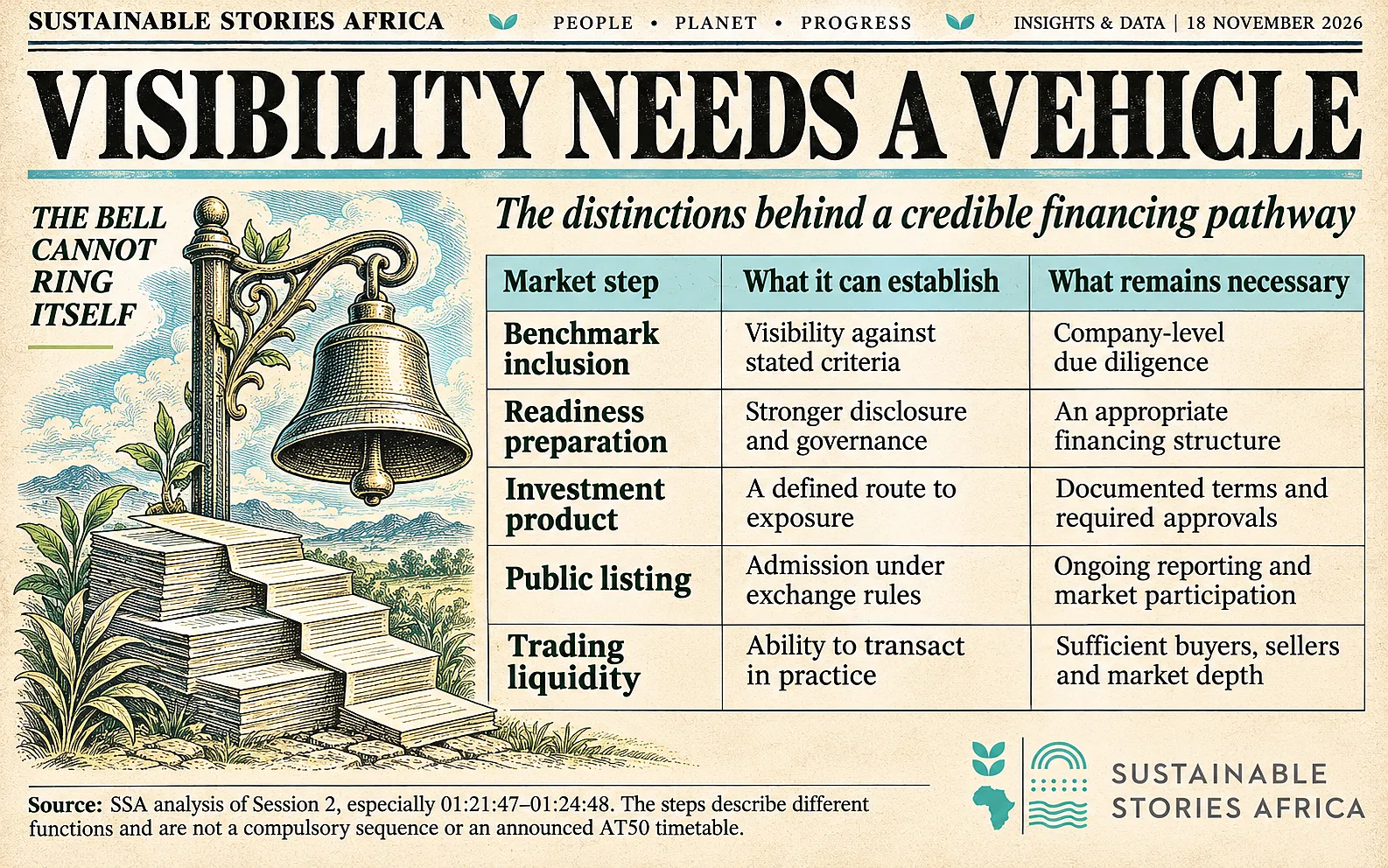
At its Lagos market engagement, the central distinction was clear: a benchmark can improve understanding, but investable products, liquidity and stock exchange listings require additional steps.
Private Technology Meets Public Market Scrutiny
The AT50 Index seeks to link Africa’s mature private technology companies with deeper pools of capital by making their performance and governance easier to assess.
- At the Nigerian Exchange on November 18, 2026, its chair, Gbite Oduneye, described a benchmark intended to support market readiness rather than provide an immediately purchasable investment.
In a fireside conversation with Yewande Adeayo of Stanbic IBTC, Oduneye argued that companies familiar with venture funding now need sustained engagement with investment bankers, auditors, lawyers and exchanges.
- The session’s theme was The AT50 Index: Making Africa’s Private Technology Economy Visible.
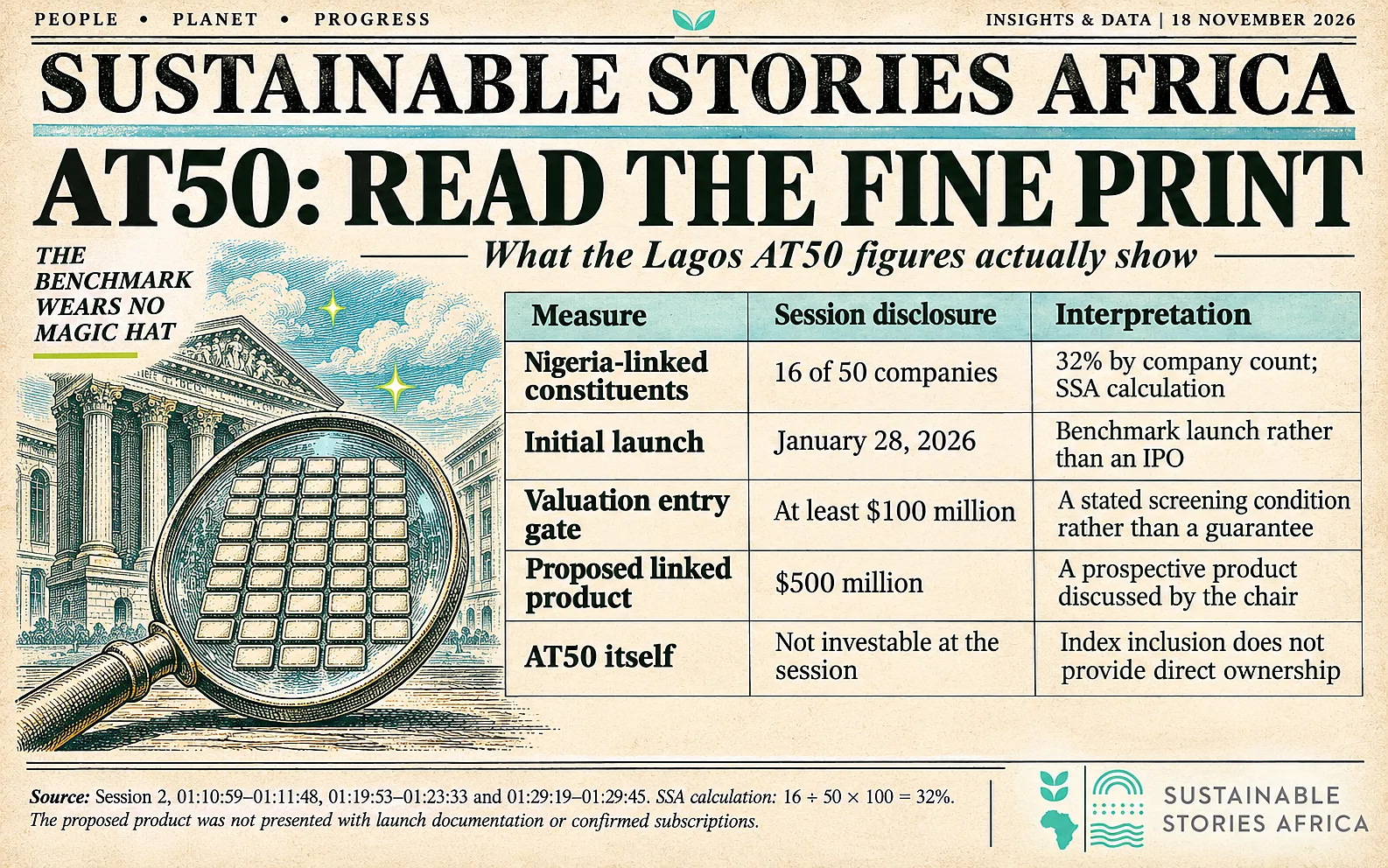
Nigeria provides a substantial test case. With 16 Nigeria-linked companies in the 50-company benchmark, the country accounts for 32% of constituents by number.
- This measures representation, not Nigeria’s share of index value or investment flows.
Sixteen Nigerian Companies Highlight The Opportunity
The presence of 16 Nigeria-linked businesses makes Nigeria AT50’s largest national cohort, according to the session and organiser information.
- It also raises a financing question: how can domestic institutions participate in businesses that have often raised their most visible funding rounds abroad?
Oduneye described a gap between companies that have learned the language of early-stage investment and financiers who need a different kind of evidence.
- Valuation headlines and fundraising announcements offer limited help when an institution needs to understand recurring revenues, governance and the conditions under which capital could be returned.
A common benchmark can make businesses easier to discover and compare.
- Its usefulness depends on the quality of the underlying information and the process discipline used to assess it.
Benchmark Credibility Depends On Consistent Disclosure
Oduneye said the framework had been developed with reference to IOSCO standards.
He described a Capital Markets Readiness Council, a Methodology Inclusion Committee and a governance secretariat, with committee participation drawn from the investment and capital-markets community.
He identified a minimum valuation of $100 million and independent board and audit arrangements among the screening conditions.
He also referred to six methodological pillars.
The more useful insight was about information behaviour.
Oduneye said companies were providing more detailed disclosures as the benchmark developed.
- No quantified disclosure baseline accompanied that claim, but the direction he described matters: investors need consistent information through difficult periods as well as successful fundraising rounds.
Comparability also requires attention to what we are comparing.
- A valuation, a revenue measure and a governance assessment answer different questions.
Investors need to know the dates, definitions and evidence behind each measure before interpreting a change in a private-company benchmark as a change in the underlying business.
Better Visibility Could Broaden Capital Access
A credible evidence base can reduce the effort required to begin an investment conversation.
- Companies become more legible to institutions that have not followed their venture-funding histories, while advisers can explore financing structures suited to their maturity and cash flows.
Oduneye referred to discussions with a bank about a prospective $500 million exchange-traded product linked to African private technology.
- He also discussed work around a technology product in Egypt.
- These references illustrated his ambitions for the infrastructure; they did not establish completed transactions, regulatory clearance or money available to constituents.
For African households and businesses, the benefit is a broader financing base for companies delivering useful services.
- Domestic participation could also allow a wider set of investors to share in business development.
- Neither outcome follows automatically from an index launch: access terms, product design, eligibility and risk allocation determine who can participate.
A benchmark can support market understanding while leaving the underlying companies private and difficult to trade.
- This distinction matters when public interest in technology brands exceeds familiarity with private-market investment restrictions.
Separate Market Readiness From Investable Products
Founders should start with the information they can control:
- Financial reporting, board effectiveness, ownership clarity and disclosure consistency.
- Advisers can then identify whether a company needs growth equity, debt, secondary liquidity or preparation for a public offering.
Benchmark providers should make selection rules, review procedures, conflict safeguards and material methodology changes easy to understand.
- When proposing new investment products, promoters should explain the underlying assets, valuation approach, investor eligibility and route to liquidity before presenting them as a solution.
For regulators and exchanges, engagement with private technology businesses can reveal where existing market structures need adaptation.
- The appropriate response is evidence-led product development and supervision.
- t should preserve investor protection while recognising that private-company information and public-market trading operate differently.
Visibility has development value when it improves capital decisions and business accountability.
- A higher profile alone is a limited result; financing outcomes and the quality of companies’ services provide a stronger test.
The immediate follow-through need not depend on a listing announcement.
- A company and its advisers can start by agreeing which records are complete, which need improvement and what risks require further examination.
That process can make future financing choices more realistic while giving management a clearer account of the business it is asking investors to support.
Path Forward – Turn Better Disclosure Into Financing Outcomes
AT50’s next test is whether more consistent information leads to useful financing conversations and stronger company practices.
Assess progress through documented outcomes rather than visibility alone.
Founders, financiers and regulators can advance that work by maintaining clear distinctions between a benchmark, a proposed product and an executed transaction.
These distinctions support trust, responsible market development and more credible access to long-term capital.